Explore Religious Heritage Across Europe

Here you can search for a building to visit. You can use the map find destinations, or you can use the filters to search for a building based upon what different criteria.

Refine search

Onze Lieve Vrouw ten Hemelopneming

Beugen, NL

The old church from 1420 remained fairly constant until the renovation / restoration in 1879 by PJH Cuypers. In 1932 enlarged by architect Van de Leur in Nijmegen, by creating a transept. Also side rooms around the chancel from 1420. Damaged by war in 1944 (the tower was blown up). The same architect Van de Leur restored and enlarged the church in 1954: the nave and the tower were restored in the old style, whereby the width of the side aisles of the nave was doubled.
Onze Lieve Vrouw ten Hemelopneming

Grubbenvorst, NL

Built to replace the Roman Catholic parish church in Grubbenvorst that was destroyed in 1944. Inaugurated in 1952. Characteristic late work in the oeuvre of Maastricht architect Alphons Boosten (1893-1951). Tower completed in 1955.

Onze Lieve Vrouw ten Hemelopneming

Borculo, NL

Temporary church that was in use during the construction of the current church and was demolished after it was put into use.

Onze Lieve Vrouw ten Hemelopneming

Hattemerbroek, NL

Important interbellum church in neo-Gothic forms, with roof turret, in Hattemerbroek. Built next to old demolished church.

Onze Lieve Vrouw ten Hemelopneming

Einighausen, NL

Charming neo-Romanesque church with double tower front. In 1905 the older church from 1840 was demolished and the new one built. This church served as an example for the St. Gertrudiskerk in Maarheeze.

Onze Lieve Vrouw ten Hemelopneming

Kerkrade, NL

This modern church replaced, among others, the nearby neo-Romanesque St. Peter's Church, which was demolished due to mine damage.

Onze Lieve Vrouw ten Hemelopneming

Beltrum, NL

The current parish church of Our Lady of the Assumption of Mary in Beltrum was built after a period of renovations and expansions. At the beginning of the nineteenth century, a water board church stood here, which was expanded in 1862-1864 to a design by HJ Wennekers. In 1894, the church was again renovated by WVA Tepe; that is when the current neo-Gothic tower was built. The last major expansion took place in 1929-'30 under the direction of architect GAP de Kort. On the site of the former nave, the current nave and transept were built under slight influence of the brick expressionism of the 1920s.

Be inspired

Stupkalnis.lt

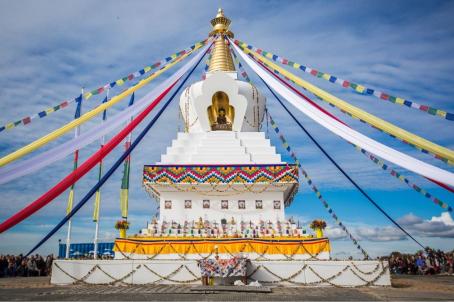
10 Buddhist stupas to discover in Europe

Stupas are symbols of enlightenment and peace that commemorate different stages of Buddha's life. Since the mid-20th century, thousands of stupas have begun to populate Europe. We have compiled some of the most impressive ones in this list.