Oude Kerk
Borne, NL
Historic village church with tower. Originally dedicated to St. Stephen.

Here you can search for a building to visit. You can use the map find destinations, or you can use the filters to search for a building based upon what different criteria.
Borne, NL
Historic village church with tower. Originally dedicated to St. Stephen.
Hardinxveld-Giessendam, NL
Tower Dutch Reformed Church. Remarkable building, dated 1821, of which the brick body of three sections, separated by natural stone frames and neo-classical entrance has embossed brick and with Ionic half-columns, which carry a pediment. The superstructure, consisting of a square and an octagonal open wooden section, still shows a baroque influence, as does the way in which the tower body is connected to the side walls of the church by means of curved gables, crowned by parapets. Mechanical tower clock, EJ Rochlitz. Above the entrance door is a strongly west-deviating wooden sundial, before 1821.
Naaldwijk, NL
The Reformed Old Church was formerly dedicated to Saint Adrian. The church consists of a tower in late Romanesque forms from the mid-13th century that was heightened in the 15th century, crowned by wrought ornament with coats of arms, and a mid-15th-century choir. Internal wooden barrel vaults. In the nave wall a false triforium. Late Gothic choir screen, pulpit in Renaissance forms. In the choir a grave monument. It was estored in 1933-1935. This church is listed as a National Monument of the Netherlands.
Soest, NL
Early 16th century added tower of the Dutch Reformed Church. Bell tower with clock by W. van Wou, 1506, diam. 124.9 cm. In roof turret clock by anonymous founder, 1576, diam. 27.3 cm. Mechanical tower clock, B. Eijsbouts, 1940, decommissioned. In the south wall of the church, there is a dial of a sandstone south hand, in the shape of a semicircle. During a restoration of the tower in 1905, medieval statues emerged from a bricked-up space, which were probably hidden there from iconoclasts. These statues are currently in the Rijksmuseum in Amsterdam, the Flehite museum in Amersfoort and the Catharijne Convent in Utrecht.
Scheveningen, NL
Reformed church from the second half of the 15th century, tower added in the 16th century, internally the pulpit and choir screen are of particular interest. a. Main organ: two-manual organ, made in 1843 by GW and HB Lohman. A free pedal was added during the reconstruction of 1971. b. Choir organ: one-manual organ, made in 1791 by J.M.Gerstenhauer for the Herv. Church in Wervershoof. Placed in Scheveningen in 1961 and provided with a lower case. Bell tower with bell by C. Antonisz. 1597, diam. 118.9 cm.
Grootebroek, NL
Single-nave 19th century church with a medieval tower in the core. An old dilapidated church stood on this site. In 1848 it was demolished and a completely new church was built against the old tower. The church was consecrated on 20 May 1849. The church has a wooden barrel vault. Pulpit with associated rear bulkhead and sounding board XVIIc, baptismal arch XVIId. Baptismal benches and baptismal fence 1690. Preacher's lectern 1749, precentor's lectern and candlestick arms XVIId.
Maasland, NL
Old Church from the 15th century; originally Roman Catholic Church of St. Mary Magdalene. Later Dutch Reformed Church.
Barneveld, NL
In 1354, land reclamation took place and Oosterland was given a wooden chapel, dedicated to Saint Jodocus. Later, this chapel was replaced by the current church, of which the nave was lost to fire in 1612.
Huizen, NL
Dutch Reformed Church located on high walled churchyard. Tower 1st half 15th century. After construction of the current nave in 2nd half 15th century raised. Brick balustrade around trans. Nave mutilated by later enlargements. Choir narrower than nave without buttresses, later heavily renewed. Bell frame with chime consisting of a bell by Johan Dop, 1659, diam. 55.8 cm and a modern bell.
Ede, NL
Reformed church. Tall, late Gothic cruciform church, built in the course of the 15th and the beginning of the 16th century after a Romanesque predecessor had burned down in 1420. The nave has a side aisle on the south side only; only the arches of the north were built. Deep, 5/8 closed choir with a sacristy on the south side. Against the east wall of the north transept a staircase tower. Internally over the choir and transept net vaults on colonettes. The nave and side aisle have cross-rib vaults, which however date from 1643. The church was restored after a fire in 1635; a complete restoration was started in 1964. The inventory includes: an oak pulpit and a baptismal fence from 1674, four copper crowns from 1791, several tombstones from the 17th and 18th centuries. Organ with two manuals, built in 1877 by L. van Dam & Zonen (Leeuwarden) for the Reformed Church of Nieuwe Niedorp . In 1967 modified by the firm B. Pels & Zoon (Alkmaar), provided with a free pedal and placed in Ede. The tower is a large building, clad with secondary processed tuff stone, with three sections, of which the upper two have two slender pointed arch niches with traceries in each facade surface. In the 17th century (VL) or in 1765 (date in corbel under the spire) the tower obtained a remarkable closure, consisting of an arched frieze, above which a series of pointed arch niches with fork traceries and, above the water list, a parapet with blind round arch niches. Mechanical tower clock, has been decommissioned.
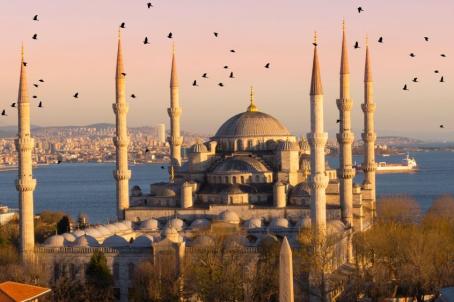
new
For a long time, Europe was ruled by powerful monarchies. Monarchy and religion have been connected since time immemorial. Here are 7 sites across Europe where royalty historically bent the knee to a higher power and received their crown.
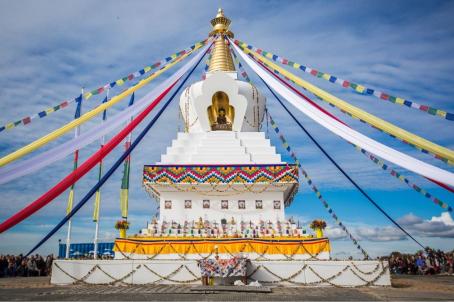
Stupas are symbols of enlightenment and peace that commemorate different stages of Buddha's life. Since the mid-20th century, thousands of stupas have begun to populate Europe. We have compiled some of the most impressive ones in this list.
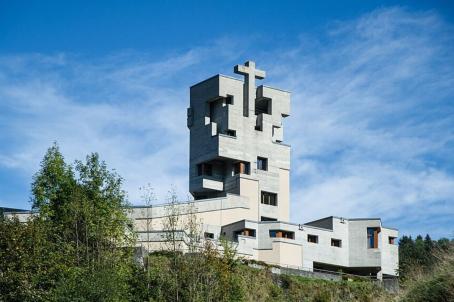
Walter Maria Förderer (1928–2006) was a Swiss architect and sculptor renowned for his neo-expressionist church designs in the 1960s. In this list we have compiled 6 of his church designs that seamlessly integrate religious and secular elements.

How is Religiana helping to conserve and promote Religious Heritage in Europe and why should you get involved?
Find out about Religiana
Are you a tourism organisation or religious heritage sites manager? Discover the advantages of becoming a partner.
See current partners
We can keep you up to date with the latest news from Religiana and religious heritage conservation across Europe.
Sign up to the FRH newsletter