Explore Religious Heritage Across Europe

Here you can search for a building to visit. You can use the map find destinations, or you can use the filters to search for a building based upon what different criteria.

Refine search

Synagoge

Breda, NL

In 1845, a synagogue was built in the Schoolstraat. The Jewish community also had its own school. There was a board for the poor and a society that took care of the sick and the poor, while a women's society took care of the maintenance of the synagogue and the ritual objects. During the occupation, approximately 80 Jews went into hiding in the vicinity of Breda, who were supported by the resistance. Serious damage was done to the synagogue by the NSB, and part of the interior was stolen. After the war, the Jewish community of Breda initially met in a room converted into a synagogue from 1952 onwards. In 1971, a building was purchased on the Dr. van Mierlostraat and consecrated as a synagogue. The old synagogue on the Schoolstraat served as a workshop for many years, but was put back into use in September 1992 after a renovation and restoration. The synagogue also houses a modest library. Since December 2002, the building has been owned by the NIG (Dutch Israelite Community) Breda, who bought it from the Breda Synagogue Exploitation Foundation. Services are held regularly. In nearby Terheijden , the synagogue of the liberal Jewish community of Brabant was inaugurated in 1983. (Source: JHM)
Synagoge

s-Gravenhage, NL

This Synagogue was founded in 1707 in the house of Jacob Pereira. Around 1725, the famous architect Daniel Marot designed the Synagogue that still exists today and is still used by the Liberal Jewish Community of The Hague. It should be noted that the clients wanted a synagogue that would resemble the Portuguese Jewish Synagogue of Amsterdam. This had been built 50 years earlier. The foundation stone of the complex in The Hague was laid on 16 April 1725. It is an impressive building. At the top is the year 5486 (1726). Below that is written in Hebrew "How lovely are your Dwellings". The complex has 12 windows, one for each tribe of Israel. The intention was that the Synagogue would also have a tower (with a clock), just like the Synagogue in Rotterdam that was built around the same time. In 1725, the administrators of The Hague agreed to its construction by a vote of 15 to 1, but several preachers from The Hague subsequently campaigned against the tower and it was never built.

Synagoge

Leiden, NL

Initially, religious services were held in a private house on the Vismarkt, but in 1723 a building on the Levendaal was occupied, which was furnished as a synagogue. In the same year, the statutes of the Jewish community were approved by the city council. The facade of the synagogue on the Levendaal was adapted to the use of the building with the permission of the government almost ten years later. Despite the restrictive provisions and the economic malaise in which Leiden found itself in the second half of the eighteenth century, the number of Jews in the city increased, certainly after the Jews officially obtained equal civil rights in 1796. The explosion of a gunpowder ship in 1807 not only destroyed the archives of the Jewish community, the synagogue was also badly damaged and the Jewish school was completely destroyed. After some provisional restorations, it proved necessary to completely renovate the synagogue building halfway through the nineteenth century. In 1858, the building on the Levendaal was reconsecrated and at the same time a new school building was put into use. Most of Leiden's Jews lived near the synagogue.

Synagoge

Oss, NL

At the beginning of the nineteenth century, a synagogue was established in a rented space on the Varkensmarkt in Oss. Before that, religious services had been held in private homes since 1764. The dilapidated synagogue on the Varkensmarkt was replaced in 1831 by a new building on the Koornstraat . Half a century later, this building was expanded with a school and an official residence and formed the centre of Jewish life in Oss until the Second World War. After the liberation, it became clear that the synagogue could no longer be restored. The front facade has been preserved and is now a municipal monument. This building is listed as a Municipal Monument of the Netherlands.

Synagoge of Apeldoorn

Synagoge of Apeldoorn

Apeldoorn, NL

In 1909, the Central Israelite Lunatic Asylum Het Apeldoornse Bosch was opened. This institution had its own synagogue. In the course of 1942, many Jewish residents of Apeldoorn were deported. In early January 1943, the remaining ones were arrested and transferred to Het Apeldoornsche Bosch. On 23 January 1943, all those who were staying in the institution at that time were deported, together with the children and their carers. Almost without exception, they were killed in Auschwitz and Sobibor.

Synagogue

s-Gravenhage, NL

Former Christian Reformed Church Eben Haëzer, Synagogue since 2003.

Synagogue

s-Gravenhage, NL

Neoclassical synagogue building in courtyard. The building was designed in 1842 as a High German synagogue by architect Roodenburg on behalf of the board of the Ashkenazi Jewish community in The Hague. It was partly financed by King William II. The synagogue was put into use in 1844. The synagogue was located in the middle of the then Jewish quarter of The Hague. After the deportation of the Jews of The Hague in 1942 and 1943, the synagogue stood empty. After the Second World War, the synagogue was restored to its former glory together with two other synagogues. However, the Jewish community had declined sharply in number after the war, from 17,000 to 2,000.

Synagogue and community center in Dresden

Synagogue and community center in Dresden

Dresden, DE

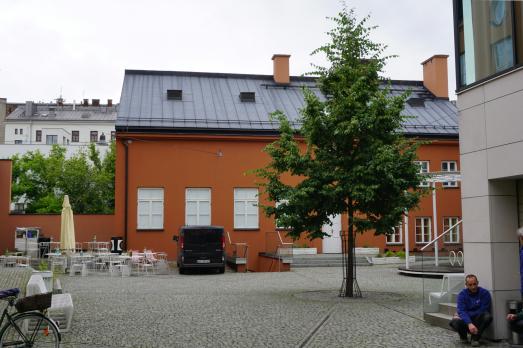
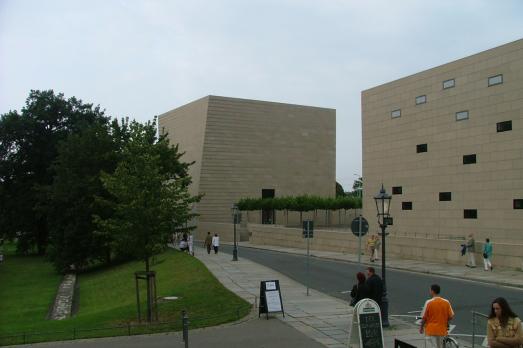
The Synagogue and community centre in Dresden are part of a modernist complex from 2001. The architects of the synagogue are Rena Wandel-Hoefer and Wolfgang Lorch. The main material of the building is concrete.

Synagogue at Dikuna St. in Shklov

Synagogue at Dikuna St. in Shklov

Shklov, BY

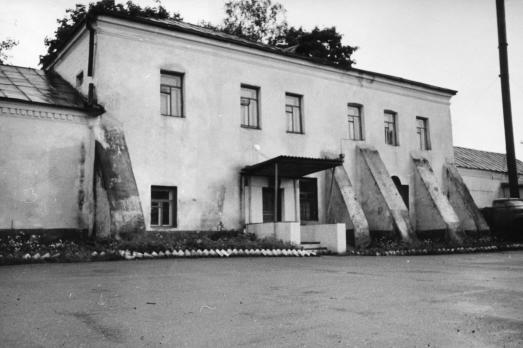
The Synagogue at Dikuna St. in Shklov is an Ashkenazi synagogue probably built in 17th century. Restored after WWII, this Baroque brick synagogue is now used as an educational institution.

Be inspired

Stupkalnis.lt

10 Buddhist stupas to discover in Europe

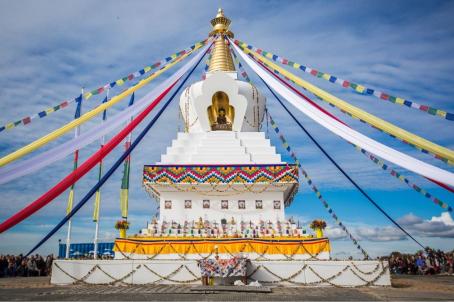
Stupas are symbols of enlightenment and peace that commemorate different stages of Buddha's life. Since the mid-20th century, thousands of stupas have begun to populate Europe. We have compiled some of the most impressive ones in this list.