Eben Haëzerkerk
Molenaarsgraaf, NL
This church is listed as a Municipal Monument of the Netherlands.

Here you can search for a building to visit. You can use the map find destinations, or you can use the filters to search for a building based upon what different criteria.
Molenaarsgraaf, NL
This church is listed as a Municipal Monument of the Netherlands.
Nieuwlande, NL
On 11 December 1913, 'De Gereformeerde Kerk te Nieuwlande' was instituted. On 8 June 1914, the first stone was laid and in August of that year 'Eben Haëzer' was put into use. The well-known reformed resistance fighter Johannes Post hid people in hiding in this church during the Second World War. The hiding place can still be seen. The Stichting Het Drentse Landschap will investigate whether the church can be preserved in some way. Nieuwlande played a special role in the war and received a Yad Vashem award for it. Of course, Nieuwlande wants to keep that past alive. 'The new destination for the reformed church in the village can play an important role in this'. It is not without reason that the church is located on the Johannes Poststraat.
Ermelo, NL
Modern church without tower. Extensions in 1985 (including a new entrance) and 2000. The Reformed Church of Ermelo was founded around 1923. An old school building was purchased to hold church services there. After initially only holding services during the week, it was decided in 1962 to hold Sunday church services. From 30 June 1963, church services were held in the 'Hervormd jeugdgebouw' on the Beekweg in Ermelo. This is more centrally located for visitors. In 1970, the decision was made to have a church building built on the Hanengewei. The church building was officially put into use by the congregation on 2 July 1971. In 1984, it was decided to build a new building and to use the existing church building as a meeting room. On 19 December 1985, the church building was put into use, with 500 seats.
Klazienaveen, NL
Initially the name was "Gereformeerde Kerk van Nieuw Dordrecht". At the end of 1938 a proposal was made to change this name to "Gereformeerde kerk van Klazienaveen". "Among the incoming documents at the meeting of 14 November 1939 a letter stating that the name change has been approved." At a meeting of 22 April 1891 in Nieuw Amsterdam there was a proposal: "with regard to the matter of Nieuw-Dordrecht the church council expresses the wish that, given the circumstances, it is necessary to establish an independent congregation". The church was initially given the name of Nieuw Dordrecht, because a brother wanted to build the church at cafe Lufting on the road from Klazienaveen to Nieuw Dordrecht.
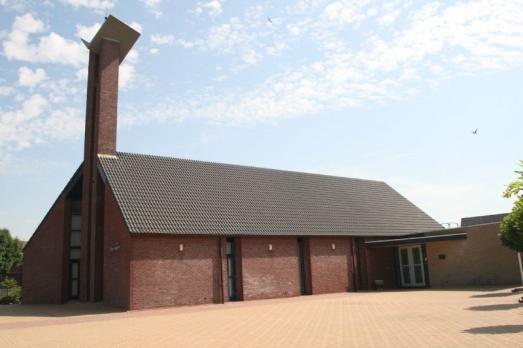
Almelo, NL
The Eben Haëzerkerk is a Christian Reformed Church built in 1927. In December 2002, the organ in the church was removed and replaced by an electronic organ.
Sliedrecht, NL
Interesting interbellum church without a tower, with neo-Gothic windows.
Meeden, NL
Small neo-Gothic church with a new, modern facade from 1975.
Heerde, NL
Reformed Church. One of the oldest houses of worship built for the Reformed Church, around 1840, consisting of a simple hall church with round-arched windows and an entrance door in a simple classicist frame, next to which is a parsonage with a storey and windows with six- and eight-pane sliding windows. The church and parsonage are covered by an elongated pantile hipped roof.
s-Gravenmoer, NL
As a religious community originally a Christian Reformed Church, emerging from the Christian Reformed Church of 's Grevelduin-Vrijhoeve-Capelle . The church building is the successor to a previously used building.
De Krim, NL
The organ case dates from around 1820 and was built by G. Pike (the case stood in Mottram, Longdendale, UK). The pipes of the main work date from 1864 and were built by JC Banfield. The pipes of the swell work date from 1902 and were built by Kingsgate Musical Instruments. The pipework comes from Derby, UK Baptist Church, Pear Tree Road. In 1997 the organ was placed in De Krim by the firm FR Feenstra, the interior (1864 / 1902) was placed in the organ case (1820).
new
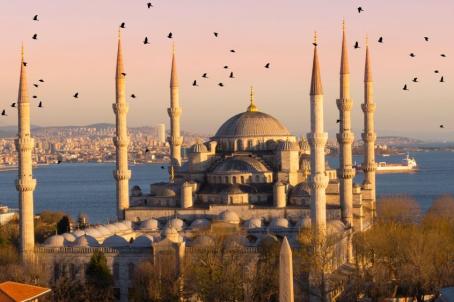
For a long time, Europe was ruled by powerful monarchies. Monarchy and religion have been connected since time immemorial. Here are 7 sites across Europe where royalty historically bent the knee to a higher power and received their crown.
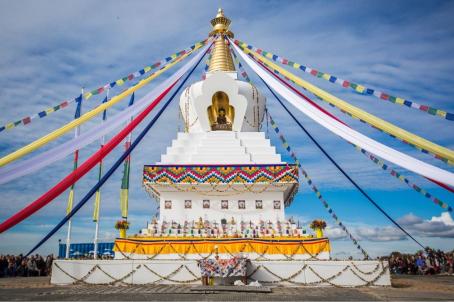
Stupas are symbols of enlightenment and peace that commemorate different stages of Buddha's life. Since the mid-20th century, thousands of stupas have begun to populate Europe. We have compiled some of the most impressive ones in this list.
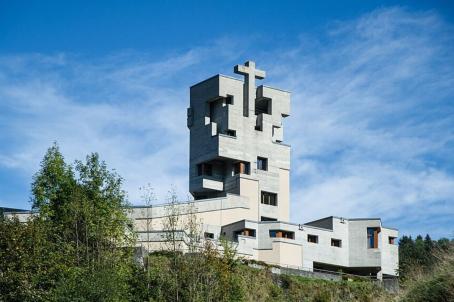
Walter Maria Förderer (1928–2006) was a Swiss architect and sculptor renowned for his neo-expressionist church designs in the 1960s. In this list we have compiled 6 of his church designs that seamlessly integrate religious and secular elements.

How is Religiana helping to conserve and promote Religious Heritage in Europe and why should you get involved?
Find out about Religiana
Are you a tourism organisation or religious heritage sites manager? Discover the advantages of becoming a partner.
See current partners
We can keep you up to date with the latest news from Religiana and religious heritage conservation across Europe.
Sign up to the FRH newsletter