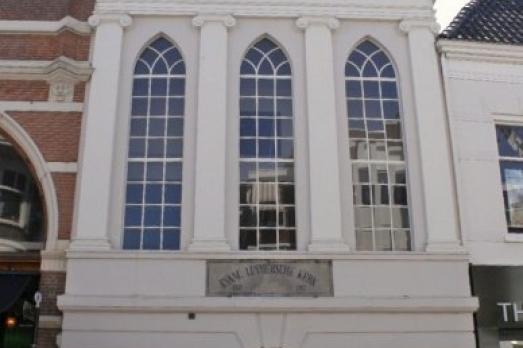
Evangelisch Lutherse Kerk
Amersfoort, NL
New neoclassical facade and demolition of tower in 1837.

Here you can search for a building to visit. You can use the map find destinations, or you can use the filters to search for a building based upon what different criteria.
Amersfoort, NL
New neoclassical facade and demolition of tower in 1837.
Delft, NL
Former chapel St.Joris Gasthuis (15th century). From 1996 to 2003 the Evangelical Church "Het Levend Water" used this church. This Evangelical Church "Het Levend Water" has used (had used) two other locations since then.
Haarlem, NL
Lutheran church, three-aisled building, which owes its current form to a major renovation around 1780 of an older building. Neo-Gothic facade with tower from 1895. Internally in the central nave a stucco barrel vault and galleries in the side aisles. Oak pulpit with oak baptismal fence from the second half of the 17th century. Organ made in 1882 by JA Strobel (Bad Frankenhausen) to replace the Bätz organ that was made in 1790. Two beautiful rococo singing boards with swans. Mid-17th century benches. Tribunes consistory (church council room) from 1910 with chimney piece and on wallpaper (linen stretched in wooden frames) the names of ministers, elders, church treasurers and deacons. Modern extension next to the church square.
Monnickendam, NL
This church is listed as a National Monument of the Netherlands.
Leeuwarden, NL
The church building of the Evangelical Lutheran community in Leeuwarden was built in 1774 to a design by the Roman Catholic city architect Van Nooteboom (1733 - 1812), with financial support from mainly the community of Amsterdam. The memorial stone in the front facade is a reminder of this. The simple building, a hall church with galleries, replaces an older church from 1681, financed by Andreas Moeller, whose funeral plaque still hangs in the church. The church was restored in 1994.
Gorinchem, NL
Restored Evangelical Lutheran Church. Simple hall church originally old catholic, rebuilt in 1842, accessible via a gate in the house Langendijk 70-74. In the gate beautiful lantern with neo-gothic motifs. Two-manual organ, made in 1859 by Kam and Van der Meulen using some pipework by JD Nolting from 1809.
Bussum, NL
At the end of December 1901, the Evangelical Lutheran community of Naarden-Bussum was founded, at that time still part of the main community of Weesp. Previously, since 1640-1645, a Lutheran community had existed in Naarden, which, however, went out of business during the nineteenth century. In 1912, the newly founded community became independent. Initially, they had worshipped in the Concordia building in Bussum. However, they wanted their own church building at a central location between Naarden and Bussum, and so a piece of land was purchased, located between the Mecklenburglaan and the Brinklaan. A new church was built on this in 1903, designed by architect Nierop from Maartensdijk. The contractor was Mr. Jurriaan from Naarden. The building was consecrated on 12 April 1903. The church was in its original form a cruciform church in Gothic style with an apse on the Brinklaan side, a roof turret at the crossing and a vaulted ceiling inside. The building blended harmoniously into the surrounding residential area.
Heerlen, NL
The church was built in 1960-1961 to a design by architect FH Meijer.
Nijmegen, NL
Neo-Gothic building with turret. Out of use as Dutch Reformed Chapel in 1924, since then Evangelical Lutheran Church (ELK). This church is listed as a National Monument of the Netherlands. The church was put up for sale in 2021 despite protests.
Groningen, NL
Evangelical Lutheran church building from 1696. In eclectic style built frontage with risalit from 1874, with risalit in which a relief in the shape of a swan, for the late 17th century (1696) hall church with gallery on three sides. The church has a richly carved pulpit 1696 with rear bulkhead and sounding board. Organ by Van Oeckelen, made in 1896.
new
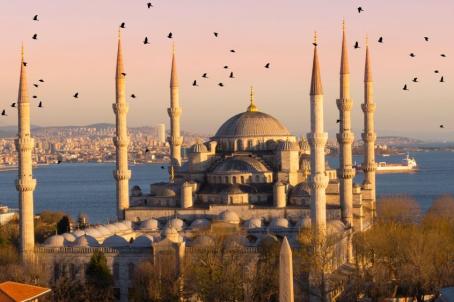
For a long time, Europe was ruled by powerful monarchies. Monarchy and religion have been connected since time immemorial. Here are 7 sites across Europe where royalty historically bent the knee to a higher power and received their crown.
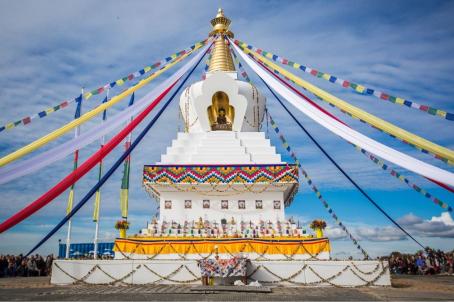
Stupas are symbols of enlightenment and peace that commemorate different stages of Buddha's life. Since the mid-20th century, thousands of stupas have begun to populate Europe. We have compiled some of the most impressive ones in this list.
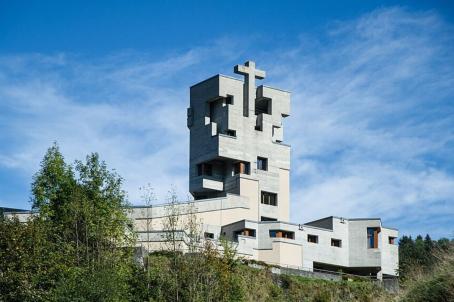
Walter Maria Förderer (1928–2006) was a Swiss architect and sculptor renowned for his neo-expressionist church designs in the 1960s. In this list we have compiled 6 of his church designs that seamlessly integrate religious and secular elements.

How is Religiana helping to conserve and promote Religious Heritage in Europe and why should you get involved?
Find out about Religiana
Are you a tourism organisation or religious heritage sites manager? Discover the advantages of becoming a partner.
See current partners
We can keep you up to date with the latest news from Religiana and religious heritage conservation across Europe.
Sign up to the FRH newsletter