Explore Religious Heritage Across Europe

Here you can search for a building to visit. You can use the map find destinations, or you can use the filters to search for a building based upon what different criteria.

Refine search

Heilige Michaël

Sittard, NL

St. Michael's Church. Single-nave church, built in 1659-1668 with a three-sided closed choir, roof turret and a strikingly richly decorated facade with volutes and pediment. The design is possibly by Father Hieronymus Mauritius from Brussels. Initially used as a monastery church by the Dominican Fathers. In the late 17th century, the sacristy was built against the choir closure with the library above it.
Heilige Michaël

Schalkwijk, NL

St. Michael, consecrated 1879, architect WVA Tepe. Important church in the oeuvre of this architect. Neo-Gothic cruciform basilica with high west tower, decorated with three niches in three floors each. Balustrades and pinnacles of brick, richly detailed gables on the transept with niches and phials. Octagonal sacristy with floor and tent roof, on which wooden tower on the south side of the choir. Round pillars with colonnettes and moulded capitals. Almost completely preserved Bernulphusgilde inventory. Single manual organ, made in 1758 by JHH Bätz for the Herv. Church in Oosterhout. After residing in two churches in Utrecht, the organ was placed in Schalkwijk in 1987. Mechanical tower clock, Gebr. van Bergen in Midwolda, 1879 (1839?), equipped with electric winding.

Heilige Michaël

De Bilt, NL

Interesting reconstruction church with tower. Replaced an earlier neo-Gothic church from 1894 designed by Alfred Tepe, of which the rectory remains. After the closure of the St. Laurentius church in Bilthoven, this is the central church of De Bilt and the south of Bilthoven. (Further on in the north of Bilthoven is the OL Vrouw van Ooitdurende Bijstandkerk ).

Heilige Michaël

Beek (NB), NL

Historic village church with tower. Originally dedicated to Mary (Our Lady) and St. Anthony.

Heilige Michael

Breda, NL

Modern small church hall. Replaced the monumental church that was demolished in 2007. which had become too large. On Sunday 29 November 2009, Bishop Van den Hende consecrated the new St. Michael's Church on the Hooghout in Breda. The consecration of the church is the highlight of a whole week of activities in and around the church. From the time of the consecration of the church, the parish of Breda-Oost will call itself the Michael's Parish. The parish of Breda-Oost decided to build a new church in 2001. The result of a careful process is a new, modern Catholic church, which aims to have a social function in the neighbourhood and is built in a complex with homes and the neighbourhood library.

Heilige Michaël

Maastricht, NL

The St. Michael's Church is a Roman Catholic Parish in the former village of Heugem aan de Maas, near Maastricht. It was built in several periods which has resulted in its mix of Baroque, neo-Romanesque and Modern architectural styles.

Heilige Moeder Anna

Heerlen, NL

The second architect was H. Teeken (1900-1950): 'a sober technical and conscientious counterpart of the artist Frits Peutz'. The church would become the new main church of the Eastern Mining Region with a thousand seats. The church is centrally located in the Bekkerveld district, on the edge of a grass field of the same name.

Heilige Naam Jezus

Broekhuizervorst, NL

The oldest part of the church probably dates from the 13th century. The first mention dates from 1214. Excavations have shown that there was a rectangular church of 12 by 6 meters. At the beginning of the 13th century, construction of the 47 meter high tower was started and in the 15th century the chancel was built against the hall church. A small chapel was built on the south side for the lords of Ooijen. In 1535 the nave was rebuilt and enlarged. Over the centuries the church was restored several times, including in 1684, 1880-1884, 1920-1930. In 1929 a sacristy was built on the south side of the chancel. The former sacristy became a children's chapel. In 1913 a new organ was installed and in 1914 a pulpit and three new altars. At the time, the church contained beautiful murals, statues and a magnificent Stations of the Cross. On 23 November 1944, the church was blown up by retreating German soldiers and completely destroyed. The historic murals disappeared with the collapsed walls. In addition to the church, the entire church inventory, with the exception of the rich treasure of art objects, was lost.

Heilige Naam van Jezus / Koepelkerk

Lierop, NL

H. Name of Jesus, 1890-1892, Ch. Weber. Crucifix basilica with large, octagonal dome tower at the crossing, surrounded by square corner towers, of which the two eastern ones each had an octagonal superstructure, which has been demolished. Characteristic example of the Romanesque-Gothic style of Weber's last period, inspired by the Roermond Munsterkerk. Alternating system of pillars and columns, dome vaults with eight ribs on pendentives. Bell by Willem and Jaspers Moer from 1509. In 1985, the two eastern towers were provided with new sections designed by J. de Jong, but considerably lower than the previous towers, in the same style as the church.

Heilige Nicolaas

Odijk, NL

Traditionally, the parish of Odijk belonged to the archdeaconry of Oudmunster. In Odijk there were grounds, 'a court' which were successively in the hands of the German emperors (end of the 10th century), the archbishop of Cologne (until 1019), the Benedictine abbey of Deutz (until 1256) and finally of the count of Gelre. The oldest church building of Odijk, a chapel, probably stood within this court. This was probably a 'daughter' of the church of Werkhoven. In the 12th century, a Romanesque cruciform church with tower was built in Odijk. This church was probably dedicated to St. Heribert. In the sixteenth century, around 1547, the choir of this church was replaced by a late Gothic choir. In the 19th century, the tower, the transept and the nave were demolished. What remained, the choir, is the current Dutch Reformed Church (the 'white church'). During the Reformation, Odijk initially remained Roman Catholic. From 1564, Evert Aelbertsz. was pastor in Odijk and around 1593 he baptized Protestants and Catholics, depending on the denomination of the parents. After the death of this last Catholic pastor, the people of Odijk went to church in Bunnik (Rhinauwen castle), Blikkenburg castle south of Zeist and also to Rijsenburg castle. In 1718, a new church was built in the hamlet of Schoudermantel near Bunnik. This church became the heart of the Bunnik station, which also included Odijk.

Be inspired

Stupkalnis.lt

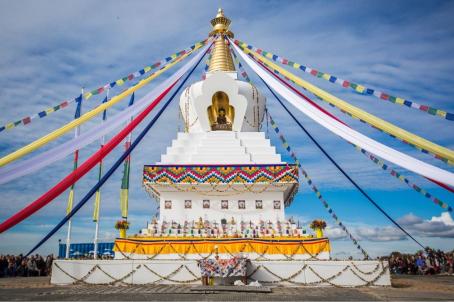
10 Buddhist stupas to discover in Europe

Stupas are symbols of enlightenment and peace that commemorate different stages of Buddha's life. Since the mid-20th century, thousands of stupas have begun to populate Europe. We have compiled some of the most impressive ones in this list.