Explore Religious Heritage Across Europe

Here you can search for a building to visit. You can use the map find destinations, or you can use the filters to search for a building based upon what different criteria.

Refine search

H.H. Nicolaas en Maria Magdalena

Krommenie, NL

Beautiful barn church, enlarged 1633, renovated 1826. Richly detailed interior. Dedicated to Saint Nicholas. In the late 1970s, the Old Catholic Parish of St. Nicholas merged with the Old Catholic Parish of St. Mary Magdalene in Zaandam. Since then, this parish has been called "St. Nicholas and St. Mary Magdalene". Regular church services take place in Krommenie. Occasionally, an Old Catholic service still takes place in Zaandam.
H.H. Petrus en Paulus

Leidschendam, NL

Roman Catholic parish church of St. Peter and Paul, built around 1880 to a design by Evert Margry (1841 - 1891) (pupil of Pierre Cuypers (1827 - 1921)), in collaboration with (presumably) his brother AAJ Margry and JM Snickers, to replace a predecessor that had become too small. Three-aisled cruciform basilica in the characteristic and recurring style of the Margrys, inspired by early French Gothic, but in this case entirely in neo-Romanesque, round-arched shapes. Asymmetrical front with tower on the right corner, on the waterfront (see images below), simple staircase tower on the other corner. Internally covered by wooden barrel vaults (main naves). Stone cross vaults over the side aisles. The design shows many similarities with that of the H. Hartkerk in Rotterdam from the same period, also designed by Evert Margry (1841 - 1891), also neo-Romanesque, which was destroyed in the bombing of 1940 (the most important neo-Romanesque church by Evert Margry (1841 - 1891), however, was the St. Monicakerk in Utrecht, which was demolished in 1977).

H.H. Petrus en Paulus

Soest, NL

Neoclassical facade with tower, 1852-1853, for modern church building. In the church a neo-baroque pulpit, an altar and chandeliers from the previous Waterstaatskerk. Mechanical tower clock, 1903, J. van de Kerkhof and Sons, in 1972 provided with electric winding. Is not in use.

H.H. Petrus en Paulus

Bergen (NH), NL

The Roman Catholic HH Petrus en Pauluskerk from 1924 replaced a church by architect Th. Asseler from 1867 that had become too small. It is a large church without a tower, in late neo-Gothic forms, designed by the Bergen architect Jan Leijen (1876-1958). At the crossing there is a small roof turret; semi-circular apse on the south side (the church is not oriented). To the right of the front facade is the parsonage, which is a remnant of the previous church from 1867. The spacious cruciform basilica was designed according to the guidelines of the Liturgical Movement from the early 20th century, in which all believers find a place in the wide central nave. The interior, executed as fair-faced masonry, is covered by rib vaults. Architecturally, there is a slight relationship, both externally and internally, with the church buildings of Joseph Cuypers from the 1920s. The seven stained-glass choir windows date from the construction period and represent the Seven Sacraments. They were made by Lou Asperslagh (1893-1949) from The Hague. The Stations of the Cross (1944) and a mural "The Miracle of Bergen" (1949) were made by the Bergen artist Jaap Min (1914-1987). The original main altar from the Haarlem studio Maas (ca. 1910) was initially in the previous church and was replaced in 1974 by a forward-placed altar table by the aforementioned Jaap Min. The organ by the Pels company (Alkmaar) dates from 1932.

H.H. Petrus en Paulus

H.H. Petrus en Paulus

Amsterdam, NL

The church, rectory and study form a whole and were designed by Johan WF Hartkamp jr. , a pupil of Hendrik Petrus Berlage . The church complex was completed in 1914 as a continuation of the clandestine church 'De Ooievaar' on the Barndesteeg .

H.H. Petrus en Paulus

Schaesberg, NL

Roman Catholic Church. Tower, single-aisled nave and two transepts against the nave from the years 1649-'99. Choir and transept, 1914. Pulpit, approx. 1700, baptismal font 17th century, 8 paintings, four pairs of cast copper candlesticks (17th century). Gravestone of Frederik van Schaesberg, approx. 1733. In the churchyard a hardstone cross, on which a small Calvary and 'memento mori'; ten stone grave crosses, 1710-1811; some fragments of sculptures. Mechanical tower clock.

H.H. Petrus en Paulus

Maassluis, NL

This church building replaced the Andreaskerk and the Petrus & Pauluskerk . The first pile for the new parish church of the HH Andreas, Petrus and Paulus was driven on 21 September 2004. The church replaced two other Roman Catholic church buildings in Maassluis.

H.H. Petrus en Paulus

H.H. Petrus en Paulus

Aalsmeer, NL

The church of SS Peter and Paul dates from 1861 and is listed as a Municipal Monument of the Netherlands.

H.H. Petrus en Paulus

Middelburg, NL

The church building has a somewhat dark interior, but that effect is partly taken away by the painting in the choir wall (apsis). What is special is that various liturgical objects in the interior were made of molten copper from the church on the Noordstraat that was destroyed in 1940. Worth seeing is the chapel with the painting of Our Lady of the Polder. This has to do with the veneration of Our Lady in Vrouwenpolder. The painting is said to have been created in a miraculous way. Around 1340, a resident of Vrouwenpolder wanted a painting of Mary to be hung in the church of his village. The painter who was given the assignment failed. Then an unknown man came along who painted the desired canvas and then disappeared without a trace. People saw the hand of God in this.

H.H. Petrus en Paulus

H.H. Petrus en Paulus

Aarlanderveen, NL

The church of SS Peter and Paul in Aarlanderveen is a Neo-Gothic church with a high tower built in 1897 according to the designs of Joseph Cuypers (1861 - 1949). It is listed as a Municipal Monument.

Be inspired

Stupkalnis.lt

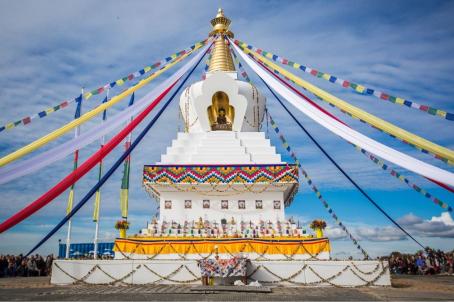
10 Buddhist stupas to discover in Europe

Stupas are symbols of enlightenment and peace that commemorate different stages of Buddha's life. Since the mid-20th century, thousands of stupas have begun to populate Europe. We have compiled some of the most impressive ones in this list.