Explore Religious Heritage Across Europe

Here you can search for a building to visit. You can use the map find destinations, or you can use the filters to search for a building based upon what different criteria.

Refine search

Heilige Barbara

Griendtsveen, NL

St. Barbara's Church, built in the style of traditionalism. The church was built in 1895 to a design by Jac. van Groenendael jr. The church is situated in the immediate vicinity of the former rectory and the guesthouse.
Heilige Barbara

Culemborg, NL

The Roman Catholic Church of St. Barbara, protected because of a bell, dedicated to St. Elisabeth, cast by Jan Tolhuis in 1555 and originating from the former St. Janskerk and the organ with two manuals and pedal made in 1861 by CGF Witte from Utrecht, moved to the current church building in 1886. The organ was restored in 1971 by the Verschueren company from Heythuysen. During that restoration, the organ was expanded with a free pedal that is of no value from the point of view of monument conservation. During a subsequent restoration in 1992 by the Steendam company from Roodeschool, the pedal from 1971 was removed again.

Heilige Barbara

Dreumel, NL

The church was restored in the years 2002-2005. A new organ was installed in the Roman Catholic Titus Brandsma Church in Oss, originating from a Protestant church. The old organ from 1968 was sold to the church of Dreumel.

Heilige Barnabas

Haastrecht, NL

Saint Barnabas, 1852-1854 by WJ van Vogelpoel. Neoclassical beige CHURCH with elements borrowed from the Baroque in the facade: on the door or cornice abutting higher middle part with pilasters and pediment. The side parts of the facade have swiveling crowns. Originally a single-manual organ, made in 1845 by Stulting and Maarschalkerweerd. In 1880 he started his career with M. Maarschalkerweerd. Clock chair with clock by Petit and Fritsen, ca. 1854, diam. 41.9 cm. Small house clock, has been taken out of use.

Heilige Bartholomeus

Poeldijk, NL

Large, late neo-Gothic church with a defining high tower of 76 m, making it the highest church tower in the Westland.

Heilige Bartholomeus

Nootdorp, NL

Large neo-Gothic church with a defining tower. Early, richly detailed Margrykerk. This church is listed as a National Monument of the Netherlands.

Heilige Bartholomeus

Eckelrade, NL

The oldest part of the church dates from the 13th century. Internal wall remains of the single-nave church from that time still remain. The lower part of the tower dates from the 14th century, as does the Gothic choir and single chapel on the north side. The tower was possibly raised in the 15th century. The chapel on the north side was enlarged in 1717 to a complete north aisle. The nave and choir were also raised. The tower was given a classicist entrance gate. When the parish became independent in 1845, a sacristy and a baptismal chapel were added to the north side. In 1923, the neo-Gothic south aisle was added on a plinth of Kunrade stone according to plans by architect Heurkens. In 1958, the tower was restored, in 1964-'65 the rest of the church. (Source: [1]

Heilige Bartholomeus

Schoonhoven, NL

Old Catholic church in Schoonhoven because of the organ, made by the organ builders L. Mintier and Gloton from Nantes (France) around 1875. Purchased from a private individual and placed in this church around 1980.

Heilige Bavo

Harmelen, NL

On the Ambachtsherenlaan, on the corner with the Joncheerelaan, a three-aisled Roman Catholic CHURCH of the pseudo-basilica type was designed in 1916 by Jan Stuyt in neo-Romanesque style. The church is built on a cross-shaped floor plan with a higher, elongated central nave covered by a saddle roof and lower, shorter side aisles of three bays wide, which are covered with hipped roofs. The roof covering consists of red old Dutch tiles with decorative gable tiles along the eaves. The choir is covered with slate tiles. The gables are provided with decorative patterns in brickwork. In a number of these patterns, the recessed sections are provided with a white-painted plaster layer. A chequered frieze of white and braised tiles has been placed in a number of places under the eaves. Bands of black-coloured brick have been incorporated into the barrel vault of the entrance. A semi-circular apse with five round-arched windows has been placed against the east facade under a six-sided roof slope; the semicircular apse is provided with mosaic. To the right of this, between the nave and the apse, is an octagonal stair tower under a tent roof. On the northeast side, the sacristy is placed against the side nave under a saddle roof with a lower ridge height, parallel to the nave. A second sacristy is placed against the southeast side with a lower ridge height under a saddle roof. On the northwest side, a semicircular baptismal chapel has been built out with a slate covering in mesh covering. On the southwest side, a tower has been placed in the armpit of the side and central nave under a slate-covered, slightly incurved spire. On the top is a weather vane in the shape of a cross with a tower cock. The tower has three sections. Halfway along the first section, a black and white chequered frieze has been applied. In the second section, above two narrow windows in each side of the tower, a diamond-shaped dial has been provided with a clock. The third section contains two sound holes in each side with a frieze above them; There is a brick balustrade in the sound holes.

Be inspired

Stupkalnis.lt

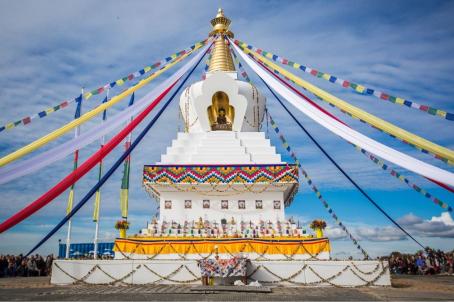
10 Buddhist stupas to discover in Europe

Stupas are symbols of enlightenment and peace that commemorate different stages of Buddha's life. Since the mid-20th century, thousands of stupas have begun to populate Europe. We have compiled some of the most impressive ones in this list.