Explore Religious Heritage Across Europe

Here you can search for a building to visit. You can use the map find destinations, or you can use the filters to search for a building based upon what different criteria.

Refine search

Yeni Moskee

Maassluis, NL

Mosque of the Turkish community in Maassluis. 'Yeni Camii' means 'New Mosque'. Architecturally nice building, with dome and minaret. In 2013 the building was adapted and expanded. The images below show both the original building and the expansion in 2013.

Yeni Mosque, Edessa

Yeni Mosque, Edessa

Edessa, GR

Yeni Mosque is a historic Ottoman mosque built in the 17th century in Edessa. It is the only surviving mosque in the city. It has been operating as a museum since 1942.

Yeni Mosque

Yeni Mosque

Thessaloniki, GR

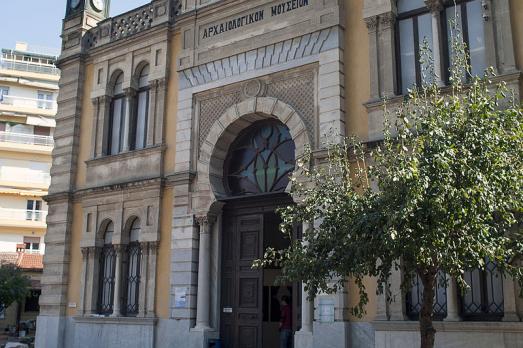
The Yeni Mosque, also called 'New Mosque', is a historic mosque built in 1902 to the plans of the Italian architect Vitaliano Poselli. The mosque was founded for the Dömne community, Jews who followed Sabbatai Zevi in his conversion to Islam in the 17th century. The new Yeni Camii Mosque is the last mosque built in Salonika under Ottoman rule. The New Mosque now belongs to the municipality of Thessaloniki and hosts art exhibitions and various other cultural events.

Yeshiva in Telšiai

Yeshiva in Telšiai

Telšiai, LT

The Telšiai yeshiva is an Ashkenazi synagogue built in 1908 by the architect Yakok I. Ushakov. Its original form is captured on a photograph from the 1920s and also in a postwar picture. Its street façade was pierced with large segment-headed windows on the ground floor, and with smaller round and segment-headed ones in the gable. The façade was decorated with brickwork pilasters, panels, frieze, stringcourses, and finials. According to a memoir by Shmuel Natanovich, the yeshiva occupied a large single-storey building, of about 800 sq m. The building was surrounded by a high fence, and the house of the rabbi was situated within the fenced yard. At the entrance to the building, there was a room for the lessons and a room for the library. In the yeshiva hall, there were three blocks of benches with lecterns, a Torah ark in the eastern wall and a bimah in the center. The brick annex on the northern part was added in the 1930s, as well as probably the upper floor in the western part. The eastern gable and the frieze were destroyed in a fire in 1960; probably, new parts were added afterward. The building was renovated in 1978. In 2004 only some decorations above the windows are still preserved. The windows are blocked with wooden planks. The building belongs to the Jewish Community of Lithuania.

Yeshivat Hokhmei in Lublin

Yeshivat Hokhmei in Lublin

Lublin, PL

The Yeshivat Hokhmei Lublin is an Ashkenazi synagogue built between 1928 and 1930 by the architect Agenor Smoluchowski. This Neo-Classical and Art Deco brick building still serves as a synagogue.

Yesil Moskee

Druten, NL

Turkish mosque. Modest building, but with a dome.

Yeunten Ling Institute

Yeunten Ling Institute

Huy, BE

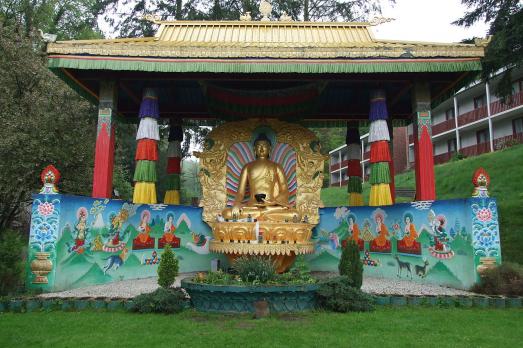
The Yeunten Ling Tibetan Institute is a Buddhist complex located in the Bishop's Castle since the 1980s. The complex includes a temple ("Thubten Shedrub Ling"), a library, meeting rooms, as well as about 50 studios and single rooms. The Yeunten Ling Institute has become one of the most important Dharma centres in Europe. Thousands of people gathered for the consecration of the Buddha statue by the Dalai Lama in 2012.

Yi Jun Memorial Church

Leidschendam, NL

The Paus Johannes Centrum is completely detached in a park-like environment, in the Prinsenhof district. The park is a large rectangular area that is completely surrounded by apartment buildings (see overview photos). The complex with a flat roof is focused on functionality and has a number of meeting rooms in addition to the church hall.

Yiddishe Shul in Botoşani

Yiddishe Shul in Botoşani

Botoşani, RO

The Yiddishe Shul (Temple at the New Market Place) in Botoşani is an Ashkenazi synagogue that was built in the 20th century. This Neo-Gothic brick building is now abandoned.

Yildirim Beyazit moskee

Middelburg, NL

In 1975, a room was put into use as a Masjeed (prayer room) at Eigenhaardstraat 2, where the Turkish Workers' Association was located. The Turkish residents of Middelburg now had the opportunity to perform their prayers. In the period that this was not possible, people went to Bergen op Zoom to perform at least the Friday prayer and the festive prayer. In 1984, the Turkish Workers' Association moved to the Demarary building at Oostkerkplein 5. In 1987, the Masjeed moved to this building. An old church building in the Stromenwijk was also purchased in 1987. Due to the high renovation costs, it was decided not to have the building renovated. Partly because the neighborhood was against a mosque and because the area was not spacious enough, people continued to look for another location to establish the mosque. The Yildirim Beyazit Mosque in Middelburg was officially opened on Saturday, May 9, 2015.

Be inspired

Stupkalnis.lt

10 Buddhist stupas to discover in Europe

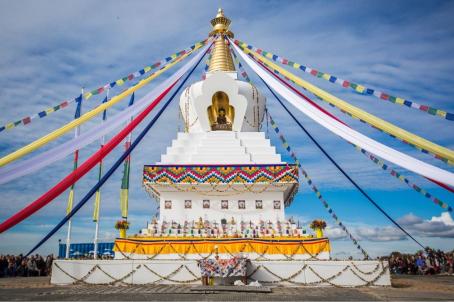
Stupas are symbols of enlightenment and peace that commemorate different stages of Buddha's life. Since the mid-20th century, thousands of stupas have begun to populate Europe. We have compiled some of the most impressive ones in this list.