Ålesund Church
Ålesund, NO
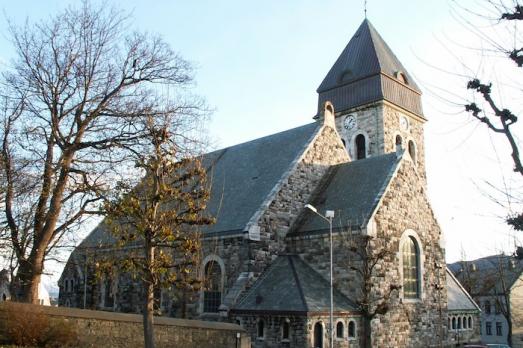
The church in Ålesund was built in stone from 1905. Nordmøre stone was chosen as the material for the church because Ålesund had just suffered a fire in 1904. Frescoes and stained glass by Enevold Thømt.
Here you can search for a building to visit. You can use the map find destinations, or you can use the filters to search for a building based upon what different criteria.
Ålesund, NO
The church in Ålesund was built in stone from 1905. Nordmøre stone was chosen as the material for the church because Ålesund had just suffered a fire in 1904. Frescoes and stained glass by Enevold Thømt.
Deventer, NL
The architecturally interesting church building (post-war modernism) Het Open Hof was designed in 1970 by Architectenbureau van der Zee, Beijert en Alting from Bolsward. It is a functional church building without a tower, built in the northeastern urban expansion of Deventer. In 1971, the facade ornament with cross shapes was applied to the east facade. In the old situation, i.e. before the merger of September 2007 and before the federation of January 2003, it was a church building of the Reformed Church. The building was a response to the realization of the major expansion plans on the north side of Deventer. The church building on the Smedenstraat had become too small for that in the meantime. Later the roles were reversed: the Smedenstraat church was sold and church services were only held in Het Open Hof. In addition, the Hervormde Ceintuurbaanwijk moved in in 1990. The Reformed Church sold its church building on the Ceintuurbaan/corner of Hoge Hondstraat in 1989. A start of cooperation and churching together was a fact. In Het Open Hof there are eleven oblong stained glass windows in expressionist style, with images of evangelists, prophets and several saints, moved here in the early 1990s from the church on the Smedenstraat. The intention is that these windows will be moved to the Grote- or St. Lebuïnuskerk after Het Open Hof is decommissioned.
Paris, FR
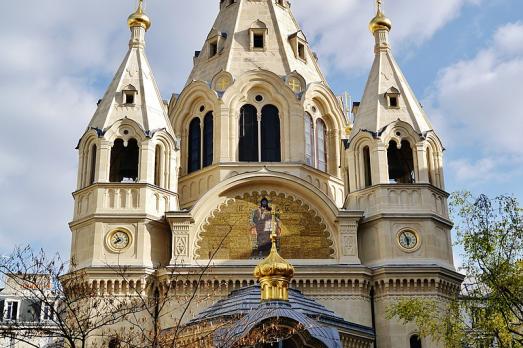
St. Alexander Nevsky Cathedral is a Russian orthodox consecrated in 1861. It is the first permanent place of worship for the Russian Orthodox community in Paris. It is under the jurisdiction of the Ecumenical Patriarchate of Constantinople. The cathedral, including the crypt, has been listed as a historic monument since 1981.
Slovyansk, UA
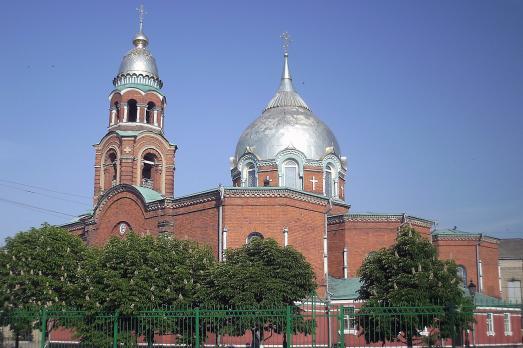
The Alexander Nevsky Cathedral of Sloviansk is an Orthodox cathedral. The church has been the target of shelling due to the ongoing fighting in the region, but the cathedral remains intact.
Sofia, BG
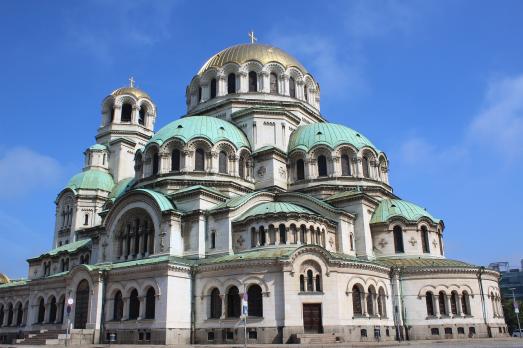
Alexander Nevsky Cathedral is an orthodox cathedral of Neo- Byzantine style built between 1882 and 1912. Comprising five naves and three altars and can hold nearly 10,000 worshipers, it is the largest cathedral on the Balkan Peninsula, one of the largest cathedrals in the Orthodox world and one of the symbols of Sofia.
Tallinn, EE
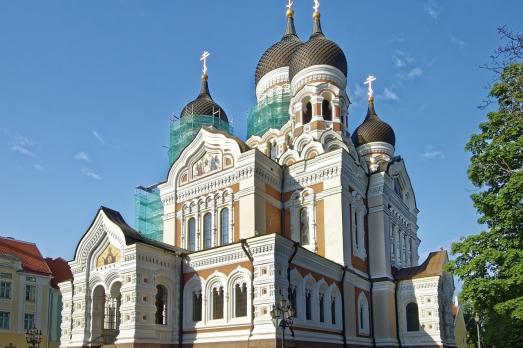
Aleksander Nevsky Cathedral is a 19th-century Orthodox church. The construction of this sanctuary, based on Russian church architecture, began in 1894 and was completed in 1900. The church was named after Alexander Nevsky (1220-1263), the Prince of Novgorod.
Rotterdam, NL
Characteristic, beautiful small church in Russian Orthodox style. Replaced the previous church on Persijnstraat .
Rinsumageast, NL
Reformed Church. One of the few multi-aisled church buildings in the Frisian countryside, created by the late Gothic extension of a 12th century tuff stone nave with an equally wide, straight-ended southern nave, separated from it by pointed arches and heavy columns. Under the choir, restored crypt divided into three naves by two columns with carved capitals. Tower renewed in 1610. On the north side, a 17th century entrance frame; on the south side, a votive stone from 1546. Two carved tombstones. Two-manual organ by Bakker and Timmenga from 1892. Bell frame with bell by H. Falck, 1620, diam. 98.3 cm. Mechanical tower clock by Haak, Gebr. Caminada and Dupont, Rotterdam.
Bennekom, NL
In the war of our country with France, which began in the disastrous year of 1672, Nigtevecht experienced a time of much misery and great horror. The headquarters of the French army was located in Utrecht and from there the road ran through the Vecht region, along which army units were to penetrate to Amsterdam. Many villages, castles and farms were destroyed. At the fort Hinderdam in Nigtevecht the French retreated to Utrecht. They completely burned down the village, including the church and many farms. Only one house was spared, that of the "schoolmaster". The villagers had fled across the ice to Weesp. Along the entire route on their retreat the French took prisoners with them, who were exposed to barbaric cruelties, as is mentioned in "De Fransche Tyrannie", published "T'Amsterdam, Bij Jan Claesz, ter Hooren, Boekverkooper over 't oude Heerelogement 1674".
Alexandreni, MK
The Alexandreni Jewish Cemetery was most likely established in the first half of the 19th century. It is marked on a map of the region from the 1860s, and epigraphic data shows it already existed in the 1850s. The cemetery remained in use after WWII, with the latest preserved gravestone dating to the 1970s.
new
For a long time, Europe was ruled by powerful monarchies. Monarchy and religion have been connected since time immemorial. Here are 7 sites across Europe where royalty historically bent the knee to a higher power and received their crown.
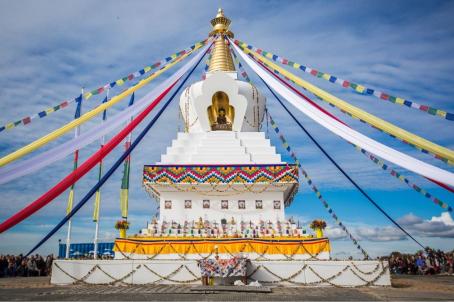
Stupas are symbols of enlightenment and peace that commemorate different stages of Buddha's life. Since the mid-20th century, thousands of stupas have begun to populate Europe. We have compiled some of the most impressive ones in this list.
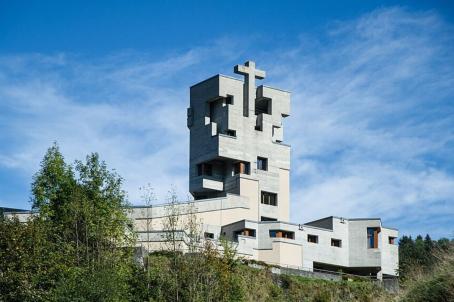
Walter Maria Förderer (1928–2006) was a Swiss architect and sculptor renowned for his neo-expressionist church designs in the 1960s. In this list we have compiled 6 of his church designs that seamlessly integrate religious and secular elements.