Protestantse Kerk
Angeren, NL
Small reconstruction church, built to replace a church destroyed during the war.

Here you can search for a building to visit. You can use the map find destinations, or you can use the filters to search for a building based upon what different criteria.
Angeren, NL
Small reconstruction church, built to replace a church destroyed during the war.
Scherpenzeel, NL
Dutch Reformed Church. Simple hall church from around 1800. Enlarged in 1860 with north arm and tower. In the windows four stained glass windows by Ype Staak, 1788. Single manual organ, made in 1881 by L. van Dam and Sons. Bell tower with clock by J. Noteman, 1638, diam. 66.5 cm. Mechanical tower clock by JV de Vries, Drogeham, 1913.
Onderdendam, NL
This church is listed as a National Monument of the Netherlands.
Bladel, NL
2019 - Heritage organization BOEi takes over the Witte Kerkje in Bladel (NB) and the adjacent community center De Dissel from the protestant community of Bladel. They sign a lease agreement for the next five years so that the church activities can be continued in the same way.
Kolham, NL
Reformed Church on churchyard. Small church built in 1640, closed on three sides on the east side and provided with a roof turret above the west facade that was renovated in 1808. A bell from 1808 once hung in the roof turret. This was stolen during the Second World War by order of the occupier.
Nigtevecht, NL
Monumental historical village church with tower. Tower 12th century.
Assendelft, NL
Interesting neo-church with tower, built 1894-1895, replacing a burnt down church. (See also below the interesting description by the SKKN, in which however no further description of the important Bakker and Timmenga organ is given).
Blijham, NL
The current Dutch Reformed Church from 1783 did have an older predecessor, possibly from the 16th century. That old church was seriously damaged in 1781 during a village riot about the appointment of a new schoolmaster. It was decided to demolish it and build a new one. On 29 September 1941, the tower (from 1872) burned down after it was hit by a crashing English plane. The church was restored in phases between 1963 and 2001. On 20 May 2003, the weather vane was replaced and the restoration was completed. On that occasion, the booklet Dutch (sic) Reformed Church Blijham - Then and Now (48-02/51-04) was published.
Sint Nicolaasga, NL
The church was originally dedicated to Saint Nicholas. Excavations have shown that there was a church before this church, probably more than one, because in addition to monastery bricks, a tufa stone called âlde Friezen was also found in the churchyard. These stones were used in church construction around 1100. There was a fire in the church in January 1970. An overheated stove in the middle of the church caused the roof to catch fire. This resulted in a large hole in the roof. The damage was then repaired using panelling and carpeting. This disrupted the acoustics in the church. During the extensive renovation of 2006/2007, some things were restored. The church is used by the Protestant Community of Tjerkgaast, Idskenhuizen and Sint Nicolaasga.
Schraard, NL
Single-nave, predominantly yellow brick (various sizes), slate-roofed CHURCH BUILDING with semi-circular closed choir and unarticulated saddle roof tower. The 12th-century Romanesque tower was raised in the 13th century during the construction of the Romanesque church. The top of the tower was renewed, possibly in the 18th century. Deep-set round-arched and pointed-arched windows with glazing bars. Access on the south side under a pointed arch. The nave is covered by a wooden barrel vault, possibly from after a fire in 1524. The inventory includes a pulpit from 1633, a baptismal fence and several pews with balls on the corners and cheeks with heads in early Renaissance style (ca. 1560). Furthermore, some tombstones and a funeral board. In the tower a belfry with a bell by W. Wegewaert, 1603, diameter 81 cm.
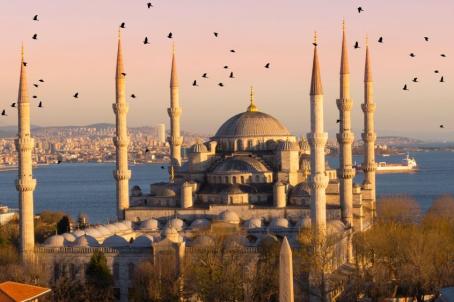
new
For a long time, Europe was ruled by powerful monarchies. Monarchy and religion have been connected since time immemorial. Here are 7 sites across Europe where royalty historically bent the knee to a higher power and received their crown.
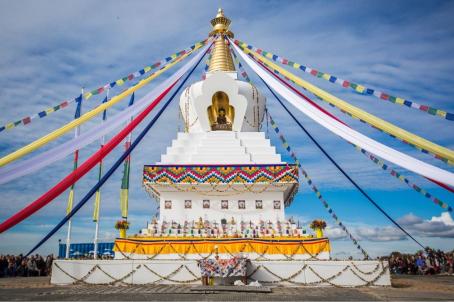
Stupas are symbols of enlightenment and peace that commemorate different stages of Buddha's life. Since the mid-20th century, thousands of stupas have begun to populate Europe. We have compiled some of the most impressive ones in this list.
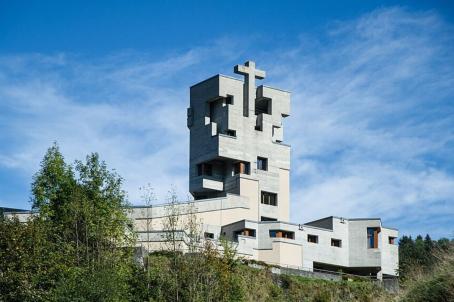
Walter Maria Förderer (1928–2006) was a Swiss architect and sculptor renowned for his neo-expressionist church designs in the 1960s. In this list we have compiled 6 of his church designs that seamlessly integrate religious and secular elements.

How is Religiana helping to conserve and promote Religious Heritage in Europe and why should you get involved?
Find out about Religiana
Are you a tourism organisation or religious heritage sites manager? Discover the advantages of becoming a partner.
See current partners
We can keep you up to date with the latest news from Religiana and religious heritage conservation across Europe.
Sign up to the FRH newsletter