Protestantse Kerk
Noorddijk, NL
This historic church is owned by the Protestant Community of Damsterboord, on the second and fourth Sunday of the month there is a service at 10:00 am. This church is listed as a National Monument of the Netherlands.

Here you can search for a building to visit. You can use the map find destinations, or you can use the filters to search for a building based upon what different criteria.
Noorddijk, NL
This historic church is owned by the Protestant Community of Damsterboord, on the second and fourth Sunday of the month there is a service at 10:00 am. This church is listed as a National Monument of the Netherlands.
Krimpen aan de Lek, NL
Built to replace the predecessor of this church, which was demolished in 1939. There is a whale on the tower of the church. This whale is a reminder of whaling, which was an important source of income for the village in earlier centuries. The bell from 1388 - elsewhere incorrectly mentioned as originating from Krimpen aan den IJssel - was damaged in 1940 and could no longer ring. The municipal authorities wanted to melt down the bell, but historians put a stop to that. The bell ended up in the Gouda museum, the Catharina Gasthuis. It has since been decided that the bell will return to Krimpen. The current bell was made in 1962 by Van Bergen in Heiligerlee.
Halfweg, NL
This architecturally very interesting, special church (architect JA Smits), with a small tower, was called the "Small Church" since the local SOW / PKN process, opposite the Reformed "Large Church" of Tj. Kuipers. In the long term, the PKN Halfweg-Zwanenburg only wanted to maintain this "Small Church", which was being restored and redesigned for this purpose from around the end of 2009 to spring 2011. Delays in the implementation of these plans arose due to the fact that all of this had to be financed from the proceeds of the (eventually to be demolished) Reformed "Large Church". In terms of architecture and layout, this Small Church is somewhat similar to Anglican churches and cathedrals in Great Britain, especially the elongated and straight-ended choir.
Axel, NL
Important historical church with many extensions, especially the extremely interesting neo-style tower.Built as Dutch Reformed Church. Replaced an older church. Renovated in 1923. Since 2001, Samen Op Weg church. The church was restored in 2001. Action was taken to restore the tower dating from 1865.
Eersel, NL
Reformed church, built in 1812, rebuilt in 1861. Simple brick hall church in plan an elongated octagon, closed on three sides on the north and south sides, with a small tower on the roof. In the west wall a memorial stone for the foundation. The church has an oak pulpit with hourglass holder and copper lectern, all 18th century. Oak bell frame, 1813, with bell by anonymous founder, ca. 1812-1830.
Ommelanderwijk, NL
At the end of August 2008, a start was made with the restoration of the 19th century reformed church. The church and tower were given a new roof, walls were repointed, etc. And especially the Roelf Meijer organ from 1874 was restored. This church is listed as a Municipal Monument of the Netherlands.
Sassenheim, NL
On the N. side of the single-nave nave remains of a tuff stone Romanesque church from the 12th century. Renovated in the 15th century, restored in 1956. Romanesque tower of brick, raised at the end of the 15th century, restored in 1957. At the site of the ME choir to the E. of the nave a choir-shaped extension from around 1700. During the restoration in 1971-73 the Romanesque appearance of the nave was reconstructed. Single-manual organ by Hans Goltfuss, originally made for the Gasthuiskerk in Delft in 1657. Reconstructed in 1973 and placed in Sassenheim. Bell frame with chime consisting of a bell by W. Wegewaert, 1592, diam. 126 cm and a modern bell. In the tower portal a bell by A. de Stomme, 1563, diam. 42 cm, has been decommissioned. Mechanical tower clock, B. Eijsbouts, 1906, equipped with electric winding. Above the entrance door of the church is a sundial on a red tile, 28 cm square, slightly obliquely built into the tuff wall.
Steenbergen (NB), NL
Classical building from 1832, consisting of a three-aisled hall church covered by a saddleback roof with a facade divided by Doric half-columns and a pediment with triglyph list, behind which rises the built-in tower, with double Ionic pilasters and crowned by a dome on which an obelisk. Interior: Doric columns with segmental arches, barrel vault in stucco over the central nave, rib vaults over the side aisles. Oak pulpit from the second half of the 18th century, to which is a copper lectern with the crowned initials W. and M. from 1693; carved organ case. Oak bell frame with bell by JP Huaert, 1794, diam. 105 cm. Iron entrance gate between bluestone pillars with vase crowning. Originally a two-manual organ from the second half of the 17th century. In the previous century the Positive was removed. Restored in 1963.
Gasseltenijveen, NL
Reformed church, built in 1858 in the water board style. The facade tower placed above the front building was added in 1879. Next to it is the catechism room GAN-OV13B-59.
Nieuwvliet, NL
NH Church. Modest freestanding hall church, hipped roof and roof turret and ball pirons. On the south side consistory built under a lean-to roof. Bell tower with bell by JA de Grave, 1720, diam. 64 cm.
new
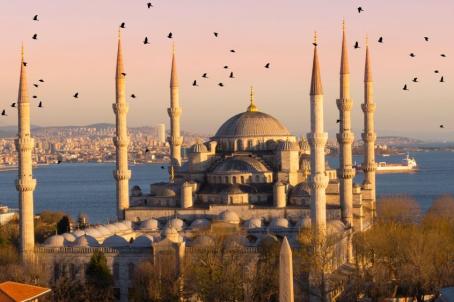
For a long time, Europe was ruled by powerful monarchies. Monarchy and religion have been connected since time immemorial. Here are 7 sites across Europe where royalty historically bent the knee to a higher power and received their crown.
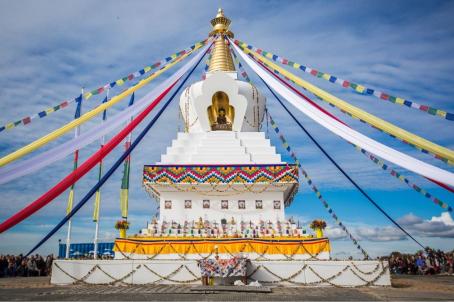
Stupas are symbols of enlightenment and peace that commemorate different stages of Buddha's life. Since the mid-20th century, thousands of stupas have begun to populate Europe. We have compiled some of the most impressive ones in this list.
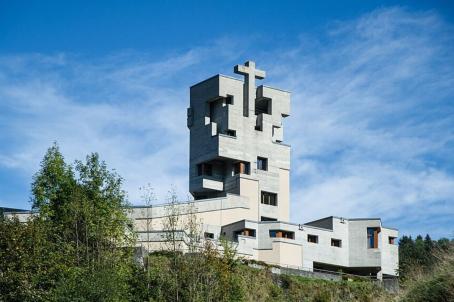
Walter Maria Förderer (1928–2006) was a Swiss architect and sculptor renowned for his neo-expressionist church designs in the 1960s. In this list we have compiled 6 of his church designs that seamlessly integrate religious and secular elements.

How is Religiana helping to conserve and promote Religious Heritage in Europe and why should you get involved?
Find out about Religiana
Are you a tourism organisation or religious heritage sites manager? Discover the advantages of becoming a partner.
See current partners
We can keep you up to date with the latest news from Religiana and religious heritage conservation across Europe.
Sign up to the FRH newsletter