Explore Religious Heritage Across Europe

Here you can search for a building to visit. You can use the map find destinations, or you can use the filters to search for a building based upon what different criteria.

Refine search

Hervormde Kerk

s-Gravendeel, NL

Crucifix church with three-sided closed choir, wide transept and unarticulated tower with perpendicular buttresses. Built in 1905 to a design by J.Th. Beijers to replace a church from 1637/1767 that burned down in 1904. The spire that was destroyed in 1940 was rebuilt in 1951. Pulpit from the construction period. Stained glass windows by Wim Korteweg and JJ van Staveren.
Hervormde Kerk

Drimmelen, NL

Dutch Reformed Church. Founded in 1792 by Jonkvrouw van Doorn, Lady of Drimmelen (commemorated in a stone above the entrance, with coat of arms), to replace the church in Oud-Drimmelen. Hall church, closed on three sides at the short ends; arched windows; high slate roof with roof turret. Internal wooden wall pilasters and wooden barrel vault with two rosettes with mermaids. Adjoining parsonage from the time of construction. Iron entrance gate between two bluestone pillars also from the time of construction. 18th century copper lecterns and baptismal font holder. Restored in 1965.

Hervormde Kerk

Oosterhesselen, NL

The church dates from the second half of the 15th century and was originally connected to the tower. At that time, the building had the tower, a low nave and a high choir. Around 1592, part of the nave was destroyed (siege of Coevorden). The remaining part of the nave was brought to the same height as the choir in 1628 and the west facade was then bricked up. Since then, the church and tower have been separated. Of the Gothic church, only the ruined eastern part and the freestanding tower (ca. 1450 - 1500) remain. The nave is said to have collapsed during the Eighty Years' War - or was the church never finished due to lack of money? When the church was plastered in 1862, the furniture, including two 17th century pews, remained reasonably intact. This church is listed as a National Monument of the Netherlands.

Hervormde Kerk

Sint Annaland, NL

Large church with tower of the Reformed Church of Sint Annaland. Reformed Federation signature.

Hervormde Kerk

Hoevelaken, NL

Tower. Brick building from the 15th or 16th century, modified in the 19th century in neo-Gothic style. Above the tower entrance the year 1873. Bell frame with the sound of two bells, one of which by J. Tolhuis, 1537, diam. 40.3 cm. and a replica of the clock by W. Both and E. van der Arck. Mechanical tower clock J. van de Kerkhof, Aarle-Rixtel, later fitted with electric winding.

Hervormde Kerk

Genderen, NL

Dutch Reformed Church. Of this building, only the tufa substructure of the tower, the interior of which is covered with a dome vault, should be considered a monument; 13th century. Restored in 1953 after the destruction of the church and the tower in 1944.

Hervormde Kerk

Harich, NL

Reformed church and churchyard, consisting of a simple nave from 1663 at a large, partly 12th century tower, made of tuff stone at the bottom, higher up of brick; under the slates the spire also consists of brick. Above the entrance of the church on the south side memorial stone from 1663. In the church pulpit, rear bulkhead and sounding board, baptismal fence; behind the pulpit late 18th century marble tomb for UA Rengers and family. Bell tower with the sound of two bells by P. Overney, 1682 and 1683, diameters respectively: 81 cm. and 96 cm.

Hervormde Kerk

Colijnsplaat, NL

Hall church with tower. Built as a Reformed church. Enlarged 1615, rebuilt 1769.

Hervormde Kerk

Dodewaard, NL

In a study conducted by the National Bureau for Archaeological Heritage Research, it was established that the church was built around 1050. In a deed from 1188, the parish of Dodewaard is mentioned for the first time among the goods of the Count of Dalen. In a letter from 1316, a parish church is mentioned, in which a valuable cross was said to have been located, which already enjoyed a certain fame at the time and was transferred to the collegiate church of St. Walburg in Arnhem because of the "unsafe" in Dodewaard. In this letter from 1316 by Reinald I of Gelre, Dodewaard, which had to give up its relic cross to Arnhem, is called an unsafe and unpopulated place. However, the tendency of this letter justifies doubt about the correctness of this mention. Reinald was looking for a reason to donate the cross to the newly established church in Arnhem, which he had endowed. The church of Dodewaard appears on a list of churches from 1395. In the confirmation of a donation on 16 October 1410, "the parishes of Dodewerde and Hyen" were mentioned. In 1613, the first minister, Hermannus van Broekhutzen, was confirmed "in the church service of Hien and Doyweert".

Hervormde Kerk

Haaften, NL

Very interesting early neo-Gothic village church with tower. The interior of the church has been largely restored to its original state. The pulpit dating from 1834 is striking. (59-08)

Be inspired

Stupkalnis.lt

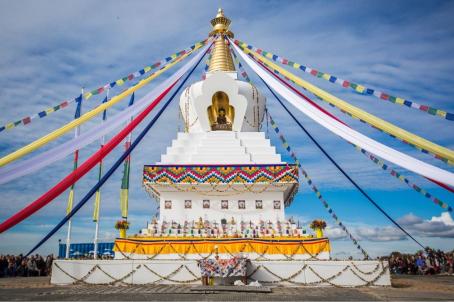
10 Buddhist stupas to discover in Europe

Stupas are symbols of enlightenment and peace that commemorate different stages of Buddha's life. Since the mid-20th century, thousands of stupas have begun to populate Europe. We have compiled some of the most impressive ones in this list.