Explore Religious Heritage Across Europe

Here you can search for a building to visit. You can use the map find destinations, or you can use the filters to search for a building based upon what different criteria.

Refine search

Nieuw Apostolische Kerk

s-Hertogenbosch, NL

Architecturally interesting church without tower. Replaced earlier temporary locations of the local New Apostolic Church. Also in use as "City Changers Church" United Pentecostal and Evangelical Church. This church now uses the former library De Rompert, Rompertcentrum 27, 5233 RG Den Bosch.

Nieuw Apostolische Kerk

Breda, NL

Hall church without tower, built around 1960. In use as a church of the Apostolic Society until 1979.

Nieuw Jeruzalemkerk

Emmeloord, NL

The New Jerusalem Church in Emmeloord was built as a Reformed Church. Willem van Leeuwen delivered an organ in 1955. It was restored by Kaat & Tijhuis in 1982. The Mixture of the Main Work was changed by them from VI-VIII strong to IV strong. The church building has been in use as a PKN church since June 2006. The organ was overhauled in 2008. The Ruispijp IV strong of the pedal was replaced by a Roerquint 5 1/3', probably by the firm Kaat & Tijhuis, who also maintain the organ. A few years later, the Octaaf 2' of the Rugwerk and the Nachthoorn 2' of the Main Work were swapped.

Nieuw Perspectief

Hurdegaryp, NL

Built as a Reformed Church. Later expanded. Hall church with roof turret.

Nieuwe Badkapel

Scheveningen, NL

Built as Dutch Reformed Church, replacing the earlier Badkapel, elsewhere in Scheveningen. Extremely important, monumental church building on the ground plan of a Greek cross, built in 1915-1916 to a design by W.Ch. Kuijper jr. The church has two large towers, placed in the armpits of the main nave and transepts. They are crowned by an octagonal structure with helmet-shaped copper roofs. A small dome-shaped crowning on the crossing. Striking entrance with arcades, the arched theme of which recurs in various places in the building. Very large windows in the gables of the four arms, provided with traceries in natural stone and brick. They contain stained-glass figurative glass. The wooden roofs are provided with decorative painting on the inside. In addition to the organ gallery, the church has deep galleries with ascending pew arrangement in the other three naves. The benches on the galleries date from the construction period, those on the ground floor were replaced later. Many interior components from the construction period were preserved; the baptismal fence and church council benches have disappeared. In 1989, new liturgical furniture was placed around the pulpit, the design of which was adapted to the pulpit.

Nieuwe Kerk

Nieuwe Kerk

Amersfoort, NL

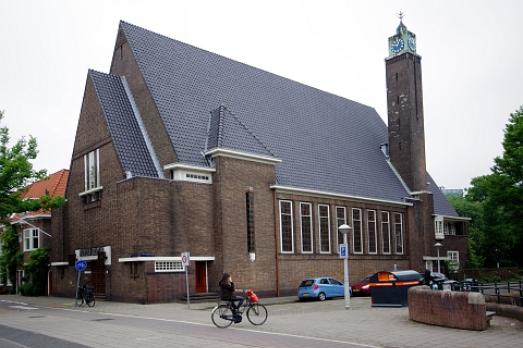
Interesting interbellum church with a tower placed on the side. Built as the Dutch Reformed Church. This church building looks very much like the (still existing) Dutch Reformed New Church in Huizen.

Nieuwe kerk

Haarlem, NL

New Church. Beautiful tower built in 1613 by Lieven de Key against the older St. Anna Church, which was replaced in 1645-1649 by the current one designed by Jacob van Campen, stone with inscription east facade. The church is a sober hall building with a wide rectangular floor plan, wider than its predecessor in little harmony with the tower. Internally divided by four pillars in a Greek cross with wooden barrel vaults and the quadrangular sections of flat ceilings. Beautiful prayer room - poor modern glazing. Freestanding pulpit, square tub from the construction period. Originally a choir organ of the St. Bavo in Haarlem, made in 1523 by J. van Covelen. In 1791 transferred to the New Church by HH Hess. He made a new two-manual instrument using much pipework from the older organ. The Pedal was installed on either side of the organ in 1862 by H. Knipscheer. Restored by Van Vulpen in 1985. Bell frame with clock by Cyprianus Crans, 1749, diam. 98 cm. Mechanical tower clock, 1795.

Be inspired

Stupkalnis.lt

10 Buddhist stupas to discover in Europe

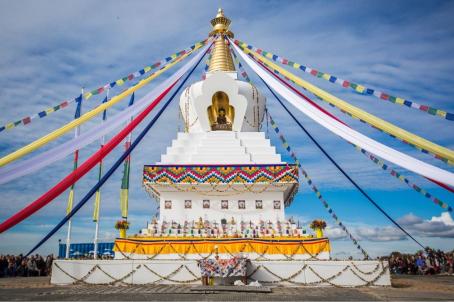
Stupas are symbols of enlightenment and peace that commemorate different stages of Buddha's life. Since the mid-20th century, thousands of stupas have begun to populate Europe. We have compiled some of the most impressive ones in this list.