Onze Lieve Vrouw ten Hemelopneming
Joppe, NL
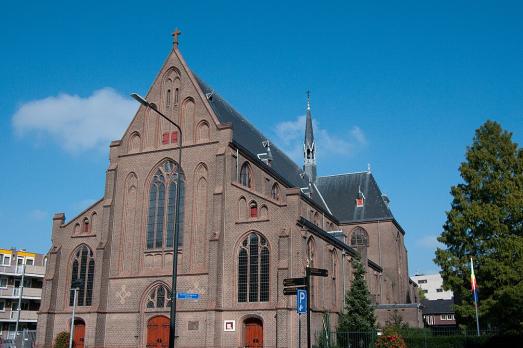
Roman Catholic Church in 't Joppe. Early neo-Gothic church with tower. Restoration 1989.

Here you can search for a building to visit. You can use the map find destinations, or you can use the filters to search for a building based upon what different criteria.
Joppe, NL
Roman Catholic Church in 't Joppe. Early neo-Gothic church with tower. Restoration 1989.
Kerkrade, NL
This modern church replaced, among others, the nearby neo-Romanesque St. Peter's Church, which was demolished due to mine damage.
Beugen, NL
The old church from 1420 remained fairly constant until the renovation / restoration in 1879 by PJH Cuypers. In 1932 enlarged by architect Van de Leur in Nijmegen, by creating a transept. Also side rooms around the chancel from 1420. Damaged by war in 1944 (the tower was blown up). The same architect Van de Leur restored and enlarged the church in 1954: the nave and the tower were restored in the old style, whereby the width of the side aisles of the nave was doubled.
Borculo, NL
Temporary church that was in use during the construction of the current church and was demolished after it was put into use.
Middelharnis, NL
Replaced a clandestine church in Sommelsdijk. Small neoclassical church. Spire from 1912.The organ that JJ Vollebregt ('s-Hertogenbosch) built for this church in 1861 was given a new purpose in 1962 as a choir organ in the Cathedral Church of St. Ignatius and St. Laurentius in Rotterdam. Subsequently, in 1968, after the closure of this cathedral in 1967, this organ was reinstalled in the Kreuzherrenkirche in Düsseldorf.
Philippine, NL
Roman Catholic brick dome church with tower and consistory designed in 1952 by Alphons M. Siebers (1893-1978) and Wilhelm M. van Dael (1912-1985). The architectural firm Van Zantbeek en Schoonis from Sas van Gent was responsible for the execution in the years 1953-1954. The church was built in a traditionalist style according to the principles of the Bossche School. It can be seen as Siebers' built argument in his discussion with JAC Tillema in the Katholiek Bouwblad in 1951-1952 about the values of post-war (Catholic) church construction and the relationship between liturgy and architecture. Important artists made high-quality contributions in the form of stone and sculpture, bronze works and paintings. The church was built as a successor to the church that was partly destroyed on 20 September 1944, whereby the building site was moved slightly to the southwest and a row of houses was demolished for the sake of a better urban and visual connection to the Market. The painted Stations of the Cross from 1938 by the Ghent artist Alberic Ysabie - on which parishioners were also depicted - were taken from the predecessor. The church is known as the Holy Assumption of Mary.
Bedum, NL
The Roman Catholic Church "Maria ten Hemelopneming" was put into use in 1881. Since then, a few more ornaments had to be placed and a number of changes have taken place. In 1883, the Mother of God altar was placed and in 1887, the 14 stations, made by Eugène de Fernelmont from Den Bosch, were installed. In the period 1891-1906, the building was given a tiled floor, the windows of the nave were provided with stained glass windows, a confessional was added and twenty benches, still from the old church, were replaced by new ones. In 1925, the church was given electric lighting and in 1928, foot heating was installed. In 1934/35 a major restoration took place, during which the building was plastered on the inside, a new tiled floor was laid, stained glass windows were installed above the chancel and the Maria and Jozef altar, made by glass artist Joep Nicolas from Roermond and the stations were repainted in the same colour. In 1962 a new pulpit was installed and the Jozef altar was demolished to make room for about forty seats. During the restoration of 1967/68 the stained glass windows were placed in aluminium frames. In 1969 the chancel was raised, the pulpit was converted into two raised lecterns, the communion benches were placed to the left and right of the chancel and a new altar was placed on the chancel. During the demolition of the St. Martinus church in Groningen, the church came into possession of a beautiful confessional from this church. The organ built in 1819 that was transferred from the old church has been replaced by an electronic organ. In 1946, the parishioners donated two new bells from the Van Bergen company in Heiligerlee to the church, after the old ones had been removed in 1943. Despite these changes, the interior has retained sufficient qualities to qualify for protection.
Apeldoorn, NL
Our Lady of the Assumption, consecrated 1885, Alfred Tepe. Three-aisled neo-Gothic cruciform basilica with octagonal crossing tower and external design with motifs derived from Romanesque: lesenes, arched friezes and small round upper windows. The crossing tower and the use of Romanesque motifs make this church an exceptional work in Tepe's oeuvre.
Mariënheem, NL
The church of Onze Lieve Vrouw ten Hemelopneming (Our Lady of the Assumption) was built in 1937. It is a three-aisled pseudo-basilica built in red machine-made brick under a saddle roof covered with grey Romanesque tiles.
Maurik, NL
Church from 1949.
new
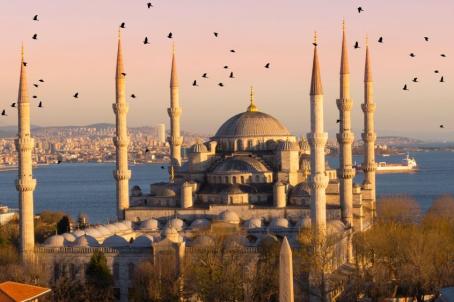
For a long time, Europe was ruled by powerful monarchies. Monarchy and religion have been connected since time immemorial. Here are 7 sites across Europe where royalty historically bent the knee to a higher power and received their crown.
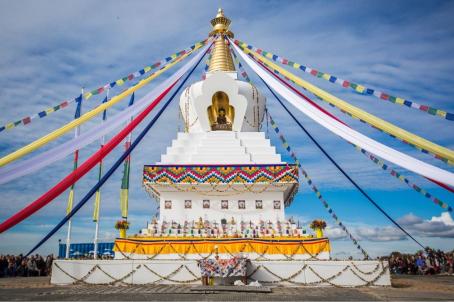
Stupas are symbols of enlightenment and peace that commemorate different stages of Buddha's life. Since the mid-20th century, thousands of stupas have begun to populate Europe. We have compiled some of the most impressive ones in this list.
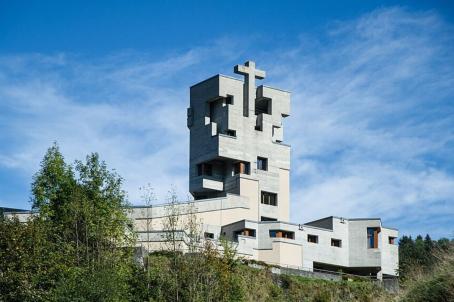
Walter Maria Förderer (1928–2006) was a Swiss architect and sculptor renowned for his neo-expressionist church designs in the 1960s. In this list we have compiled 6 of his church designs that seamlessly integrate religious and secular elements.

How is Religiana helping to conserve and promote Religious Heritage in Europe and why should you get involved?
Find out about Religiana
Are you a tourism organisation or religious heritage sites manager? Discover the advantages of becoming a partner.
See current partners
We can keep you up to date with the latest news from Religiana and religious heritage conservation across Europe.
Sign up to the FRH newsletter