Explore Religious Heritage Across Europe

Here you can search for a building to visit. You can use the map find destinations, or you can use the filters to search for a building based upon what different criteria.

Refine search

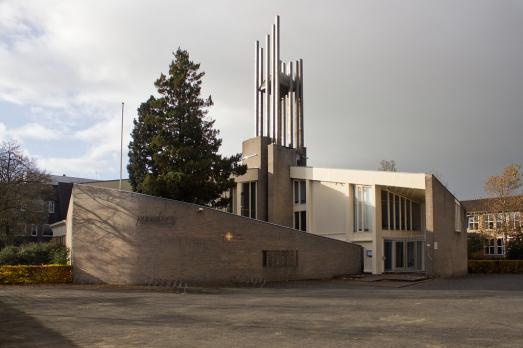
Protestantse Gemeente te Oss, Paaskerk

Protestantse Gemeente te Oss, Paaskerk

Oss, NL

On April 2, 1966, the church building was inaugurated as a new Reformed Church. The church replaced the older church in the centre of Oss, which was demolished after the move. Around 1978 the old church of the Reformed congregation on the Burgemeester Van den Elzenlaan in Oss had become too small and people started using the building of the Reformed congregation. A few years later, in 1980, a second church building was built behind the existing Reformed church building for the Reformed congregation. A few years later, only joint church services were held. In 1989 the Reformed Church and the Reformed Church federated. In addition, the church building was given the name Paaskerk and the annex has since been called Pentecost mound. In the years that followed, a new entrance and entrance hall were built that connected the two buildings. The non-oriented church building is a modern church in the style of post-war modernism. It has an eight-sided ground plan from which a quarter has been cut. In the centre is a tower of metal columns with a belfry. Inside, the building consists of two rooms next to the entrance, with the second room being used for smaller services.
Protestantse Kapel

Megchelen, NL

The Reformed Church , also known as the Protestant Chapel , is a Protestant church in the Dutch town of Megchelen. It was built in the 18th century.

Protestantse Kerk

Hoogkerk, NL

A Romanesque brick house of worship from the early 13th century. The church once had a tower but it was lost to war violence. With old, new facade from the 1960s. Also known as Haghekerke, Hogerkerken, Hoegekerk or Ollekerk.

Protestantse Kerk

Kleverskerke, NL

Around 1200 the first church was founded in Kerkwerve. For the first centuries it was Roman Catholic. Shortly after the siege of Zierikzee around 1576 the Reformation began to break through on Schouwen-Duiveland. The residents of Kerkwerve joined the new doctrine. The damaged church was partly demolished and partly restored and made suitable for the Reformed church service. In the 1980s the exterior of the Dutch Reformed church was restored. Between 1992 and 2004 the interior was restored in phases. Finally the coats of arms of the Lords of Kleverskerke were given a makeover. They are hanging back in their place in the pew. And with this the restoration was completed on 22 October 2004.

Protestantse Kerk

Nieuwpoort, NL

Dutch Reformed Church. Three-aisled PSEUDOBASILIC (16th century) with five-sided closed choir and narrow ambulatory. The three naves and the ambulatory under a high roof. Major renovations in 1774, when, among other things, the tower was demolished and replaced by a new west facade, above which an open dome tower. The church was restored in 1842-1843. Slender columns inside; a wooden barrel vault with tie beams over the tall central nave and half barrel vaults over the side aisles and ambulatory. Good inventory: pulpit in Lod. XVI-like forms (1842); baptismal fence (17th century B) with precentor's lectern (18th century A); beautifully carved lord's pew (1652); three copper crowns (18th century?); grave board (1679); several tombstones (17th-18th century). Bell tower with clock by H. Meurs, 1605, diam. 67.3 cm.

Protestantse Kerk

Dalerpeel, NL

Modern church. Inaugurated on July 4, 1965. Built to replace a Chapel of the Reformed Evangelisation Association Dalerpeel/Nieuwe Krim, from 1920.

Protestantse Kerk

Sijbekarspel, NL

Reformed Church. Single-nave church, of which the tower was demolished before 1515 and the choir in 1815. West gable 19th century B; the east gable contains remains of the demolished choir section on the corners and further consists of masonry from 1815. Internal wooden barrel vault in the keystones letters, a coat of arms and the year 1547. Recently restored. Beautiful pulpit 17th century A; copper baptismal arch 18th century B; three large twelve-arm copper crowns, the largest 1644. Organ with main work and upper work, made in 1883 by L. van Dam and Sons.

Protestantse Kerk

Schermerhorn, NL

Small expressionist church with tower. Built to replace the previous Reformed Church that burned down in 1923. Together with the historic church in Stompetoren, this church building is used for services by the Protestant Community of Schermer.

Protestantse Kerk

Rottum, NL

The building has a two-sided closed hipped roof, covered with a black glazed Frisian corrugated tile, against a straight front facade; under the gutter (not original) a frieze of decorative brickwork in red, yellow and lime sand brick. The rear facade is crowned by an octagonal piron with plume. The two side facades (north and south), which are divided into four by brick lesenes, each have four pointed arch windows with cast iron tracery under a pointed arch of dark brick. The front facade (west) with a climbing frieze of red, yellow and dark brick is flanked on both corners by pilasters with recessed surfaces of lime sand brick and is crowned by a roof turret. The roof turret has a plastered lantern with pointed arch-shaped sound holes and a constricted spire covered with slates; under the roof turret a (non-original) clock face with: anno 1958. In the middle of the front facade a double panel door with a brick stoop (two steps) under a pointed arch of red and yellow brick surrounded by dark stone; in the arch drum filled with red brick a pointed arch-shaped facade stone with the text: built in 1889, churchwardens DB Smedema, OR Clevering, WO Wolthuis. To the left of the door two bricks with the initials WW and OC and to the right of the door two with Ds. E. and DS. On either side of the entrance a pointed arch window with cast iron tracery under a pointed arch of red brick surrounded by a projecting pointed arch of dark stone with blocks; the sills of dark brick also have blocks. Above the entrance a cast iron rose window with a roll layer of red, yellow and lime sandstone.

Protestantse Kerk

Berlicum, NL

Single-nave church with a tower of three sections. The original 13th century tower, the 15th century nave and an organ by WH Kam from 1859 were destroyed in 1944. The 15th century choir was preserved and renovated in 1949 to a design by FJA den Tex and J. Hillebrants, and extended with a new narrower nave. In 1953 provided with a new tower of three sections. In 1986 the liturgical arrangement was changed. During an extension in 1999 the nave was provided with modern bay windows.

Be inspired

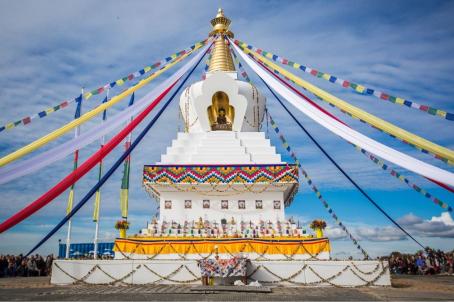
Stupkalnis.lt

10 Buddhist stupas to discover in Europe

Stupas are symbols of enlightenment and peace that commemorate different stages of Buddha's life. Since the mid-20th century, thousands of stupas have begun to populate Europe. We have compiled some of the most impressive ones in this list.