Explore Religious Heritage Across Europe

Here you can search for a building to visit. You can use the map find destinations, or you can use the filters to search for a building based upon what different criteria.

Refine search

Protestantse Kerk

Scherpenzeel, NL

Dutch Reformed Church. Simple hall church from around 1800. Enlarged in 1860 with north arm and tower. In the windows four stained glass windows by Ype Staak, 1788. Single manual organ, made in 1881 by L. van Dam and Sons. Bell tower with clock by J. Noteman, 1638, diam. 66.5 cm. Mechanical tower clock by JV de Vries, Drogeham, 1913.

Protestantse Kerk

Protestantse Kerk

Angeren, NL

Small reconstruction church, built to replace a church destroyed during the war.

Protestantse Kerk

Oisterwijk, NL

The original parish church (Petrus' Banden) of Oisterwijk is returned to the Roman Catholics during the reign of King Lodewijk Napoleon. For an amount of ƒ 7,000, a new church for the Reformed (later Protestant) will be built. Mr. Hubert is given and accepts the assignment to design the drawings of the new church and to draw up the associated specifications, cost estimates, etc. This church is listed as a National Monument of the Netherlands.

Protestantse Kerk

Hoogkarspel, NL

The current Reformed Church of Hoogkarspel had two, probably three predecessors. The first church must have been a small tuff chapel that was later replaced by a late Gothic church dedicated to Laurentius. This church is at least mentioned in a deed from 1514. An engraving by H. Spilman after Cornelis Pronk from 1726 shows a church with a large tower. The building is briefly described in Van der Aa: '... an old building, that still stands well on its foundations and is provided with a tower with a stone spire. In the past, there was a house organ, which was donated to this church by Mr. P. van den Willigen, Councillor in the Vroedschap and Mayor of the city of Enkhuizen, but this was replaced in 1802 by a completely new one, which was paid for from the church fund. There is also a very neat and efficient public cemetery laid out in 1829, and a parsonage built in 1839, which is the most beautiful house between Hoorn and Enkhuizen. In 1859 the church was in such a bad state that "the Chief Engineer of the Water Board" was asked for advice on restoration or new construction. The latter was decided upon. The design for the new church came from D. and L. van der Tas, architects in Schiedam and Sloten. The foundation stone for the second church building was laid on 19 October 1860, and on 4 May 1862 the church was put into use. The very beautiful neo-Gothic church had, judging from old postcards, a matching interior. The building was a polygonal central structure of brick and stucco. Unfortunately, little of the old interior was saved and/or brought to the current church. The new church showed serious structural problems in 1909 due to subsidence due to an inadequate foundation. A major restoration prevented collapse, but only led to a postponement of the need for demolition and new construction. The new church was built in 1966, based on a design by the architects CH Bekink and J. Bijleveld. The church has a freestanding tower. It was built because the old church had become too large. On the north side of the current church, a number of gravestones from the first church can still be found in the pavement. It is not known whether they were removed from the old church and given a new resting place here or whether they were never moved from their place but suddenly ended up outside the church walls when the second and especially the third church became smaller.

Protestantse Kerk

Sint Nicolaasga, NL

The church was originally dedicated to Saint Nicholas. Excavations have shown that there was a church before this church, probably more than one, because in addition to monastery bricks, a tufa stone called âlde Friezen was also found in the churchyard. These stones were used in church construction around 1100. There was a fire in the church in January 1970. An overheated stove in the middle of the church caused the roof to catch fire. This resulted in a large hole in the roof. The damage was then repaired using panelling and carpeting. This disrupted the acoustics in the church. During the extensive renovation of 2006/2007, some things were restored. The church is used by the Protestant Community of Tjerkgaast, Idskenhuizen and Sint Nicolaasga.

Protestantse Kerk

Bladel, NL

2019 - Heritage organization BOEi takes over the Witte Kerkje in Bladel (NB) and the adjacent community center De Dissel from the protestant community of Bladel. They sign a lease agreement for the next five years so that the church activities can be continued in the same way.

Protestantse Kerk

Noordwolde, NL

This church is listed as a National Monument of the Netherlands. Since the Reformation, Noordwolde has been part of the combination Steggerda, Vinkega, Noordwolde and Boijl. The then minister lived in Noordwolde. In 1727, the municipality of Steggerda, Vinkega and got its own minister. In 1860, the municipality of Boijl also became independent. (Source: Information board at the church)

Protestantse Kerk

Oostwold, NL

Beautiful interbellum church in the style of the Groningen variant of the Amsterdam School, with characteristic needle as a tower. Nowadays in the possession of the Protestant Community of Nieuwolda-Oostwold. This church is listed as a National Monument of the Netherlands.

Protestantse Kerk

Schraard, NL

Single-nave, predominantly yellow brick (various sizes), slate-roofed CHURCH BUILDING with semi-circular closed choir and unarticulated saddle roof tower. The 12th-century Romanesque tower was raised in the 13th century during the construction of the Romanesque church. The top of the tower was renewed, possibly in the 18th century. Deep-set round-arched and pointed-arched windows with glazing bars. Access on the south side under a pointed arch. The nave is covered by a wooden barrel vault, possibly from after a fire in 1524. The inventory includes a pulpit from 1633, a baptismal fence and several pews with balls on the corners and cheeks with heads in early Renaissance style (ca. 1560). Furthermore, some tombstones and a funeral board. In the tower a belfry with a bell by W. Wegewaert, 1603, diameter 81 cm.

Protestantse Kerk

Lemele, NL

Around 1860, the committee for the Foundation of a Reformed Church of Lemele and Archem was established. At that time, the inhabitants of Lemele still had to walk about nine kilometres to Ommen to attend church services on Sundays. This proved to be too much of a task for many people. The efforts of the committee paid off. On 21 May 1865, the Koepelkerk was consecrated. This soon proved to be too small and after several renovations, it was decided to build a new church at the end of the 1930s. This was put into use in January 1940.

Be inspired

Stupkalnis.lt

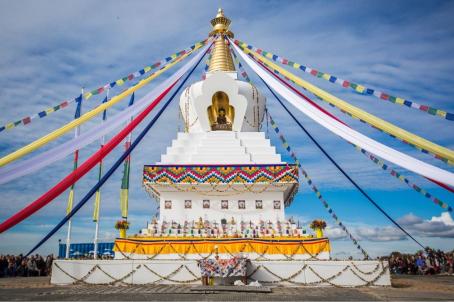
10 Buddhist stupas to discover in Europe

Stupas are symbols of enlightenment and peace that commemorate different stages of Buddha's life. Since the mid-20th century, thousands of stupas have begun to populate Europe. We have compiled some of the most impressive ones in this list.