Explore Religious Heritage Across Europe

Here you can search for a building to visit. You can use the map find destinations, or you can use the filters to search for a building based upon what different criteria.

Refine search

Village church

Heerlen, NL

Simple church without tower. Various renovations. This church was in service until Sunday 15 November 2015. Then the church was closed for worship. The members of Heerlen are included in the municipality of Kerkrade.

Village church

Sellingen, NL

Historic village church with tower from 1858. Excavations during a restoration showed that there was already a wooden predecessor to this current church. The earliest mention of a church in Sellingen dates from 1150 in a list of churches of the Corvey Abbey in the Osnabrück diocese. During the aforementioned restoration, the National Institute for Archaeological Heritage Research uncovered about 20 old graves, two of which date from around 1100. There are probably more graves present, but due to lack of money, not the entire church floor was excavated at the time. A gravestone can still be found in the churchyard. (Source [1]

Village Church

Doornspijk, NL

Neoclassical church with tower. Extensions in 1950 and 1996. Since 2004 also in shared use as a Reformed Reformed Church.

Village church

Oostzaan, NL

Originally Dutch Reformed Evangelisation building, with small roof turret, which later disappeared. In 1886 in use as Reformed Church, and as such out of use in 1984. From 1984 Dutch Reformed Church (NGK). Also in use as Reformed Church (Liberated) (GKV). For a number of years, 4 church services were held in this building every Sunday: morning and afternoon services of both GKV and NGK. This church is listed as a National Monument of the Netherlands.

Village church

Heemskerk, NL

This church was first mentioned in 1063. It is unknown what it looked like. Over the centuries, a church was built of tuff, a grey volcanic stone from the Eifel, on the site of the current one. The tower was built in the 13th century from the so-called monastery bricks, these are large baked bricks that were used to build monasteries. The tower, built in Gothic style, probably originated in the first half of the fifteenth century. This can be deduced from the year 1464 on the bell. Just like the church, the bell was dedicated to Saint Laurentius. The bell had a social warning function. In the event of a storm, fire or other danger, the population was called to help or warned by ringing the bell. During the siege of Alkmaar in 1573, the Spanish demolished everything that was flammable from the church. Only the tower remained intact. In the meantime, the Reformation had taken place. After the departure of the Spanish soldiers, the reconstruction by the Protestants began. It became a hall church without a choir in Gothic style. The church was rebuilt in 1628. A year later the church was completely finished. Since 1798 the tower has been municipal property. In 1970-1971 the tower and the church were restored

Village church

Hendrik-Ido-Ambacht, NL

Original building from 1968. Major renovation and extension in 1999, with turret on roof. Municipality founded in 1953.

Village church

Kinderdijk, NL

The church was designed in 1916 by architect Jan Wils and built in 1923-1924 in Expressionist architectural style with clear influences from FL Wright. Wils was, like JJP Oud and R. van 't Hoff, one of the architects from De Stijl who were particularly inspired by Wright. The stained glass windows were probably designed by T. van Doesburg or a style related to him. The church was built against the Lekdijk on the outer dike side. The high bell tower marks the location of the church in the bend of the dike near the nearby village centre. NB In 1966 the church was partly adapted: the organ was removed, the slope was removed from the floor, the pew plan was changed and the pulpit and communion table were renewed. In 1997 the pointing was renewed (flat).
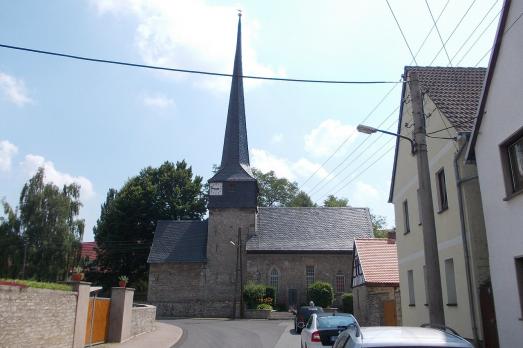

Village Church of Gelmeroda

Village Church of Gelmeroda

Weimar, DE

The village church of Gelmeroda was built from the 13th century. At the beginning of the 13th century, the oldest part of the choir tower church was built. The nave was built in the 14-15th century and rebuilt later. During the GDR era, the church was abandoned. The citizens of the village and the surrounding area became active as members of an association and saved the building from decay. After extensive renovation work, the church was consecrated again in 1991 and in 1994 it became the first church in the new Länder to be granted the status of a motorway church.

Villers Abbey

Villers Abbey

Villers-la-Ville, BE

Villers Abbey was founded in 1146 by Bernard de Clairvaux and was one of the first "daughters" of the Abbey of Clairvaux. After a period of decline from the 14th to the 17th century, the abbey experienced a second golden age in the 18th century when some of its buildings were refurbished in the neoclassical style (facades of the church and the convent building). Sacked by the French Revolution and then confiscated by it as national property, its monks were then expelled and its estate sold in lots.

Villingen Cathedral

Villingen Cathedral

Villingen-Schwenningen, DE

Villingen Cathedral was begun in 1130 in the Romanesque style and completed in 1284 in the Gothic style, but it was later enlarged due to the fire of the town of Villingen in 1271, which had destroyed part of the cathedral. Two 50-metre high towers were added in the 15th and 16th centuries.

Be inspired

Stupkalnis.lt

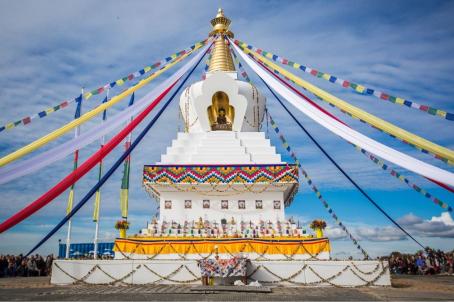
10 Buddhist stupas to discover in Europe

Stupas are symbols of enlightenment and peace that commemorate different stages of Buddha's life. Since the mid-20th century, thousands of stupas have begun to populate Europe. We have compiled some of the most impressive ones in this list.