Explore Religious Heritage Across Europe

Here you can search for a building to visit. You can use the map find destinations, or you can use the filters to search for a building based upon what different criteria.

Refine search

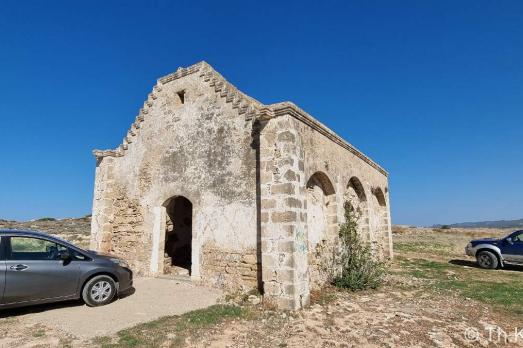
Davlos Agios Sozomenos Chapel

Davlos Agios Sozomenos Chapel

Davlos, CY

The Agios Sozomenos chapel is located northeast of the village, directly on the sea. The building dates from the Middle Ages. The current condition must be considered as poor. There are many signs of decay. In the interior, large areas of the plaster are crumbling and there are damaged stones and holes in the masonry.
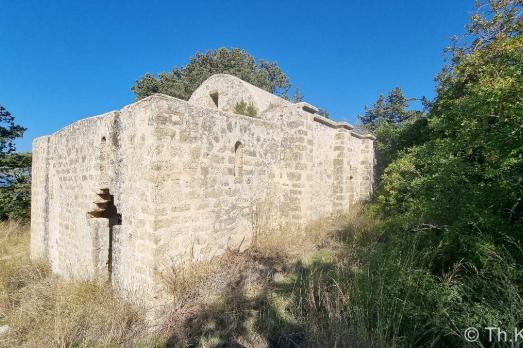
Davlos Holy Monastery of Saint Nicolaos

Davlos Holy Monastery of Saint Nicolaos

Davlos, CY

The Holy Monastery of Saint Nicolas is located about 2 km northeast of Davlos on a mountainside. According to Kassinis, the complex was built in the 15th-16th century and restored in 1777. Today, the complex is still in a fair state of repair. Both the exterior and interior of the building appear to be structurally sound. However, none of the original furnishings of an Orthodox church remain.

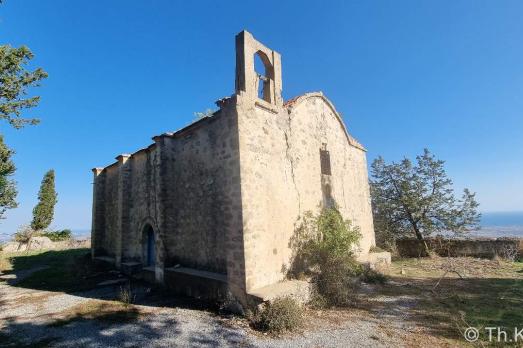
Davlos Panagia Kantariotissa Church

Davlos Panagia Kantariotissa Church

Davlos, CY

The Panagia Kantariotissa Church is located near the Kantara Forest Station Square. According to Kassinis, this church was built in the Ottoman period and was renovated in 1771. The current condition can be described as fair to poor. In the west wall with the small bell tower on top, larger cracks can be seen to the left and right of the door, which are also reflected on the inner wall. The plaster in the interior is crumbling in some places and numerous cracks can be seen. The interior has also been converted into a warehouse and workshop.

Dax Cathedral

Dax, FR

At the end of the 13th century, in the midst of a period of prosperity, the Bishopric had a series of ecclesiastical buildings built, including a new cathedral built on an old Romanesque sanctuary that had become too small. This building collapsed in 1646, and the construction of the current building was built from 1656 to 1719 on Vauban's plans, and was not completely completed until 1894. Of the 13th century building, only the old gate rebuilt in the north arm remains. This portal is called the Apostles' portal.

De Achthoek

Scherpenzeel, NL

Built as a Reformed Church, on the site of the old mill. Interesting reconstruction church in octagonal shape. Expansion in 1989. Federated in 1991, and merged in 2007 with the Reformed Church "De Hoeksteen" to form the Protestant Church.

De Acker

Pijnacker, NL

Modern church centre, without a tower, in the north of Pijnacker.

De Akker

Ede, NL

Built as a Reformed Church.

De Akker

Gees, NL

The GKV was built in 1945. An extension followed in 1981 and in 1998 the church got a new extension. The church is big enough for its own 180 members, but especially for the holidaymakers the church is much too small in the summer months. In 2007 the church was expanded considerably. After that expansion the church also got a name: De Akker. The church was officially put back into use on 31 May 2008. (56-06/59-08/60-08/61-09) Built as Reformed Church (Liberated), after merger in 2023 Dutch Reformed Church.

De Amshoff

De Amshoff

Kiel-Windeweer, NL

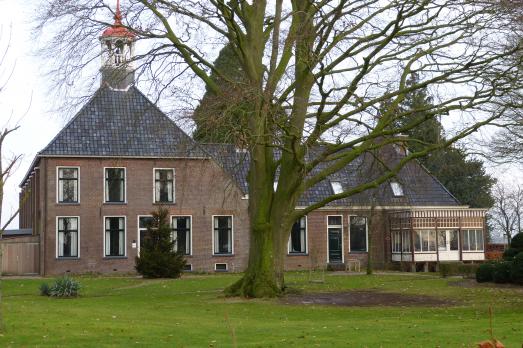
A beautiful, secluded building, this is a colonial church from the 19th century with an octagonal roof turret. The arms of the city can be found in the wind vane on turret. In 1754, the 800 inhabitants of the town of Windeweer applied to the municipality of Groningen for a private church with a pastor. Their request was granted almost immediately and in 1755 the city of Groningen build this peat colonial church with a presbytery.

De Antenne

Dedemsvaart, NL

When the Reformed Church in Dedemsvaart felt compelled to build a new church in 1995, the architect GERRITSMA from Assen was asked to incorporate two facets. On the one hand, the building had to become the home - as the centre of church life - for the congregation. On the other hand, it had to be clearly recognisable as a church that is aware of its place in society - albeit not dominant, but modest. After extensive discussions, it was decided to create a space with a light character, but also with the privacy of round walls that envelop the congregation. Small openings provide a window on the world. The indirect daylight and the circular lines in the walls strengthen the feeling of intimacy and solidarity. At one point, the enveloping wall breaks open and only the structural frame remains, the facade gives way to make room for the light that falls from above.

Be inspired

Stupkalnis.lt

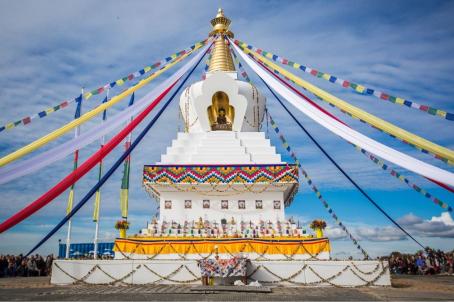
10 Buddhist stupas to discover in Europe

Stupas are symbols of enlightenment and peace that commemorate different stages of Buddha's life. Since the mid-20th century, thousands of stupas have begun to populate Europe. We have compiled some of the most impressive ones in this list.