Heilige Lambertus
Huisseling, NL
Neo-Gothic church with tower.

Here you can search for a building to visit. You can use the map find destinations, or you can use the filters to search for a building based upon what different criteria.
Huisseling, NL
Neo-Gothic church with tower.
Haren (NB), NL
St. Lambertus, 1867-1868, HJ van Tulder. Three-aisled neo-Gothic basilica with west tower. First church of Van Tulder with stone cross-ribbed vaults. Three 18th century wooden statues of saints, corpus ca. 1500; gravestone 1706. In the tower a hatch clock, 1654. In the churchyard a stone cross, 1633. Organ with main work and secondary work, made in 1875 by the Gebr. Gradussen. Oak bell frame with clock by J. Michelin, 1645, diam. 89.5 cm. Mechanical tower clock, B. Eijsbouts, 1943, electric winding.
Empel, NL
The Sint Landelinus Church in Empel was built in 1948–1949 to a design by the Tilburg architect NH Pontzen (1919–1979) in reconstruction style. The church is located in the centre of Empel, the village rebuilt after the Second World War that is located slightly further from the Maas than the original ribbon village of Empel along the Maas. The Sint Landelinus Church and an associated rectory were built to replace the neo-Gothic Landelinus Church in Oud Empel, which was destroyed in November 1944. The Sint Landelinus Church and rectory have a traditionalist design influenced by the Bossche School. The church is designed according to the pseudo-basic type with a high square crossing tower and adjacent side chapels. Christocentric: the altar is located centrally in the crossing, which is externally crowned by a heavy tower. Behind this is a shallow five-sided apse extension. In 1996, an extension was added to the sacristy. The church has, in accordance with the basilica spatial division, a central nave with side aisles. The central nave is very wide and has benches on either side. The side aisles function as walkways and procession corridors. The central nave reaches to the triumphal arch wall that marks the connection to the high choir located under the crossing tower. At the end of the side aisles, on either side of the choir, are chapels. The church contains, among other things: Stations of the Cross by E. Deckers; a cross by Albert Termote; a statue of Antonius Abt by Frans van der Burgt and a triptych by L. Wiegman, which depicts the so-called Miracle of Empel (1585).
Breda, NL
Very monumental neo-Gothic church with heavy crossing tower, which is 60 m high. Interior (too) heavily simplified in the 1960s.
Oud Gastel, NL
Brick tower from the middle of the 15th century, restored in the upper section (1696) after a fire (1671), during which the spire was added; restored in 1865 and in 1952-1959. Four sections with diagonal buttresses; the wall surfaces decorated with profiled niches, natural stone blocks used everywhere. Partly 17th century, partly modern bell storey on which octagonal spire covered with slates. Against the south wall polygonal staircase tower. Mechanical tower clock Petrus Megan i Brussells Fecit 1704, has been decommissioned. This church is listed as a National Monument of the Netherlands.
Hoogkarspel, NL
Large church with interesting expressionist details. Facade to the north, choir to the south. Wide central nave and very narrow side aisles, with straight-ended (higher) choir section, flanked by two rectangular towers with small crowns.
Kekerdom, NL
Roman Catholic Church. The Roman Catholic Church of St. Laurentius is a single-nave building from the 14th century, vaulted by cross-ribbed vaults, the capitals of which rest on short scutcheons. The church and the sacristy, also built against the south side and also dating from the 14th century, were raised with an arched frieze in 1835-'40, after which a neo-Gothic tower was built in 1872 on the site of a previous one from 1837. According to the Provisional List, the choir was built in 1872 with old stone in the Gothic style. The church has a pulpit, two copper chandeliers, 17th century, and a Gothic copper candlestick. On an organ gallery from the first quarter of the 19th century, an organ with main work and lower positive, made in 1865 by FC Smits. Restored in 1982 by the Vermeulen company. Mechanical tower clock Addicks?, Amsterdam, 1922, later fitted with electric winding.
Roermond, NL
Replaced a church destroyed by war.
Bemelen, NL
The church of St. Laurentius was donated by Prince-Bishop Balderic II of Liège (1007-1018), together with the tithes of Bemelen, to the chapter of Our Lady in Maastricht. This donation was confirmed by Pope Adrian IV in 1157. It was the mother church of the St. Martinus parish in Wijck-Maastricht. Parts of the east wall of the marlstone, unarticulated tower date back to the 12th century, the rest dates from around 1350. The current spire dates from around 1760. The former church was replaced in 1845 by a neoclassical church, probably designed by Mathias Soiron. The church was restored in 1976. Mathias Soiron died in the year the church was built and is buried against the church wall, to the right of the entrance. {Source: [1] }
Oudorp, NL
Three-aisled pseudo-basilica with a half-built-in front tower, a nave of eight bays under a slate-covered saddle roof, and a shallow choir with three-sided closure. The outer wall is built of red-yellow machine-made brick Waal format in cross bond with cut joint. The wall has a surrounding plinth with a bluestone top edge, and a cordon list of red profiled stone below the windows. The buttresses are covered with bluestone at the top and at the height of the cuts. The pointed arches above the windows, blinds and niches have a limestone keystone. The tower in the middle of the front facade (W), built on a square plan, is made up of three segments - the middle segment is higher than the lower and upper ones - and provided with a high, constricted eight-sided spire with a slate covering and on top a wrought-iron cross with a gilded rooster. The tower has right-angled buttresses on the corners up to the top with two cuts at the level of the segment transitions. A Gothic portal has been placed against the front of the lower section, the steep gable of which is crowned by a bluestone finial. The recessed front door is designed as a double door of clamped beading and provided with wrought iron decorative fittings. A slender limestone column with a bluestone base and a leaf capital of softer stone stands against the reveals of the portal. The fanlight above the bluestone lintel of the door is designed as a pointed arch window with green stained glass and limestone tracery. Three pointed arch niches have been placed at the top of the gable of the portal. The lower section is separated from the middle section by projecting decorative brickwork in which two mouse teeth have been set. In the middle segment, three high pointed arch windows have been placed, above which is a rose window within a pointed arch recess. These three windows and the limestone rose window have stained glass windows. Above the rose window, as in the side walls of the tower, there are three small pointed arch niches, above which is a projecting double mouse dent and decorative brickwork in the form of diagonal diamonds consisting of bricked-out roll courses with limestone blocks at the intersections. The upper tower section has a pointed arch-shaped recessed field on all four sides with a clock face at the top and two coupled sound holes with a pointed arch shape below it. Below the profiled hardstone upper edge of the tower is projecting brickwork in the form of two double mouse dents. The front facade, covered by a donkey's back, has a buttress with a cutting to the left and right of the tower, and at the corners perpendicular buttresses with two cuttings on which an octagonal brickwork crowning with an eight-sided tent roof of hardstone. In line with the side aisles, a pointed arch window with limestone tracery and stained glass has been placed on the left and right of the front facade.Above these windows the front facade has a band of projecting brickwork (including three mouse teeth). Above this, on the outside of the two buttresses to the left and right of the tower, there is a hatch above which is a bluestone lintel and a pointed arch niche. At the same height, on either side of the tower, there is a narrow pointed arch window. Below the left window, there is another narrow arched window lower down. The side facades are divided into eight bays by buttresses with one cut. Two pointed arch windows are fitted in each bay. On the side of the front facade, there is another half bay without a window opening. Above the side facades, there is a gutter molding on a projecting double mouse tooth, below which is a sawtooth-shaped roll layer with limestone at the corners. Against the sixth whole bay from the front facade, both side facades are provided with a rectangular confessional extension containing two small pointed arch windows. These extensions have a slate-covered lean-to roof under which a grey-painted natural stone gutter on a double mouse tooth. The large saddle roof has five dormers above both side walls: one on the left, right and in the middle, and in between two smaller ones at the top. The dormers have slate-covered sides and a similar saddle roof with an overhang and bargeboards in a pointed arch shape. The lower ones have a hatch with three lancet windows, the upper one a pointed arch-shaped hatch with a round window. The choir has a five-sided slate-covered roof that adjoins the eastern gable of the nave, crowned by a hardstone cross and covered with a donkey's back. This facade has a band of decorative brickwork as in the front facade, above which also on the left and right a hatch with a hardstone lintel and pointed arch niche, and on the corners perpendicular buttresses with one cut. On the chord roof there is a dormer window in the middle behind like the one at the bottom of the side slopes of the main roof. The choir is articulated by buttresses with two cuts. In the three bays of the choir closure a high pointed arch window is placed with stained glass.Against the sixth whole bay from the front facade, both side facades are provided with a rectangular confessional extension with two small pointed arch windows. These extensions have a slate-covered lean-to roof under which a grey-painted natural stone gutter on a double mouse tooth. The large saddle roof has five dormers above both side facades: one on the left, right and in the middle, and in between two smaller ones at the top. The dormers have slate-covered sides and a similar saddle roof with an overhang and bargeboards in the shape of a pointed arch. The lower ones have a hatch with three lancet windows, the upper one with a pointed arch-shaped hatch with a round window. The choir has a five-sided slate-covered roof that connects to the eastern gable of the nave, crowned by a hardstone cross and covered with a donkey's back. This facade has a band of decorative brickwork as in the front facade, above which also on the left and right a hatch with hardstone lintel and pointed arch niche, and on the corners right-angled buttresses with one cut. On the choir roof, in the middle behind, there is a dormer window like the one at the bottom of the side slopes of the main roof. The choir is divided by buttresses with two cut-outs. In the three bays of the choir closure, a high pointed arch window with stained glass has been placed.Against the sixth whole bay from the front facade, both side facades are provided with a rectangular confessional extension with two small pointed arch windows. These extensions have a slate-covered lean-to roof under which a grey-painted natural stone gutter on a double mouse tooth. The large saddle roof has five dormers above both side facades: one on the left, right and in the middle, and in between two smaller ones at the top. The dormers have slate-covered sides and a similar saddle roof with an overhang and bargeboards in the shape of a pointed arch. The lower ones have a hatch with three lancet windows, the upper one with a pointed arch-shaped hatch with a round window. The choir has a five-sided slate-covered roof that connects to the eastern gable of the nave, crowned by a hardstone cross and covered with a donkey's back. This facade has a band of decorative brickwork as in the front facade, above which also on the left and right a hatch with hardstone lintel and pointed arch niche, and on the corners right-angled buttresses with one cut. On the choir roof, in the middle behind, there is a dormer window like the one at the bottom of the side slopes of the main roof. The choir is divided by buttresses with two cut-outs. In the three bays of the choir closure, a high pointed arch window with stained glass has been placed.

new
For a long time, Europe was ruled by powerful monarchies. Monarchy and religion have been connected since time immemorial. Here are 7 sites across Europe where royalty historically bent the knee to a higher power and received their crown.
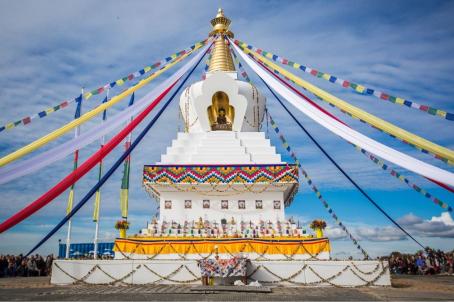
Stupas are symbols of enlightenment and peace that commemorate different stages of Buddha's life. Since the mid-20th century, thousands of stupas have begun to populate Europe. We have compiled some of the most impressive ones in this list.
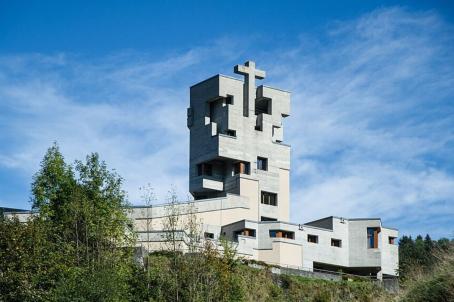
Walter Maria Förderer (1928–2006) was a Swiss architect and sculptor renowned for his neo-expressionist church designs in the 1960s. In this list we have compiled 6 of his church designs that seamlessly integrate religious and secular elements.

How is Religiana helping to conserve and promote Religious Heritage in Europe and why should you get involved?
Find out about Religiana
Are you a tourism organisation or religious heritage sites manager? Discover the advantages of becoming a partner.
See current partners
We can keep you up to date with the latest news from Religiana and religious heritage conservation across Europe.
Sign up to the FRH newsletter