Explore Religious Heritage Across Europe

Here you can search for a building to visit. You can use the map find destinations, or you can use the filters to search for a building based upon what different criteria.

Refine search

Reformed church

Lexmond, NL

Dutch Reformed cruciform church, Gothic building with tower from the first half of the 14th century and nave and choir from the second half of the 14th century. The interior contains a Strumpfler organ from the 18th century. The church also contains the coat of arms of the shooting guild and a funeral board of the Lords of Brederode. The church contains gravestones from the 17th and 18th centuries.
Reformed church

s-Graveland, NL

Reformed Church, sober, stately house of worship, basic shape a similar cross 1657-1658 after a design by Daniel Stalpert. Organ with main work and lower positive, made in 1824 by J. and JMW Batz. Bell tower with clock by François and Pieter Hemony, 1655, diam. 70.5 cm. Mechanical tower clockwork, circa 1920.

Reformed church

Giessen-Oudekerk, NL

The church is a Gothic building of brick on a tuff base. The single-nave nave dates from the end of the fifteenth century or the beginning of the sixteenth century with a heavy, brick west tower. The wooden barrel vault was restored in 1657, according to the inscription on one of the tie beams. In 1838 the choir was demolished and the consistory was built in its place. During a restoration in 1952-1953 the floor was renewed and the window tracery in the windows changed. On this occasion the pulpit was moved. The ceiling was replaced in 1995.

Reformed church

Rotterdam, NL

Built as a Reformed Church (Liberated) in the IJsselmonde district. Now in use (since when?) by Jehovah's Witnesses. Between 2014 and 2019, the Jehovah's Witnesses left this building. Today, the building is used as a mosque.

Reformed church

Heesbeen, NL

Single-nave, straight-closed church with round-arched windows, 18th century, with remains of a medieval church in tufa stone in the western half; flat tower from the 14th century in brick. Oak pulpit and pew from the 18th century; funeral board from 1764 for Sophia Amalia Maria van Gent, lady of Heesbeen sculpted gravestone for Willem Torck, lord of Heesbeen (died 1557) and his wife Bartha Pieck. The front of an organ by C. van Oeckelen from 1823. The instrument is no longer present. Around the churchyard a brick wall with a gatehouse on the north side, with a saddle roof between gables. Bell frame with chime consisting of a bell by J. van Haer, 1393, diam. 90 cm. and a bell by an anonymous founder, 1393, diam. 85 cm.

Reformed church

Ochten, NL

From the end of 1932 until its establishment as an independent municipality in 1946, Ochten was a department of Opheusden. In 1956, the municipality, previously also called the 'Keukenskerk', together with the mother municipality of Opheusden, left the association of Reformed congregations to join the 'withdrawn' Reformed Church in the Netherlands .

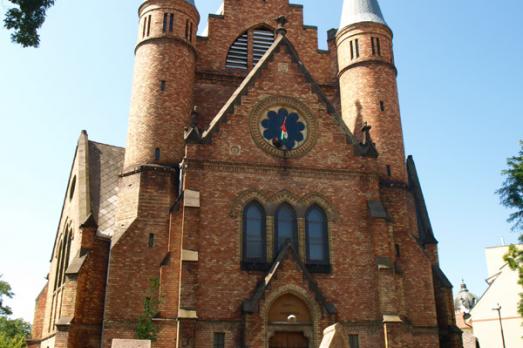
Reformed Church, Szolnok

Reformed Church, Szolnok

Szolnok, HU

The reformed church was built in 1893-1894 and designed by the architect Sztehlo Otto in the neo-gothic style. It is the first Reformed church in the town.

Reformed church

Hardinxveld-Giessendam, NL

Simple hall church without a tower.

Reformed church

Langerak (ZH), NL

Brick Gothic village church with three-sided closed choir without buttresses (possibly 14th century), wide, single-nave nave with lower transept arms (16th century). The church is covered by wooden barrel vaults and was restored in 1912; the tower was restored in 1953. Inventory: pulpit (18th century); choir screen and baptismal screen (17th century); four copper chandeliers (18th century); two tombstones (17th century).

Reformed Church, Avas

Reformed Church, Avas

Miskolc, HU

The Gothic Reformed Church of Avas is the oldest building in the centre of Miskolc. The construction of the church began in the 13th century in the Romanesque style. In 1544 the Turks set fire to the church, which was rebuilt from 1563 to 1569 and made Protestant. The Baroque mortuary in the south was built in 1760 and the neo-Gothic in the north in 1896.

Be inspired

Stupkalnis.lt

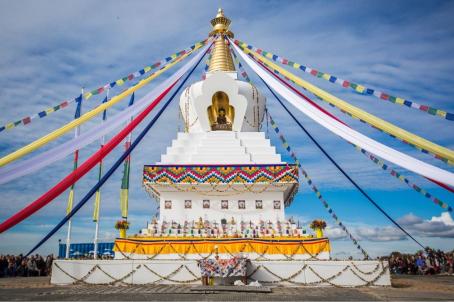
10 Buddhist stupas to discover in Europe

Stupas are symbols of enlightenment and peace that commemorate different stages of Buddha's life. Since the mid-20th century, thousands of stupas have begun to populate Europe. We have compiled some of the most impressive ones in this list.