Explore Religious Heritage Across Europe

Here you can search for a building to visit. You can use the map find destinations, or you can use the filters to search for a building based upon what different criteria.

Refine search

Doopsgezinde Kerk

Steenwijk, NL

Simple, early 19th century Mennonite Meeting House (date stone 28 June 1828), on a rectangular plan. The building, which shows Gothic elements on the front facade, is constructed of brick; only the front facade is provided with a block-shaped plastering. The wide pointed gable is terminated on both sides by corner pilasters with profiling. In the facade plane two blind niches with trefoil motif and wide round-arched windows with wooden tracery, the latter type of window also used in the side facades. Protruding plastered entrance portal with corner pilasters with sunken fields and crownings; the entrance is set within an arch with trefoil motif. Simple profiled gutter; bar anchors. Furthermore, two stones with inscription, respectively: THE EARTH STONE LAID BY CHOVENSGREVE 28 JUNIJ 1828 and: IMMANUEL Ao 1630. Internally some 19th century furniture consisting of benches, pulpit and small organ on gallery. The site is bordered by a simple iron fence crowned with even profiled points and French lilies.

Doopsgezinde Kerk

Broek op Langedijk, NL

Hall church from 1858. Renovation, including new facade, in 1968.

Doopsgezinde Kerk

Monnickendam, NL

Mennonite Meeting House. Timber frame construction, 17th century, with brick side walls and a brick gable with interlacing at the rear with round arched windows, 17th century. Neoclassical facade with pediment, 19th century. Pulpit, benches, wooden lectern and copper candlestick. 17th century. Organ 19th century. Copper lectern, 18th century. This church is listed as a National Monument of the Netherlands.

Doopsgezinde Kerk

De Knipe, NL

Bovenknijpe. The current church building was built on the site of a church building from 1751. The church was built as a meeting house. In 1856 the front facade was completely renovated. The original interior with pews and chairs is still present in the church

Doopsgezinde Kerk

Bolsward, NL

The Bolsward clandestine church is located behind the building line of the buildings in the street. Built in 1809 and expanded and embellished from 1848 to 1855. Framed entrance (all mid-19th century). With a roof turret.

Doopsgezinde Kerk

Dordrecht, NL

Rather inconspicuous, but architecturally interesting, modern church without a tower.

Doopsgezinde Kerk

Schagen, NL

Built as a Reformed Church. As such out of use around 1974, when a new Reformed Church was put into use elsewhere in Schagen.

Doopsgezinde Kerk

Hallum, NL

Straight-ended hall church with extended entrance portal, built in 1912. Round-arched windows with coloured stained glass in rectangular patterns, furniture from the construction period, made of unpainted pine, still present in its entirety. Single-manual organ by Bakker & Timmenga (Leeuwarden) from 1906.

Doopsgezinde Kerk

Damwâld, NL

The foundation stone for the Mennonite meeting house was laid on 29 April 1767 by two-year-old Wyger Martens. Renovations took place in 1858 and 1910. In 1974-1975, another renovation took place, during which the pews were replaced by chairs and the pulpit was replaced by a smaller and heavier one. The interior was renovated in 2008. The colour blue now predominates. There is a wooden floor and the organ has been painted completely white. The re-opening took place on 20 September 2008. (61-09)

Be inspired

Stupkalnis.lt

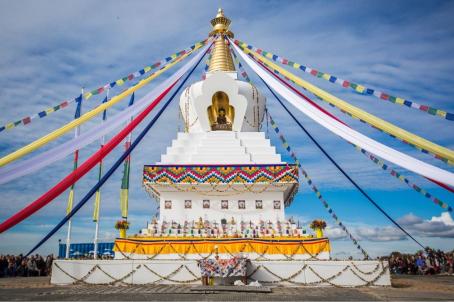
10 Buddhist stupas to discover in Europe

Stupas are symbols of enlightenment and peace that commemorate different stages of Buddha's life. Since the mid-20th century, thousands of stupas have begun to populate Europe. We have compiled some of the most impressive ones in this list.