Explore Religious Heritage Across Europe

Here you can search for a building to visit. You can use the map find destinations, or you can use the filters to search for a building based upon what different criteria.

Refine search

Protestantse Kerk

Gasseltenijveen, NL

Reformed church, built in 1858 in the water board style. The facade tower placed above the front building was added in 1879. Next to it is the catechism room GAN-OV13B-59.

Protestantse Kerk

Onderdendam, NL

This church is listed as a National Monument of the Netherlands.

Protestantse Kerk

Hedel, NL

The Reformed Church in Hedel was built around 1640 in a semi-Gothic transitional style on the foundations of the transept and choir of a larger cruciform church.

Protestantse Kerk

Kûbaard, NL

The church was restored between early 2000 and spring 2007. The restoration plan was drawn up by the architectural firm Jelle de Jong in Lemmer. That does not mean that there were no churchgoers in the church for seven years. First, the tower was restored. Then the exterior and interior of the church followed. And church services continued as much as possible. 18 gravestones were removed from under the floor. Two of these were very old. The squat (gallery) has disappeared. It was needed at the time when a liberal minister came to Wommels and many churchgoers from Wommels came to Kubaard. After an open house on 21 April 2007, the restored church was officially put back into use. (53-05/58-07)

Protestantse Kerk

Sijbekarspel, NL

Reformed Church. Single-nave church, of which the tower was demolished before 1515 and the choir in 1815. West gable 19th century B; the east gable contains remains of the demolished choir section on the corners and further consists of masonry from 1815. Internal wooden barrel vault in the keystones letters, a coat of arms and the year 1547. Recently restored. Beautiful pulpit 17th century A; copper baptismal arch 18th century B; three large twelve-arm copper crowns, the largest 1644. Organ with main work and upper work, made in 1883 by L. van Dam and Sons.

Protestantse Kerk

Schettens, NL

Dutch Reformed Church, because of a burial vault a large tombstone by Mr. BG 1544. Two tombstones by P. Claes and one by Jacob Douwes 1639. Two-manual organ made in 1891 by Gebr. van Oeckelen. Mechanical tower clock.

Protestantse Kerk

Ilpendam, NL

In 1408 a chapel dedicated to St. Sebastian was already mentioned. In 1449 the church was enlarged. In 1544 Ilpendam had a parish church. As a result of the Eighty Years' War the church was largely destroyed. Remains from the old church are the roguish statues in the choir closure. During the Reformation the church was transferred to the Dutch Reformed Church. A definitive reconstruction took place in 1656. The church then got its current form. In the years 1723, 1850, 1922, 1946 and 1984 the church was restored. The last major maintenance took place in 2004/2005.

Protestantse Kerk

Gauw, NL

Simple church building with a heavy tower from the 13th century, during a major renovation of the church, bricked up with clinkers. The church has a 17th century pulpit. Oak pulpit from the 17th century. Single manual organ, made in 1861 by W. Hardorff. Mechanical tower clock G. de Looze, Leeuwarden, 1894. Churchyard.

Protestantse Kerk

Pijnacker, NL

Dutch Reformed Church. From the late Gothic village church, the following were preserved during the construction of the neo-Gothic church in 1892: the foundations on which the new church was built, and the columns with capitals, provided with some curly cabbage leaf wreaths, as well as the arches of the nave. Two-manual organ, made in 1830 by H. Knipscheer. Bell frame with bell by G. van Hyntym from 1434, diam. 118 cm.

Protestantse Kerk

Ressen, NL

A small Romanesque church, largely made of tuff. The tower is 12th century, the nave perhaps even older. Both are decorated with arched friezes. The Gothic choir is 15th century.

Be inspired

Stupkalnis.lt

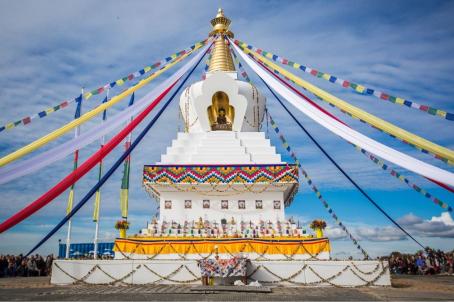
10 Buddhist stupas to discover in Europe

Stupas are symbols of enlightenment and peace that commemorate different stages of Buddha's life. Since the mid-20th century, thousands of stupas have begun to populate Europe. We have compiled some of the most impressive ones in this list.