Explore Religious Heritage Across Europe

Here you can search for a building to visit. You can use the map find destinations, or you can use the filters to search for a building based upon what different criteria.

Refine search

Protestantse Kerk

s-Hertogenbosch (Engelen), NL

Dutch Reformed Church. Consisting of the choir of the late 15th century Lambertus Church, destroyed in 1587. Closed on three sides, provided with buttresses, pointed arch windows, slate saddle roof with roof turret, in which bell from 1668 by P. Hemony. The church restored in 1963. Double copper eight-light crown, cast by Borghart in Den Bosch in 1794; tombstone from 1561 for "frater Thomas de Berhey". Bell frame with bell by Pieter Hemony, 1668, diam. 56.5 cm.
Protestantse Kerk

Maarsbergen, NL

Reformed church in Maarsbergen, built in 1883-1884 by order of Geertruida Adriana du Bois, widow of CJ Blok. The church is said to have been built in response to the wishes of her brother, Aalt du Bois. The Du Bois family lived in Maarsbergen Castle and had the church built on their own land. The hall church, built in eclectic style, was designed by architects FW van Gendt and AR Freem. The Renaissance features that can also be seen in the Amsterdam Zuider- and Westerkerk can be seen, particularly in the tower and the buttresses. In 1934, the tower was built on the initiative of the Commission for the commemoration of the 50th anniversary, based on plans by architect J. Pothoven. This tower with an open imperial crown replaced a small facade crowning. This original crowning is indicated on the design drawings of the Maarsbergen church. The front and rear facades originally had a simple articulated crowning. On the front facade a bell was placed under a canopy, on the back facade a spherical crowning. The interior has been preserved intact. The organ is protected by the state. A meeting room was built against the back facade of the church, which is not protected. The north facade of this building dates from the 19th century. Originally the building served as a school building.

Protestantse Kerk

Heteren, NL

Neoclassical church without a tower. Built to replace the previous historic church, the old tower of which remains standing, near the present church. The church was badly damaged by war violence in 1944. Restored in 1946. In the meantime, an emergency church has been in use. This church is used by a Reformed Church with a Reformed Federation signature.

Protestantse Kerk

Egmond aan Zee, NL

Built as a Dutch Reformed Church. Replaced an older church, which was dedicated to St. Agnes.

Protestantse Kerk

Roswinkel, NL

Dutch Reformed Church. Nave from 1759, tower from 1853. Inventory: pulpit from 1662. Memorial board from 1759. Bell tower with bell from an anonymous founder, 1362, 83 cm. Vertical sundial on the south side of the church.

Protestantse Kerk

Alteveer, NL

Extension in 1919. Demolished in 1961 for new construction.

Protestantse Kerk

Hedel, NL

The Reformed Church in Hedel was built around 1640 in a semi-Gothic transitional style on the foundations of the transept and choir of a larger cruciform church.

Protestantse Kerk

Kûbaard, NL

The church was restored between early 2000 and spring 2007. The restoration plan was drawn up by the architectural firm Jelle de Jong in Lemmer. That does not mean that there were no churchgoers in the church for seven years. First, the tower was restored. Then the exterior and interior of the church followed. And church services continued as much as possible. 18 gravestones were removed from under the floor. Two of these were very old. The squat (gallery) has disappeared. It was needed at the time when a liberal minister came to Wommels and many churchgoers from Wommels came to Kubaard. After an open house on 21 April 2007, the restored church was officially put back into use. (53-05/58-07)

Protestantse Kerk

Onderdendam, NL

This church is listed as a National Monument of the Netherlands.

Protestantse Kerk

Ilpendam, NL

In 1408 a chapel dedicated to St. Sebastian was already mentioned. In 1449 the church was enlarged. In 1544 Ilpendam had a parish church. As a result of the Eighty Years' War the church was largely destroyed. Remains from the old church are the roguish statues in the choir closure. During the Reformation the church was transferred to the Dutch Reformed Church. A definitive reconstruction took place in 1656. The church then got its current form. In the years 1723, 1850, 1922, 1946 and 1984 the church was restored. The last major maintenance took place in 2004/2005.

Be inspired

Stupkalnis.lt

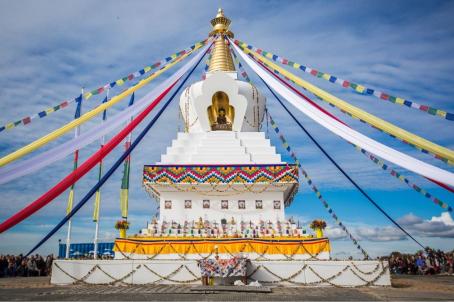
10 Buddhist stupas to discover in Europe

Stupas are symbols of enlightenment and peace that commemorate different stages of Buddha's life. Since the mid-20th century, thousands of stupas have begun to populate Europe. We have compiled some of the most impressive ones in this list.