Explore Religious Heritage Across Europe

Here you can search for a building to visit. You can use the map find destinations, or you can use the filters to search for a building based upon what different criteria.

Refine search

Doopsgezinde Kerk

De Westereen, NL

In Kollumerzwaag a Mennonite community was founded between 1600 and 1620. At the beginning of the 19th century this community declined and was threatened with dissolution. Around 1816 the Vermaning was demolished and rebuilt in 1816 in Zwaagwesteinde. There was not a single church there at the time. After the death of Rev. Bosma the community ceased to exist in 1844. The Vermaning was sold and converted into a smithy. Later it became two workers' houses and in 1934 family doctor Noordhof bought the old Vermaning, had it demolished and built his doctor's house on the foundation.
Doopsgezinde Kerk

Leeuwarden, NL

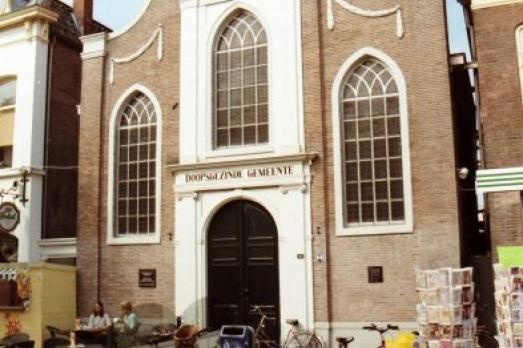
Mennonite Church. Simple building with an entrance framed by columns. Pulpit. Organ with main work and upper work, made in 1786 by J. Strumphler for the Mennonite Church "De Zon" in Amsterdam. Moved to Leeuwarden in 1850. Extensively renovated in 1858 by L. van Dam and Sons.

Doopsgezinde Kerk

Grou, NL

Frontage of the Mennonite Church. Above the gate passage, next to which two six-pane windows, floor with three such windows. Facade closed off by block moulding. Hidden church in a three-sided closed hall building covered by a barrel vault from 1829. Simple pulpit. Originally a single-manual organ made in 1872 by the Gebr. Adema from Leeuwarden. Modified in 1920 by Bakker and Timmenga.

Doopsgezinde Kerk

Purmerend, NL

Built as the Chapel of the Roman Catholic Hospital St. Liduina Foundation, which was abandoned in 1988. Sober reconstruction chapel in Bossche School style.

Doopsgezinde kerk

IJlst, NL

Mennonite church with extensions. The church has a neck gable dated 1857; heavily framed entrance. On either side service buildings under a saddle roof with a shield in front and behind and chimneys above. Six-pane windows. Cast iron fence along the church grounds. Pavement posts of the service buildings. Single manual organ, made in 1881 by Bakker and Timmenga.

Doopsgezinde Kerk

Beverwijk, NL

Hall church in neo-Romanesque forms, with a roof turret on the front facade. Since 2010 (after the Mennonite Meeting House in IJmuiden was decommissioned), this has been the Mennonite Church for "De IJmond". In 2012, extensive attention was paid to the centenary of this church building. Among other things, with an exhibition about the Danish artist Thorvaldsen.

Doopsgezinde Kerk

Doopsgezinde Kerk

Almelo, NL

The Doopsgezinde Kerk (Mennonite Church) in Almelo was built in 1684. In 1732, the church was expanded and the current facade was added. The building was restored in 1978. It is listed as a National Monument of the Netherlands.

Doopsgezinde Kerk

Sappemeer, NL

Mennonite church, because of the originally two-manual organ, built in 1855 by GW Lohman from Groningen. In 1866 modified by P. van Oeckelen from Harenermolen and extended with a free pedal. In 1983 and later years restored in phases.

Doopsgezinde Kerk

Noordhorn, NL

Mennonite church from 1838. The side walls are divided by lesenes, between which there is a semicircular closed window. It also has a framed entrance. This church is listed as a National Monument of the Netherlands.

Doopsgezinde Kerk

Sneek, NL

Mennonite Church. Neoclassical hall church, built in 1842 to plans by PJ Rollema. Front facade with an entrance with round arch windows, four Doric pilasters, a Doric frieze and a triangular gable field. The windows in the side facades have, remarkably enough, the pointed arch shape. The interior has a semicircular closure and shows a wall treatment formed by Corinthian pilasters. These carry a cornice that forms the transition to the flat ceiling. Pulpit in neo-Gothic shapes. Organ with main work and upper work, made in 1847 by JC Scheuer. Scheuer used the wind chest and pipework of the old organ, which was made in 1786 by A. van Gruisen.

Be inspired

Stupkalnis.lt

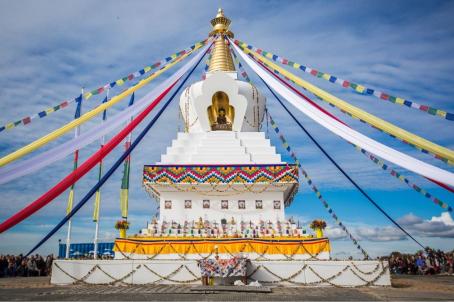
10 Buddhist stupas to discover in Europe

Stupas are symbols of enlightenment and peace that commemorate different stages of Buddha's life. Since the mid-20th century, thousands of stupas have begun to populate Europe. We have compiled some of the most impressive ones in this list.