Explore Religious Heritage Across Europe

Here you can search for a building to visit. You can use the map find destinations, or you can use the filters to search for a building based upon what different criteria.

Refine search

Dormition of the Virgin Mary, Pazardzhik

Dormition of the Virgin Mary, Pazardzhik

Pazardzhik, BG

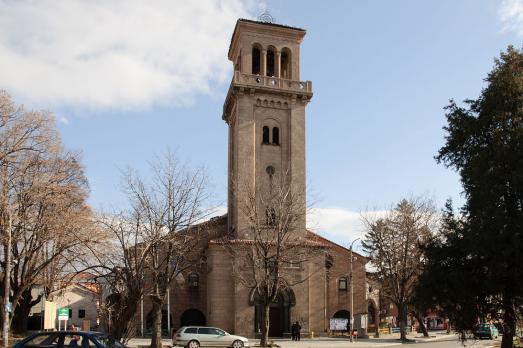
The Dormition of the Virgin Mary is the largest preserved neo-Nazi church in the country. Built in 1836 - 1837, the church is famous for its iconostasis made of boiled walnut wood and carved with very artistic woodwork by the masters of Debar for ten years. The bell tower on the west façade was built in 1906 and completed in 1932-34.
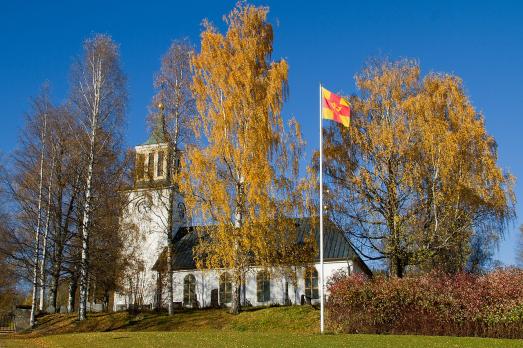
Dorotea kyrka

Dorotea kyrka

Dorotea, SE

The Dorotea Church is a 1934 reconstruction of an old church from the early 19th century. The new church was built in wood according to the plans of Evert Milles.

Dorpskerk

Nieuw- en Sint Joosland, NL

In 1991 the church was refurbished. The heating was replaced. The wooden floor was replaced by a stone one and the wooden benches by chairs. In addition, a kitchen was fitted out and the church was made suitable for multifunctional use. Financially, the job was made possible thanks to the willingness to sacrifice of the Nieuwlanders, including people who were not members of our congregation. 36 guilders were raised per inhabitant. In addition, many volunteers helped out, which kept the costs down. The clock faces and hands of the tower were overhauled in the period October/November 1991. In 1994 the civil authorities restored the church tower.

Dorpskerk

Roden, NL

Dutch Reformed Church. Three-aisled church, consisting of a nave, the central nave dating from the 13th century and the side aisles from the 15th century. The choir dates from the beginning of the 15th century, the tower with saddle roof from the beginning of the 16th century. The church was restored in 1932-33 and was treated internally as beautiful masonry in accordance with the prevailing views at the time. The central nave now has a brick barrel vault from the 17th century. Originally there were probably dome vaults here. Furniture from the 18th century, pulpit from 1717.

Dorpskerk

Rhoon, NL

The village church in Rhoon was built around 1430. The choir and tower were built first. The choir was then used as a chapel. The nave was completed around 1500. That was when the church acquired its current size. The interior of the 16th century Dutch Reformed Church with the marble tomb of the two wives of Hans Willem Bentinck and the rococo funeral boards of that family has been restored. The most striking feature is the walls treated with lime mortar, which makes the church seem much lighter.

Dorpskerk

Goudriaan, NL

Dutch Reformed Church. Late Gothic village church with single-aisled nave and deep, three-sided closed choir. Heavy brick tower on the west side, decorated by series of narrow, blind niches and crowned by an eight-sided, constricted spire.

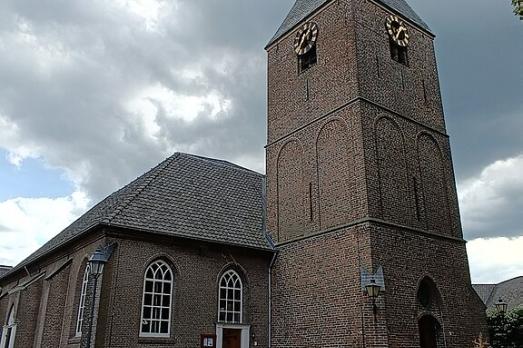
Dorpskerk

Dorpskerk

Almen, NL

Brick church from the 14th century. The tower was originally separate from the church and is somewhat older. The church has a Romanesque Bentheimer stone baptismal font. Under the choir lie several mummies. Enlarged in 1849, choir built in 1915.

Dorpskerk

Nunspeet, NL

As early as the 12th century, a stone church must have stood on the site of the village church. Before that, there was probably a thatched wooden church. The church was dedicated to Saint Anthony. On 6 June 1855, the church burned down. A large fire destroyed part of the church and also a large number of the village houses, only a part of the church tower was preserved. In 1857, new construction began. In 1949, three new bells were cast, replacing the two previous bells. They weighed 650, 371 and 260 kilos respectively and sounded in G sharp, B and C sharp. The middle bell was replaced in 1961 after a crack. The inscriptions read according to bells:

Dorpskerk

Goudswaard, NL

Dutch Reformed Church. Rectangular hall church with wooden barrel vault and tie beams, lit by round arch windows, 18th century. Simple tower with constricted spire, probably from 1721. The inventory includes: a pulpit in Louis XVI forms with a copper lectern and baptismal fence holder. A baptismal fence with a copper baptismal arch from the same period and a precentor's lectern. Four simple benches, two of which with a canopy, 18th century. Three copper crowns, 18th century. Some tombstones from the 16th and 17th centuries. Single manual organ, made in 1809 by PJ Geerkens. Restored in 1982 by Leeflang Orgelbouw. ​​Bell frame with bell by P. Waghevens, 1503, diam. 82 cm and a bell by an anonymous founder, 14th or 15th century, diam. 60.5 cm.

Be inspired

Stupkalnis.lt

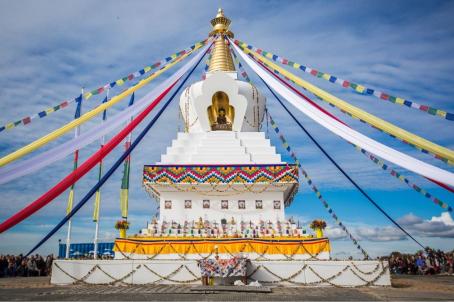
10 Buddhist stupas to discover in Europe

Stupas are symbols of enlightenment and peace that commemorate different stages of Buddha's life. Since the mid-20th century, thousands of stupas have begun to populate Europe. We have compiled some of the most impressive ones in this list.