
Explore Religious Heritage Across Europe

Here you can search for a building to visit. You can use the map find destinations, or you can use the filters to search for a building based upon what different criteria.

Refine search

Heilige Jeroen

Noordwijk-Binnen, NL

Non-oriented colossal neo-Gothic hall church with high tower in Noordwijk-Binnen. Built in two phases. The first phase was designed by architect N. Molenaar, the second by his son. In 1892 this church was granted the status of pilgrimage church. Behind the water board church from 1834, the transept and choir of the neo-Gothic church were built in 1894. When further expansion was necessary, the old water board church was demolished. In 1925-1926 the church was completed with the construction of the nave, front facade, tower and parsonage, designed by Nicolaas Molenaar Jr. (1892-1973). At the top of the facade is a statue of the patron saint of the church, Saint Jeroen. The falcon on his arm is said to indicate his noble origins. This church is listed as a National Monument of the Netherlands.
Heilige Joachim

De Moer, NL

Large, important neo-Gothic church with tower. In 1894, De Moer became an independent parish. Before that, the area belonged to the parish of Loon op Zand. When the parish was founded, a temporary wooden church was placed that had been taken over from Dussen. In 1902, this was replaced by the current church, designed by CF van Hoof from Tilburg. The consecration by pastor AHF Kamp took place on 2 February 1902, after which it was consecrated on 6 June 1903 by W. van der Ven, bishop of 's-Hertogenbosch. The pastor had a brother, Joachim, who had been a chaplain and had died at a young age. Out of love for him, and in his memory, the pastor chose St. Joachim as the patron saint of his newly founded parish. At the initiative of pastor Kamp, a veneration of St. Anna (feast day 16 July) was created. After his death in 1939, this quickly declined. In the fifties of the previous century the last pilgrims came to visit the place. Behind the church is the cemetery where pastor Kamp, who died on September 22, 1939, is also buried.

Heilige Joannes de Doper

Noord-Scharwoude, NL

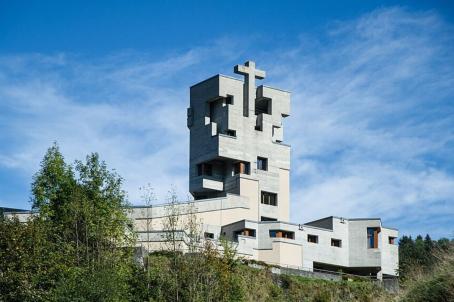
The St. John the Baptist Church is the Roman Catholic parish church of Langedijk, in North Holland. The church has been in use since 1906. This church is listed as a National Monument of the Netherlands.
Heilige Joannes van Oisterwijk

Oisterwijk, NL

Extremely important church with a wide saddle roof tower. This church is listed as a National Monument of the Netherlands.

Heilige Johannes Apostel

Enschede, NL

Characteristic modern church with tower. Replaced an earlier St. Jan church from 1921, demolished "due to dilapidation", designed by W. te Riele Gzn.

Heilige Johannes Bosco

Maastricht, NL

The Bosco Church is a modern church building in Maastricht built in the 1950s. The church was withdrawn from Catholic worship in 2017. The Maastricht Baptist Community briefly used it as a meeting place. The building is now pending a decision on its future use.

Heilige Johannes de Doper

Nieuwstadt, NL

During the Second World War, the church of Nieuwstadt was located where the front stopped in September 1944. It is therefore one of the few churches around Sittard that suffered considerable war damage. The first shelling took place between 19 and 29 September 1944 by the Americans, which incidentally caused little damage. On 12 November 1944, however, when the Americans were in Nieuwstadt, the Germans started firing back with much heavier material. This happened in the morning hours, when a Holy Mass was in progress. The shelling lasted for three quarters of an hour, during which one person was fatally hit and the church suffered considerable damage. This was repeated two days later, but now no one was injured. On 21 November 1944, the English relieved the Americans and Nieuwstadt was evacuated. The village suffered from German grenade and mortar fire for another four months. (Source: [1]

Heilige Johannes de Doper

Baexem, NL

The church in Baexem was mentioned in 1485 at least as independent of the mother church in Thorn. The oldest remains of church buildings were found during the archaeological research after the Second World War by P. Glazema. In his reconstruction, the oldest remains of a stone church were not dated, the tower was dated from around 1200. This tower remained standing until 1944. The old church was a small hall church, against which a polygonal chancel was built at some point later. The church was also enlarged at some point with a second nave. A memorial stone with the date 1576, which was built into the tower above the entrance, could indicate the renovation of the church, or the cladding of the tuff tower with marl. In 1850, the old church, with the exception of the tower, was demolished and replaced by a three-aisled neoclassical church. The church of 1850 became too small for the growing population. Therefore, in 1928, under the direction of architect Caspar Franssen, the side aisles were extended along the chancel. New sacristies and a new baptismal chapel were added next to the tower. On 15 November 1944, the tower was blown up by the retreating Germans. Almost the entire inventory was destroyed by the explosion. The bell from 1829 had already been stolen by the occupiers on 11 January 1943, the bell from 1450, cast by Jan van Asten, which was still hanging in the tower, fell to the ground during the explosion, virtually undamaged.

Heilige Johannes de Doper

Pijnacker, NL

Neo-Romanesque church with tower. Replaced a barn church from 1775. In 2017 celebration of the 125th anniversary of this church building. Also restoration of church and tower.

Be inspired

Stupkalnis.lt

10 Buddhist stupas to discover in Europe

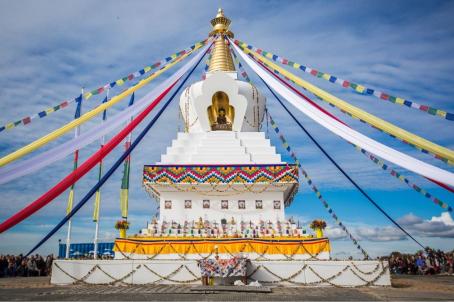
Stupas are symbols of enlightenment and peace that commemorate different stages of Buddha's life. Since the mid-20th century, thousands of stupas have begun to populate Europe. We have compiled some of the most impressive ones in this list.