Explore Religious Heritage Across Europe

Here you can search for a building to visit. You can use the map find destinations, or you can use the filters to search for a building based upon what different criteria.

Refine search

Heilige Johannes de Doper

Nieuwstadt, NL

During the Second World War, the church of Nieuwstadt was located where the front stopped in September 1944. It is therefore one of the few churches around Sittard that suffered considerable war damage. The first shelling took place between 19 and 29 September 1944 by the Americans, which incidentally caused little damage. On 12 November 1944, however, when the Americans were in Nieuwstadt, the Germans started firing back with much heavier material. This happened in the morning hours, when a Holy Mass was in progress. The shelling lasted for three quarters of an hour, during which one person was fatally hit and the church suffered considerable damage. This was repeated two days later, but now no one was injured. On 21 November 1944, the English relieved the Americans and Nieuwstadt was evacuated. The village suffered from German grenade and mortar fire for another four months. (Source: [1]
Heilige Johannes de Doper

Kaatsheuvel, NL

Very important, large, late neo-Gothic church with double tower front and high roof turret. Main work by architect CF van Hoof. Replaced the predecessor of this church . In the late Middle Ages, churches were held in Loon op Zand and Sprang, until the church of Sprang came into Protestant hands in 1609. The Catholics of Kaatsheuvel could now go to church in a farm, on the spot where the Nieuwe Markt is now. It was not until 1736 that Catholics were allowed to build churches again, but with restrictions. This is how the barn churches came into being. The barn church of Kaatsheuvel stood on the spot where the parish centre is now. The parish in Kaatsheuvel was founded in 1796 by separating from the old parish of Loon op Zand. Ultimately, the first stone church was not built until 1835: the Waterstaatskerk, see there. In 1911, pastor Volker suggested plans for new construction. The new church was built next to the Waterstaatskerk and consecrated on July 5, 1913.

Heilige Johannes de Doper

Eygelshoven, NL

Large church with a tower placed on the side. The church was built when the old Gothic church on the nearby church hill became too small due to the expansion of Eygelshoven, as a result of the Laura and Julia mines. In 1920, construction began on the new church, designed by A. Boosten in Maastricht and J. Ritzen in Heerlen.

Heilige Johannes de Doper

Oud-Valkenburg, NL

Probably a small hall church was built on this site in the 11th or 12th century . Parts of the tower and the nave date from that time. The south aisle was added later. In the 16th century the tower and the north aisle were renovated.

Heilige Johannes de Evangelist

Meterik, NL

A hall church from 1899-1900. In 1907 the nave was partly demolished again to expand the church by adding side aisles along the nave. This church is listed as a National Monument of the Netherlands.

Heilige Johannes Evangelist

Buitenkaag, NL

Interesting church building with roof turret in Amsterdam School style in Buitenkaag, which was called Leeghwaterdorp until the 1960s.

Heilige Johannes Evangelist

Breezand, NL

Spacious, single-nave cruciform church in traditionalist forms with a large west tower, covered by a brick spire. The design is in line with the concept of the people's church. Internally covered by wooden barrel vaults. Characteristic work in the oeuvre of HPJ de Vries.

Heilige Johannes Evangelist

Hoensbroek, NL

New neo-Gothic St. John's Church with roof turret, tower not built. The church replaced the adjacent "Little St. John" from the thirteenth century. This beautiful neo-Gothic church, and the historic Little St. John, are the only church buildings still in use in the Hoensbroek Parish.

Heilige Johannes Evangelist

Eindhoven, NL

Nice modern church, without a tower, with various side rooms, and a portable chest organ from 1968 by Verschueren.

Be inspired

Stupkalnis.lt

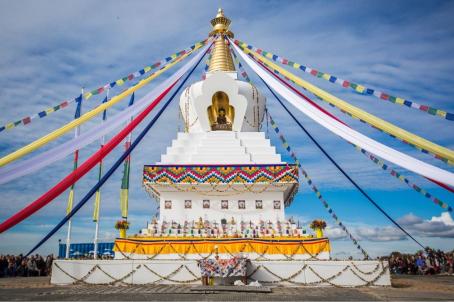
10 Buddhist stupas to discover in Europe

Stupas are symbols of enlightenment and peace that commemorate different stages of Buddha's life. Since the mid-20th century, thousands of stupas have begun to populate Europe. We have compiled some of the most impressive ones in this list.