Heilige Johannes de Doper
Mijdrecht, NL
This church is listed as a National Monument of the Netherlands.

Here you can search for a building to visit. You can use the map find destinations, or you can use the filters to search for a building based upon what different criteria.
Mijdrecht, NL
This church is listed as a National Monument of the Netherlands.
Balgoij, NL
Exceptionally important church in neo-Romanesque and neo-Gothic styles, with tower. Built to replace an earlier church , the medieval tower of which still remains elsewhere in the village. Crucifix church on a strongly centralised plan, with an apse on the choir side. Tower to the left of the front facade, covered by a tent roof. The design is in line with the wishes of the Liturgical Movement (so-called people's church) of the early twentieth century: enlarged crossing in the form of an irregular octagon. Largely wooden vaulting of the interior; the vault over the crossing contains a fanlight. The late nineteenth-century inventory (including the main altar) probably comes from the previous church. Partly because this is one of the last remaining churches designed by architect J. van der Valk, this church has an extra rarity value. The only other church by this architect that still exists and is in use as a church is the OL Vrouw Moeder van Goede Raad in Tilburg-Broekhoven; two others have been demolished, and one is out of use; the 2 demolished churches are the H. Sacrament in 's-Hertogenbosch and the St. Joseph in Eindhoven-Tongelre; the St. Bernadette in Rosmalen-Maliskamp is out of use.
Katwijk aan den Rijn, NL
Fairly sober late neo-Gothic church with tower, which is a defining feature of Katwijk aan den Rijn. Replaced an earlier early neo-Gothic church.
Kudelstaart, NL
The Kudelstaart station was founded in 1661. Churches were held in a wooden shed on the Robend. In 1822, a three-aisled neoclassical church was built, which was restored in 1837 after a flood. In 1868-1870, the west side was provided with a nice neo-Romanesque facade with built-in tower by Th. Asseler (consecrated 22-4-1870). In 1959, modern paintings and Stations of the Cross were already installed. The original furniture was removed in 1968-1969 and the interior was drastically modernized at that time.
Montfoort, NL
This church is listed as a National Monument of the Netherlands.
Grootebroek, NL
Large interbellum church, with a large tower and many architecturally interesting details. In the churchyard behind the church is a Marian chapel, ao. 1998. Non-oriented church: the front facade faces south, the choir faces north. Designed by the Zaanse architect SB van Sante, following, or in the style of Dom. Paul Bellot, which can be seen in many architectural details. As far as is known, this is the only existing church building designed by this architect.
Keijenborg, NL
Late neo-Gothic church with tower. This is the last church designed by architect Jan Stuyt.
Leimuiden, NL
Replaced barn church from 1752. Single-nave neo-Gothic church with tower, built in 1854-1856. Internal plastered vaults. Altar, pulpit and other furnishings from the construction period, probably from Louis Veneman. Organ by Gebr. Adema from 1856. Neo-Gothic front designed by Dirk Ypma.
Nieuwstadt, NL
During the Second World War, the church of Nieuwstadt was located where the front stopped in September 1944. It is therefore one of the few churches around Sittard that suffered considerable war damage. The first shelling took place between 19 and 29 September 1944 by the Americans, which incidentally caused little damage. On 12 November 1944, however, when the Americans were in Nieuwstadt, the Germans started firing back with much heavier material. This happened in the morning hours, when a Holy Mass was in progress. The shelling lasted for three quarters of an hour, during which one person was fatally hit and the church suffered considerable damage. This was repeated two days later, but now no one was injured. On 21 November 1944, the English relieved the Americans and Nieuwstadt was evacuated. The village suffered from German grenade and mortar fire for another four months. (Source: [1]
Breukelen, NL
Beautiful, richly detailed neo-Gothic church with tower.
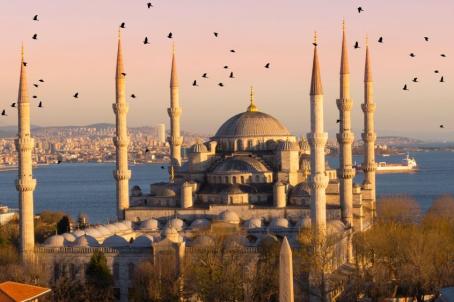
new
For a long time, Europe was ruled by powerful monarchies. Monarchy and religion have been connected since time immemorial. Here are 7 sites across Europe where royalty historically bent the knee to a higher power and received their crown.
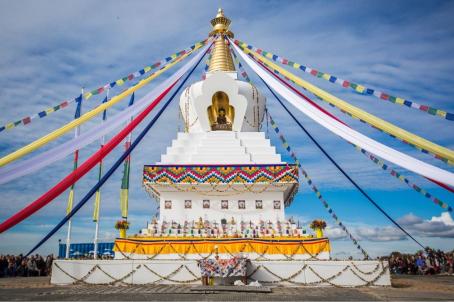
Stupas are symbols of enlightenment and peace that commemorate different stages of Buddha's life. Since the mid-20th century, thousands of stupas have begun to populate Europe. We have compiled some of the most impressive ones in this list.
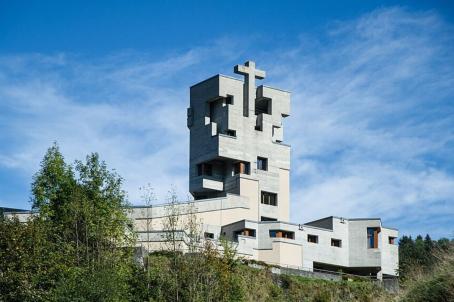
Walter Maria Förderer (1928–2006) was a Swiss architect and sculptor renowned for his neo-expressionist church designs in the 1960s. In this list we have compiled 6 of his church designs that seamlessly integrate religious and secular elements.

How is Religiana helping to conserve and promote Religious Heritage in Europe and why should you get involved?
Find out about Religiana
Are you a tourism organisation or religious heritage sites manager? Discover the advantages of becoming a partner.
See current partners
We can keep you up to date with the latest news from Religiana and religious heritage conservation across Europe.
Sign up to the FRH newsletter