Explore Religious Heritage Across Europe

Here you can search for a building to visit. You can use the map find destinations, or you can use the filters to search for a building based upon what different criteria.

Refine search

Heilige Lambertus

Rotterdam, NL

Beautifully situated beautiful neo-Gothic church with a defining tower, since 1979 (fire H. Verlosserkerk) the highest existing church tower in Rotterdam, at the bottom of the high Oostzeedijk (height of the tower in m to be determined). Replaced an older church from 1802/1830 in the then village of Kralingen, later annexed by Rotterdam. Early work designed by architect EJ Margry. In Rotterdam, this church is in 2023 one of the two remaining neo-Gothic churches that are actively used as a Roman Catholic Church (the other is the St. Hildegardiskerk in the Het Oude Noorden district). Despite a modernization of the interior in 1969, in which, among other things, the pew plan was replaced and the pulpit and communion bench disappeared, the architecture and furnishings have been well preserved in many details. This church contains an important Maarschalkerweerd organ. The church is open every Saturday from 10:00 to 13:00 for viewing, prayer, etc.
Heilige Lambertus

Nederweert, NL

Historic church with high tower (76 m). Replaced older church. According to a memorial stone, the tower dates from 1467. The church was damaged by War in 1944. This church is listed as a National Monument of the Netherlands.

Heilige Landelinus

Empel, NL

The Sint Landelinus Church in Empel was built in 1948–1949 to a design by the Tilburg architect NH Pontzen (1919–1979) in reconstruction style. The church is located in the centre of Empel, the village rebuilt after the Second World War that is located slightly further from the Maas than the original ribbon village of Empel along the Maas. The Sint Landelinus Church and an associated rectory were built to replace the neo-Gothic Landelinus Church in Oud Empel, which was destroyed in November 1944. The Sint Landelinus Church and rectory have a traditionalist design influenced by the Bossche School. The church is designed according to the pseudo-basic type with a high square crossing tower and adjacent side chapels. Christocentric: the altar is located centrally in the crossing, which is externally crowned by a heavy tower. Behind this is a shallow five-sided apse extension. In 1996, an extension was added to the sacristy. The church has, in accordance with the basilica spatial division, a central nave with side aisles. The central nave is very wide and has benches on either side. The side aisles function as walkways and procession corridors. The central nave reaches to the triumphal arch wall that marks the connection to the high choir located under the crossing tower. At the end of the side aisles, on either side of the choir, are chapels. The church contains, among other things: Stations of the Cross by E. Deckers; a cross by Albert Termote; a statue of Antonius Abt by Frans van der Burgt and a triptych by L. Wiegman, which depicts the so-called Miracle of Empel (1585).

Heilige Laurentius

Heemskerk, NL

St. Laurentius, 1889-1891. JH Tonnaer. Three-aisled cruciform basilica in neo-renaissance forms with high cross tower and polygonal stair towers on either side of the front facade. The wooden tower at the crossing is covered with slates and consists of two square and two octagonal sections, separated by vaulted roof surfaces. In the nave round brick columns with natural stone bands and round arches, above which an entablature. Over the main aisles wooden barrel vaults with hipped roofs, over the crossing a six-part wooden cross-ribbed vault. The side aisles carry stone cross-ribbed vaults. Plastered wall surfaces, on the barrel vaults a vine painting. Mechanical tower clock by Eijsbouts, 1916.

Heilige Laurentius

Oud Gastel, NL

Brick tower from the middle of the 15th century, restored in the upper section (1696) after a fire (1671), during which the spire was added; restored in 1865 and in 1952-1959. Four sections with diagonal buttresses; the wall surfaces decorated with profiled niches, natural stone blocks used everywhere. Partly 17th century, partly modern bell storey on which octagonal spire covered with slates. Against the south wall polygonal staircase tower. Mechanical tower clock Petrus Megan i Brussells Fecit 1704, has been decommissioned. This church is listed as a National Monument of the Netherlands.

Heilige Laurentius

Kekerdom, NL

Roman Catholic Church. The Roman Catholic Church of St. Laurentius is a single-nave building from the 14th century, vaulted by cross-ribbed vaults, the capitals of which rest on short scutcheons. The church and the sacristy, also built against the south side and also dating from the 14th century, were raised with an arched frieze in 1835-'40, after which a neo-Gothic tower was built in 1872 on the site of a previous one from 1837. According to the Provisional List, the choir was built in 1872 with old stone in the Gothic style. The church has a pulpit, two copper chandeliers, 17th century, and a Gothic copper candlestick. On an organ gallery from the first quarter of the 19th century, an organ with main work and lower positive, made in 1865 by FC Smits. Restored in 1982 by the Vermeulen company. Mechanical tower clock Addicks?, Amsterdam, 1922, later fitted with electric winding.

Heilige Laurentius

Breda, NL

Very monumental neo-Gothic church with heavy crossing tower, which is 60 m high. Interior (too) heavily simplified in the 1960s.

Heilige Laurentius

Bemelen, NL

The church of St. Laurentius was donated by Prince-Bishop Balderic II of Liège (1007-1018), together with the tithes of Bemelen, to the chapter of Our Lady in Maastricht. This donation was confirmed by Pope Adrian IV in 1157. It was the mother church of the St. Martinus parish in Wijck-Maastricht. Parts of the east wall of the marlstone, unarticulated tower date back to the 12th century, the rest dates from around 1350. The current spire dates from around 1760. The former church was replaced in 1845 by a neoclassical church, probably designed by Mathias Soiron. The church was restored in 1976. Mathias Soiron died in the year the church was built and is buried against the church wall, to the right of the entrance. {Source: [1] }

Heilige Laurentius

Hoogkarspel, NL

Large church with interesting expressionist details. Facade to the north, choir to the south. Wide central nave and very narrow side aisles, with straight-ended (higher) choir section, flanked by two rectangular towers with small crowns.

Be inspired

Stupkalnis.lt

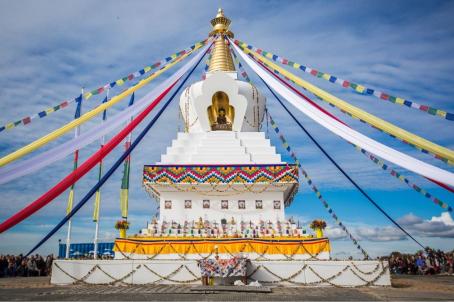
10 Buddhist stupas to discover in Europe

Stupas are symbols of enlightenment and peace that commemorate different stages of Buddha's life. Since the mid-20th century, thousands of stupas have begun to populate Europe. We have compiled some of the most impressive ones in this list.