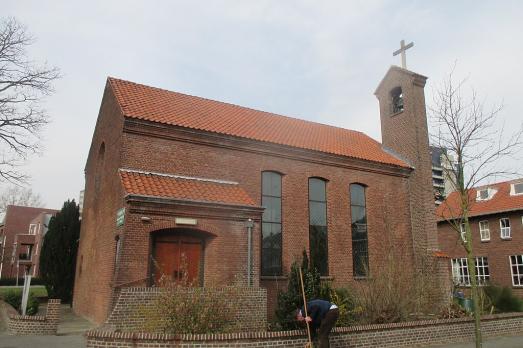
Heilige Willibrordus
Arnhem, NL
The church building dates from 1941, which was of course a strange time to build a church. On the other hand, it was not yet known at that time whether the German occupation would be permanent.

Here you can search for a building to visit. You can use the map find destinations, or you can use the filters to search for a building based upon what different criteria.
Arnhem, NL
The church building dates from 1941, which was of course a strange time to build a church. On the other hand, it was not yet known at that time whether the German occupation would be permanent.
Middelbeers, NL
This church is listed as a National Monument of the Netherlands.
Obbicht, NL
The church replaced the previous church from 1903, which had become too small.
Sint Willibrord, NL
In 1841 a parish was founded and a church built. Since 1885 Sint Willebrord has been a place of pilgrimage. In that year a first Lourdes grotto was built. In 1925 a new church was built. The original design by pastor Bastiaansen, a representation of the Basilica of Lourdes, was elaborated by the architect Jacques (NJH) van Groenendael from Breda. In front of the church is a procession park.
Diessen, NL
The church of Diessen is named after Saint Willibrord, an English Benedictine monk. Around 712, he donated a number of properties, including properties in Diessen, to the abbey of Echternach. At that time, Willibrord also built a well in the village for baptism. A 16th-century replica can still be seen next to the church, which has undergone several transformations over time. In 1161, the church consisted of a chapel made of wood and straw. In order to manage the properties donated by Willibrord, the abbot of Echternach had appointed a guardian or advocate in various places, who also exercised a form of worldly authority in the area assigned to him. The Benedictines of Echternach were also involved in pastoral care in Diessen.
Neerkant, NL
Hall church on an almost rectangular plan, consisting of a partly exposed concrete skeleton, filled with brick. A detached, openwork bell tower and semi-detached baptismal chapel to the side. Front facade with simple narthex. The central nave is covered by a curved concrete shell roof. As a whole, the church is an important example of renewal, also a fairly exceptional early example of modernism in Roman Catholic church architecture from the 1950s. This church is listed as a Municipal Monument of the Netherlands.
Demen, NL
Built by Pierre Cuypers (1827 - 1921) while retaining the 15th century tower of the former church, in 1890 this architect clad it, raised it and provided it with a staircase tower. The church consists of a nave of five bays, covered by a pointed wooden barrel vault and a choir with 5/8 closure and brick cross-ribbed vaults. Tower 15th century.
Julianadorp, NL
Founded as a temporary church from the Roman Catholic parish of Den Helder. Sober church with roof turret. Never replaced by a permanent church building.
Riethoven, NL
Roman Catholic Church of St. Willibrord. Since the renovation and extension by architect C. Franssen in 1890-99, only some masonry remains of the 15th century church, namely the 3/8 closed choir, the transept and the substructure of the tower. Bell frame with two bells by W. Kaerwas, 1478, diam. 116 and 102 cm respectively. Mechanical tower clock, Van Dorst (Gilze), 1896, electrically wound.
Ruurlo, NL
During the Reformation, the Catholics of Ruurlo attended church in Zwillbrock, just across the German border. From 1801, they had a barn church in their own municipality. In 1828, a new, larger church was completed. In its place, the current parish church, dedicated to St. Willibrordus, was built in 1869-1870, based on a design by Dr. Pierre Cuypers (1827 - 1921). The church, like that of Cuypers in neighbouring Kranenburg, was built thanks to a legacy from Baron Van Dorth tot Medler. The church was originally built as a single-nave hall church with a narrowed and straight-closed choir, side-mounted gables, and a front tower. The interior is covered by a wooden barrel vault.
new
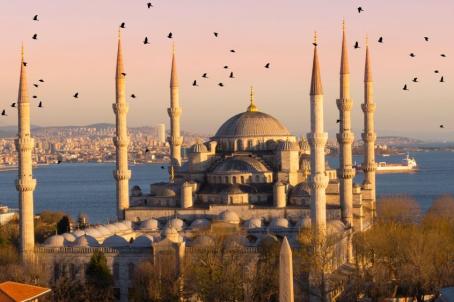
For a long time, Europe was ruled by powerful monarchies. Monarchy and religion have been connected since time immemorial. Here are 7 sites across Europe where royalty historically bent the knee to a higher power and received their crown.
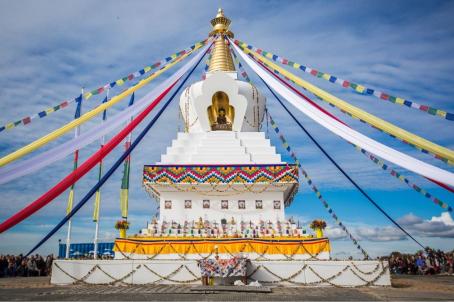
Stupas are symbols of enlightenment and peace that commemorate different stages of Buddha's life. Since the mid-20th century, thousands of stupas have begun to populate Europe. We have compiled some of the most impressive ones in this list.
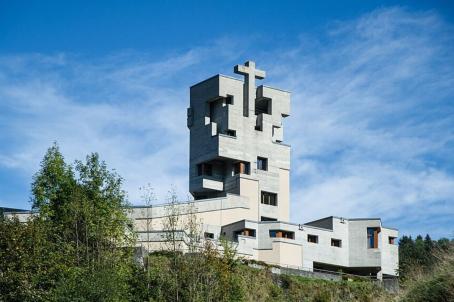
Walter Maria Förderer (1928–2006) was a Swiss architect and sculptor renowned for his neo-expressionist church designs in the 1960s. In this list we have compiled 6 of his church designs that seamlessly integrate religious and secular elements.

How is Religiana helping to conserve and promote Religious Heritage in Europe and why should you get involved?
Find out about Religiana
Are you a tourism organisation or religious heritage sites manager? Discover the advantages of becoming a partner.
See current partners
We can keep you up to date with the latest news from Religiana and religious heritage conservation across Europe.
Sign up to the FRH newsletter