Hervormde Kerk
Bruinisse, NL
Interesting reconstruction church with roof turret. Replaced a historic church destroyed by war.

Here you can search for a building to visit. You can use the map find destinations, or you can use the filters to search for a building based upon what different criteria.
Bruinisse, NL
Interesting reconstruction church with roof turret. Replaced a historic church destroyed by war.
Puttershoek, NL
Dutch Reformed Church. Hall church (1839), of which the eastern facade has an entablature with triglyphs and metopes and a cornice. Hipped roof. Round arched windows. Plastered tower (15th?), provided with a wooden superstructure after a fire in 1889. Inventory: Pulpit and lord's pew (18th). Organ with main work and secondary work, made in 1858 by CGF Witte. During the restoration by Flentrop in 1989, a free pedal was added.
Haamstede, NL
Reformed church. Rebuilt 16th century after fire around 1500. Crucifix church without choir with open roof turret at the crossing. In the west wall a gate with a basket-handle arch and a large closed arch window. Nave and transept of brick with sandstone corner blocks in the bears. In the basements of the walls on the south side moldings of tufa, originating from an earlier church. Nave covered by a wooden barrel vault and aisles by half-half barrel vaults. Nave separated from transept by a painted partition 19th century. Transept with high closed windows in the north and east side, roofing as in the nave. In use as a consistory and winter church. Board with the name list of ministers. Interior: fragment of a baptismal font of red sandstone. Pulpit 18th century, copper lectern. Baptismal fence 17th century with candle holder. Pew 18th century with alliance coat of arms. Two pews. Three copper crowns around 1700. Board with the name list of ministers. Interior: fragment of baptismal font of red sandstone. Pulpit 18th century, copper lectern. Baptismal fence 17th century with candle holder. Gentlemen's pew 18th century with alliance coat of arms. Two pews. Three copper crowns circa 1700. In the tower on the crosswork is the modern bell from 1950. During the Second World War, a bell from an unknown founder disappeared. A second bell, made in 1532 by Jacob Waghevens, was preserved after the war and was subsequently placed in the church. There is also said (?) to have been a bell by J. van den Ghein from 1532.
Best, NL
Built as a Dutch Reformed Church in the Wilhelminadorp district, in the south of Best..
Oostwold, NL
Cross-shaped church from 1775, enlarged in 1882. This church is listed as a National Monument of the Netherlands. Since 2020 the church has been closed for safety reasons due to the inestability of the building's structure.
Hoevelaken, NL
Tower. Brick building from the 15th or 16th century, modified in the 19th century in neo-Gothic style. Above the tower entrance the year 1873. Bell frame with the sound of two bells, one of which by J. Tolhuis, 1537, diam. 40.3 cm. and a replica of the clock by W. Both and E. van der Arck. Mechanical tower clock J. van de Kerkhof, Aarle-Rixtel, later fitted with electric winding.
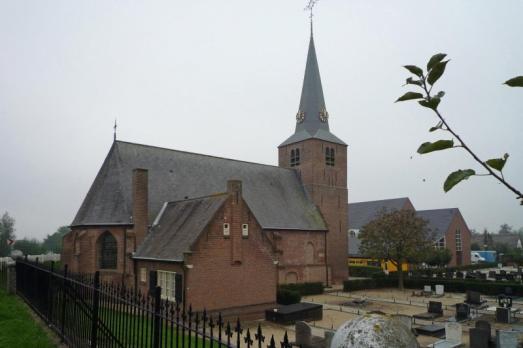
Aalburg, NL
The Trudokerk was founded in 1100 under the authority of the Abbey of Sint Truiden (Belgium). It is the oldest church in the region of Land van Heusden en Altena.
Schiermonnikoog, NL
Reformed church. Straight-ended hall church from 1866 on the site of the old church from 1762. Above the front facade a wooden facade tower with spire. All facades have round-arched windows. After restoration in 1916 a major restoration followed in 1967 during which the interior was significantly changed. Pulpit from 1866. Organ by J. Proper from 1897, originating from Culemborg and placed in this church in 1927. The bell dates from 1989 and was made by Eijsbouts in Asten (NBr.). It replaces the bell that was made by Jacob Noteman in Leeuwarden in 1649 and is now, being torn, on display in the hall of the town hall of Schiermonnikoog.
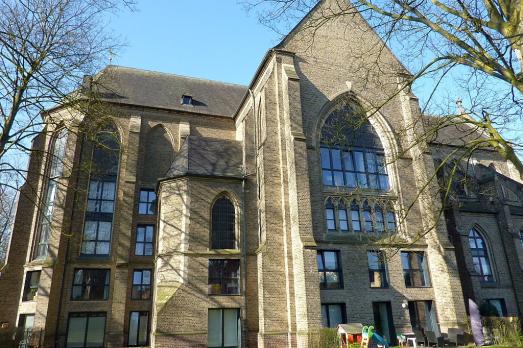
Mönchengladbach, DE
The Catholic Parish Church of St. Peter in Mönchengladbach, Germany, underwent a transformation into publicly funded apartments. Designed by Josef Kleesattel, the neogothic church retained its monumental character while accommodating a socially diverse community with affordable rents.
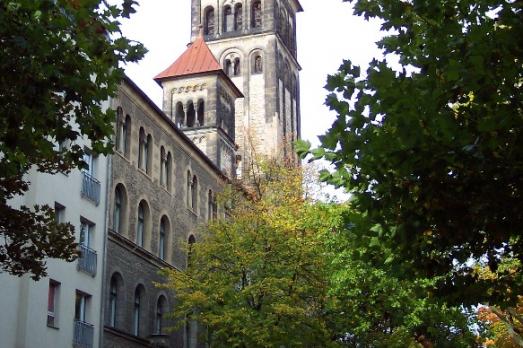
Berlin, DE
The Sacred Heart Church is a Catholic church that was built between 1897 and 1898 by the architect Christoph Hehl. At the end of the 19th century, the urban expansion of Berlin necessitated the construction of new places of worship. As the future district of Prenzlauer Berg was not very dense, the only notable pre-existing buildings were windmills and inns. One of these inns was purchased in 1890 by the parish of St. Hedwig to build a chapel, together with the adjacent presbytery and a Catholic school.
new
For a long time, Europe was ruled by powerful monarchies. Monarchy and religion have been connected since time immemorial. Here are 7 sites across Europe where royalty historically bent the knee to a higher power and received their crown.
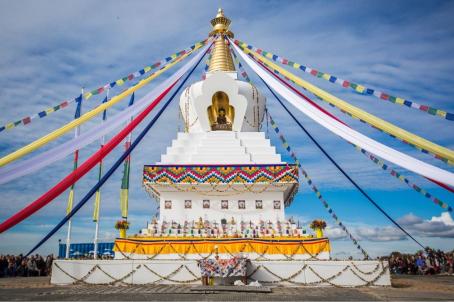
Stupas are symbols of enlightenment and peace that commemorate different stages of Buddha's life. Since the mid-20th century, thousands of stupas have begun to populate Europe. We have compiled some of the most impressive ones in this list.
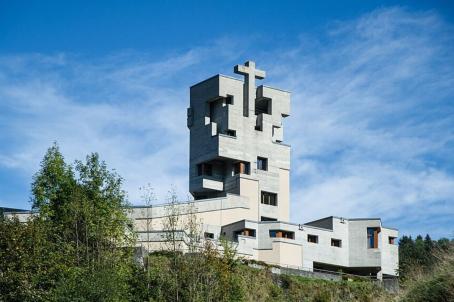
Walter Maria Förderer (1928–2006) was a Swiss architect and sculptor renowned for his neo-expressionist church designs in the 1960s. In this list we have compiled 6 of his church designs that seamlessly integrate religious and secular elements.

How is Religiana helping to conserve and promote Religious Heritage in Europe and why should you get involved?
Find out about Religiana
Are you a tourism organisation or religious heritage sites manager? Discover the advantages of becoming a partner.
See current partners
We can keep you up to date with the latest news from Religiana and religious heritage conservation across Europe.
Sign up to the FRH newsletter