Hervormde Kerk
Hollandscheveld, NL
Dutch Reformed Church. Straight-ended neoclassical hall church, consecrated on 26 December 1850, with a facade tower with openwork lantern and constricted spire.

Here you can search for a building to visit. You can use the map find destinations, or you can use the filters to search for a building based upon what different criteria.
Hollandscheveld, NL
Dutch Reformed Church. Straight-ended neoclassical hall church, consecrated on 26 December 1850, with a facade tower with openwork lantern and constricted spire.
Puttershoek, NL
Dutch Reformed Church. Hall church (1839), of which the eastern facade has an entablature with triglyphs and metopes and a cornice. Hipped roof. Round arched windows. Plastered tower (15th?), provided with a wooden superstructure after a fire in 1889. Inventory: Pulpit and lord's pew (18th). Organ with main work and secondary work, made in 1858 by CGF Witte. During the restoration by Flentrop in 1989, a free pedal was added.
Hichtum, NL
Reformed Church. With its west side on the Zeilvaart on a mound, an early 13th century church building with a tower from the 16th century. Inside, behind the pulpit, a large 17th century epitaph; carved gravestone 1626. Single-manual organ, with Louis XVI case by organ builder A. van Gruisen, 1795. Bell tower with the sound of two bells, one by H. Falck, 1617, diam. 106 cm. and a modern clock. Mechanical wrought iron tower clock, 17th century, later fitted with electric winding.
Langezwaag, NL
Reformed church and tower on churchyard. Simple church building with built-in tower 1781. In the church richly carved pulpit with back wall and sounding board; lectern 17th century communion table. Seven carved gravestones, three 17th century and four 18th century. Organ case and front by H. Knipscheer from 1866. Knipscheer used an old four-foot front that was extended on both sides. Mechanical tower clock by Bergen, Midwolda, 1923, no. 1236.
Giessen, NL
The history of the church in Giessen goes back to the 11th century. During a study between 1958 and 1960, foundation remains of a tuff stone hall church of 16 x 8 metres were found on the east side, adjacent to the church. Due to flooding in 1275, the western part of the church was washed away and the building collapsed. Approximately eleven years later, in 1286, reconstruction began, with the nave being given the same dimensions. The remaining part of the foundation was used for this. In addition, a three-sided closed choir was built onto the nave. Some time later, a transept chapel was added to the northern side.
Lekkum, NL
The former reformed church of Tijnje is a simple hall church without a tower built around 1890 or in 1907-1908: the exact year of complete construction is not clear. The straight-closed church building was originally built of brown brick, but the walls were all plastered at a later stage.
Iens, NL
Herv. Church and Cemetery. Picturesquely situated in the construction of a 13th century church, renovated in 1874 with the exception of a section on the north side; western saddle roof tower, in the core also still 13th century. The church contains: 17th century oak pulpit with rear bulkhead and sounding board; crowned carved coat of arms, two oak text boards. Bell tower with the sound of two bells, one of which was cast by H. Wegeaert, 1612, diam. 87.8 cm. and a modern bell.
Oostwold, NL
Cross-shaped church from 1775, enlarged in 1882. This church is listed as a National Monument of the Netherlands. Since 2020 the church has been closed for safety reasons due to the inestability of the building's structure.
Opijnen, NL
Plastered church building from 1860. The church is a three-sided closure, internal cove ceiling. The inventory includes: a richly carved pulpit in transitional forms Louis XIV-Louis XV, dated on the sounding board; 1744. Lectern and baptismal font holder. Otherwise complete inventory from the construction period; reader's chair, lord's pew, wainscoting with copper wall arms, all circa 1860. Two-manual organ, made in 1859 by H. Knipscheer. The free Pedal made in 1947 is not protected. This church is listed as a National Monument of the Netherlands.
Genderen, NL
Dutch Reformed Church. Of this building, only the tufa substructure of the tower, the interior of which is covered with a dome vault, should be considered a monument; 13th century. Restored in 1953 after the destruction of the church and the tower in 1944.
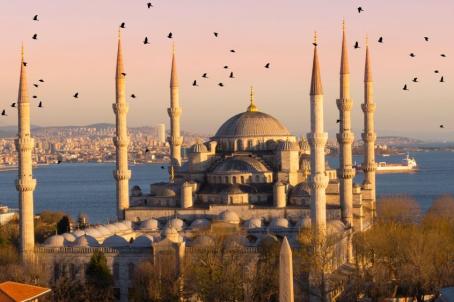
new
For a long time, Europe was ruled by powerful monarchies. Monarchy and religion have been connected since time immemorial. Here are 7 sites across Europe where royalty historically bent the knee to a higher power and received their crown.
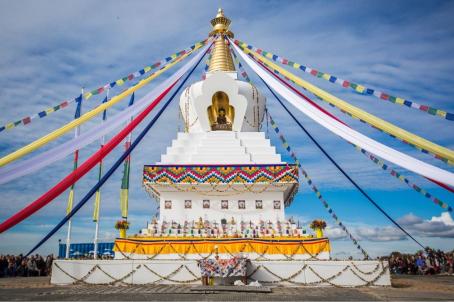
Stupas are symbols of enlightenment and peace that commemorate different stages of Buddha's life. Since the mid-20th century, thousands of stupas have begun to populate Europe. We have compiled some of the most impressive ones in this list.
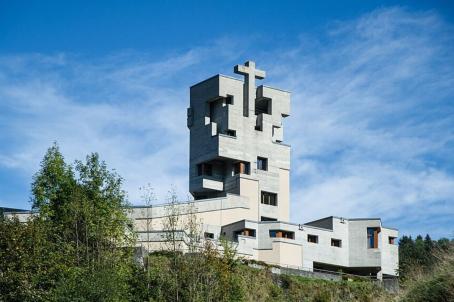
Walter Maria Förderer (1928–2006) was a Swiss architect and sculptor renowned for his neo-expressionist church designs in the 1960s. In this list we have compiled 6 of his church designs that seamlessly integrate religious and secular elements.

How is Religiana helping to conserve and promote Religious Heritage in Europe and why should you get involved?
Find out about Religiana
Are you a tourism organisation or religious heritage sites manager? Discover the advantages of becoming a partner.
See current partners
We can keep you up to date with the latest news from Religiana and religious heritage conservation across Europe.
Sign up to the FRH newsletter