Explore Religious Heritage Across Europe

Here you can search for a building to visit. You can use the map find destinations, or you can use the filters to search for a building based upon what different criteria.

Refine search

Hervormde Kerk

Oldemarkt, NL

In 1448 a chapel was built on this site. In 1850 it was expanded with a side aisle on the south side. This side aisle was demolished again in 1970-1973, during the restoration. As a result, the church regained its original form. For the construction of the chapel at that time, a certain Jacob Muerling, who had many possessions in Oldemarkt, made a considerable effort by donating lands to the church. The parish church was at that time in Paaslo. In 1489, the parish church was transferred to Oldemarkt. This church is listed as a National Monument of the Netherlands.

Hervormde Kerk

Randwijk, NL

Reformed church. Of the medieval church, only the late Gothic, single-nave, three-sided closed choir remains. The west side of the nave was irreparably damaged when the tower was blown up in 1944-1945. Under the leadership of ir WJG van Mourik, the choir was restored and a completely new nave was built, more or less in keeping with the style of the choir. Against the west side, a large square tower with a pointed roof and bell spire. The work was completed in 1953, during which the nave, which had been badly damaged in 1944, was subsequently rebuilt in quasi-Gothic forms.

Hervormde Kerk

De Westereen, NL

This was an interesting church in neo-Gothic forms. Out of use 1964, scrapped in 1965.Replaced by a modern church building.

Hervormde Kerk

Piershil, NL

Reformed church. Rectangular hall church, after 1524, in late Gothic forms with barrel vaults and tie beams. North wing from 1643. Late Gothic tower with a decoration of arched niches, restored around 1964. The inventory includes a pulpit with lectern, baptismal font holder and baptismal fence, all second quarter 17th century. A precentor's lectern, 18th century. A lord's pew with carved coats of arms and arch panels, second quarter 17th century. A lord's pew with attachment in Louis XIV forms. Five mourning boards in carved frames, 1775, 1757, 1760, 1762 and 1794. Bell tower with chime consisting of a bell by C. and DJ Ouderogge, 1642, diam. 49 cm and a bell by J. Specht, 1753, diam. 48 cm.

Hervormde Kerk

Nieuw-Beijerland, NL

This church is listed as a National Monument of the Netherlands.
Hervormde Kerk

Kloosterhaar, NL

The church replaced a smaller church from 1892. Striking and quite rare example of reformed church building from the reconstruction period in traditionalist forms.

Hervormde Kerk

Boven-Hardinxveld, NL

Important neoclassical church with roof turret. The current church building was put into use on 16 February 1862. Before that, there was probably already a chapel on the same site, dating from Roman Catholic times. This was therefore already built before the Reformation. This chapel was probably partly destroyed during the Eighty Years' War and was also once ravaged by fire.

Hervormde Kerk

Bleskensgraaf, NL

Gothicized single-nave church with tower and narrowed liturgical centre, built in 1948 by G. van Hoogevest. Internal wooden barrel vaults between brick belt arches. Some furniture from the previous church, destroyed in 1940.

Hervormde Kerk

Hervormde Kerk

2e Exloërmond, NL

The Hervormde Kerk is a Protestant place of worship dating from 1939. Since 2002, after the Reformed Church was decommissioned in each location, it has been used as the central church of the Protestant Church in the Netherlands (PKN) in Exloërmond. The church organ was built in 1976 by the firm Gebr. Reil (Heerde).

Hervormde Kerk

Stavenisse, NL

NH Church from 1910, placed on the list of monuments because of interior components: Tomb monument of Tuyl van Serooskerken (approx. 1670) made by Rombout Verhulst. Tomb with reclining figure, the back wall decorated with quarters and putti. Pulpit with Ionic pilasters on the corners of the bowl. XVIId. Reader's pew and regent's bench from the same period.

Be inspired

Stupkalnis.lt

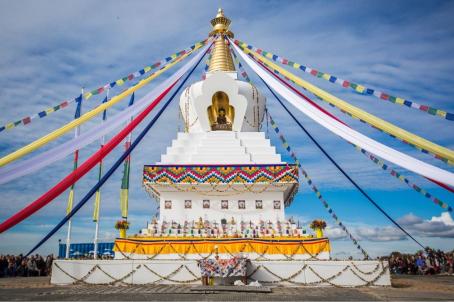
10 Buddhist stupas to discover in Europe

Stupas are symbols of enlightenment and peace that commemorate different stages of Buddha's life. Since the mid-20th century, thousands of stupas have begun to populate Europe. We have compiled some of the most impressive ones in this list.