Explore Religious Heritage Across Europe

Here you can search for a building to visit. You can use the map find destinations, or you can use the filters to search for a building based upon what different criteria.

Refine search

Hervormde Kerk

Randwijk, NL

Reformed church. Of the medieval church, only the late Gothic, single-nave, three-sided closed choir remains. The west side of the nave was irreparably damaged when the tower was blown up in 1944-1945. Under the leadership of ir WJG van Mourik, the choir was restored and a completely new nave was built, more or less in keeping with the style of the choir. Against the west side, a large square tower with a pointed roof and bell spire. The work was completed in 1953, during which the nave, which had been badly damaged in 1944, was subsequently rebuilt in quasi-Gothic forms.
Hervormde Kerk

Piershil, NL

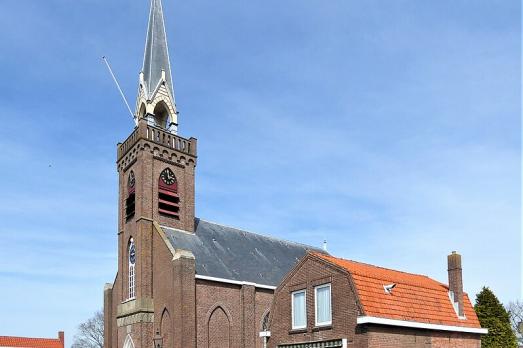
Reformed church. Rectangular hall church, after 1524, in late Gothic forms with barrel vaults and tie beams. North wing from 1643. Late Gothic tower with a decoration of arched niches, restored around 1964. The inventory includes a pulpit with lectern, baptismal font holder and baptismal fence, all second quarter 17th century. A precentor's lectern, 18th century. A lord's pew with carved coats of arms and arch panels, second quarter 17th century. A lord's pew with attachment in Louis XIV forms. Five mourning boards in carved frames, 1775, 1757, 1760, 1762 and 1794. Bell tower with chime consisting of a bell by C. and DJ Ouderogge, 1642, diam. 49 cm and a bell by J. Specht, 1753, diam. 48 cm.

Hervormde Kerk

Een, NL

Originally a reformed evangelism, founded in 1912.

Hervormde Kerk

Nieuw-Beijerland, NL

This church is listed as a National Monument of the Netherlands.

Hervormde Kerk

Herbaijum, NL

Reformed Church with roof turret on churchyard. In 1872 largely renovated church, which has retained the medieval north wall. Bell frame with bell of anonymous founder from the 14th century, diam. 72 cm. The bell has a crack in the lip and has been taken out of use. In the churchyard some 17th century gravestones.

Hervormde Kerk

Didam, NL

The Reformed Church in Didam worshipped in the old Mariakerk until 1951. Because this building was much too large, it was sold to the Roman Catholic parish in that year, and a small new church was built. In 1956, Van Vulpen delivered a new organ for this church. The instrument is almost identical to the organ that Van Vulpen placed at the World Exhibition "Expo 1958" in Brussels two years later. E. Verschueren from Tongeren (B) carried out revision work in 1974. Various changes were made: the pedal was placed in its own case against the back of the church on a larger new wind chest. The Vox Humana 4' of the pedal was replaced by a Fagot 16'. Verschueren adjusted the intonation of the organ and remedied the 'spucking'. Finally, the composition of the Scherp was adjusted. Hans Kriek was the advisor for the work. In the years that followed, Hans Kriek made several changes: the Scherp was changed into a Mixtuur, placed on a raised bench, in order to improve accessibility during tuning. The Quint 1 1/3' was moved up to 2 2/3'. Instead of the Cimbel, a Terts 1 3/5' from c.° was introduced. The Fagot 16', which contributed little to the total sound, was replaced by a stronger register. Since 1 May 2004, the church has been in use by the Protestant Community of Didam.

Hervormde Kerk

Hervormde Kerk

Arnemuiden, NL

The chronicler Reigersberg writes that on 9 May 1505 the first stone was laid for a new church, a cruciform church. That church was put into use in 1545 and dedicated to Saint Martin.

Hervormde Kerk

Kesteren, NL

New church, the old church was destroyed by war. The historic tower was preserved. Oak pulpit, second quarter 17th century with copper lectern and baptismal font arm; a 17th century chandelier and several 17th century tombstones.

Hervormde Kerk

Gellicum, NL

The previous church was destroyed by fire in 1928.

Be inspired

Stupkalnis.lt

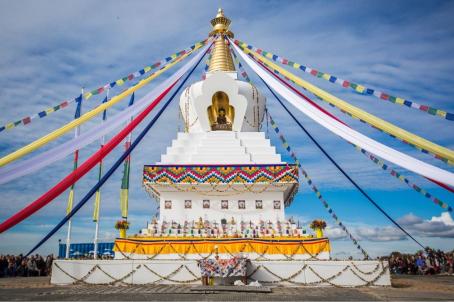
10 Buddhist stupas to discover in Europe

Stupas are symbols of enlightenment and peace that commemorate different stages of Buddha's life. Since the mid-20th century, thousands of stupas have begun to populate Europe. We have compiled some of the most impressive ones in this list.