Explore Religious Heritage Across Europe

Here you can search for a building to visit. You can use the map find destinations, or you can use the filters to search for a building based upon what different criteria.

Refine search

St. Willibrordusbasiliek

Hulst, NL

Roman Catholic Church of St. Willibrordus. Late Gothic, completely covered with cross-ribbed vaults, with an older tower at the crossing. The building, completely covered with limestone, is a beautiful example of a small city basilica in mature Brabant style. The tower, as far as the substructure is concerned, can still date from the 14th century; the church itself was built in the second half of the 15th and the first half of the 16th century. Interior: richly carved pulpit around 1800. Originally a single-manual organ made in 1610 by L. Isoré. Organ case with painted doors, which was given its current form around 1740. Reconstructed in 1971 and extended with a sub-positive and free Pedal. In the three radiating chapels of the ambulatory three stained glass windows with depictions of Willebrord (1902), Mary, Christ (signed 'Jul Dobbelaere Brugge', 1901). In the north wall of the choir window with depiction of Mary ('Rosa Mystica'). In the south wall of the choir glass with text 'Go to Joseph', signed 'Mengelberg Utrecht' and 'dd Jos Seydlitz'. Adjoining chapel with depiction of the Holy Family (1868-1893) and twelve saints. Glass in clerestory of choir closure with three scenes from the Passion story. Window in west facade with Last Judgement, signed 'Joep Nicolas 1933'. The stained glass windows are valuable art and cultural historical components of the basilica. Bell frame with chime consisting of a bell by W. Wegewaert, 1563, diam. 156 cm and a clock by Pieter Hemony, 1669, diam. 66 cm. Mechanical tower clock, B. Eijsbouts, 1915. On the wall of the south aisle there is a sundial that deviates slightly to the east.

St. Willibrorduschurch

St. Willibrorduschurch

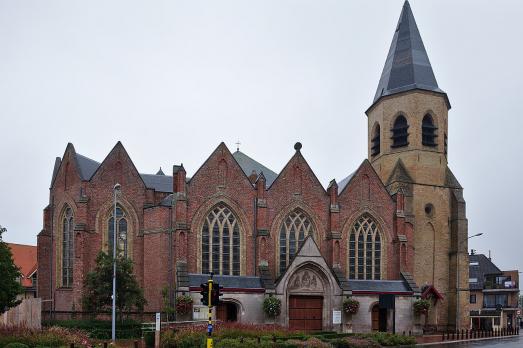
Middelkerke, BE

Middelkerke became an independent parish in 1293, but their church flooded in 1334. The building was destroyed in 1576 because of the wars of religion. The south aisle was restored in 1635 and the tower, which now served as the west tower, in 1681. The building was demolished again from 1848 until 1850, but the tower was preserved. A new church was built in neo-Gothic style. During the First World War, the church and tower were shelled by the Allies and blown up by the German occupier in 1915. From 1919 until 1921, the church was rebuilt to a design by Gustaaf Vandamme, whereby the destroyed church was reconstructed as much as possible. From 1932-1935 the church was greatly expanded, with the existing church with choir still serving as an extension of the nave, now transverse to the new church, which was constructed in a neo-Romanesque style in a south-north orientation. This last design was also by Gustaaf Vandamme.

St. Willibrorduskerk

St. Willibrorduskerk

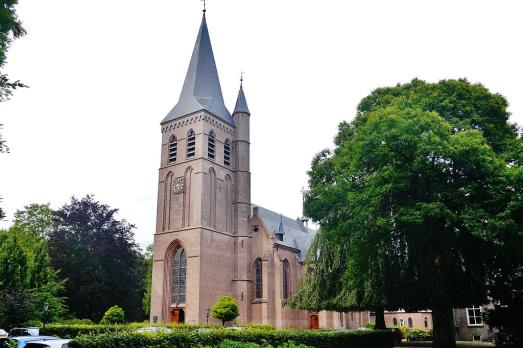
Vierakker, NL

St.Willibrordus Church, beautifully situated on estate 't Suideras in Vierakker, was built in 1869-1870.

St. Wolfgang's Church

St. Wolfgang's Church

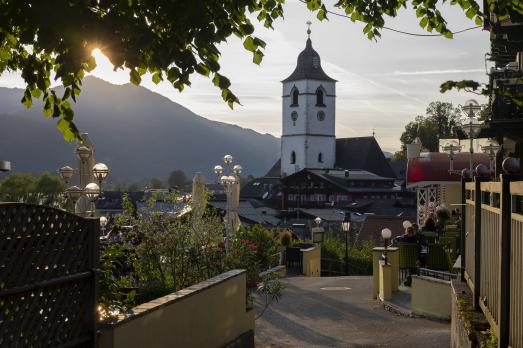
St. Wolfgang im Salzkammergut, AT

St. Wolfgang's Church is a pilgrimage church, first mentioned in 1183. According to legend, it was preceded by a church founded by St. Wolfgang himself in 976. The present building, however, dates mainly from the 15th century, after the previous church was destroyed by fire in 1429. The church was enlarged in the Rococo style in 1713, but the church is still almost entirely preserved in its late Gothic style.

St.-Antonius van Padua kerk

Nijnsel, NL

Charming little neo-Romanesque church with tower, in the hamlet of Nijnsel. This church is listed as a National Monument of the Netherlands.

St.-Augustinuskerk / Evangelisch Lutherse Kerk

Middelburg, NL

The small square Lutheran church at the Suikerpot had become too small at the beginning of the 18th century. A new church was built based on a design by the city architect, as evidenced by a memorial stone in the church: "This church was completed in the year 1742 Under the leadership of Mr. Jan de Munck Famous architect of this city Middelburg In whose honor the Lutheran community erects this memorial". The church was restored in the 1960s. The slates were recently replaced. This church is listed as a National Monument of the Netherlands.

St.-Bavokerk

Nuth, NL

Roman Catholic Church. Nave with west tower from 1763 in the style of the Aachen architect Laurensz Mefferdatis; transept; choir and side aisles modern. Baptismal font ca. 1200, two gentlemen's pews in Louis XV style and two 19th century. Limestone holy water (18th century). Gravestone, 1697. In the churchyard thirteen stone grave crosses, 1624-1746. Single-manual organ (national monument), made in 1763, possibly by H. Möseler. The organ was internally renovated in 1980 by L. Verschueren (Heythuysen).

St.-Jacobskapel

Galder, NL

Chapel of St. Jacob. 16th century hall building with three-sided choir closure and a western tower, restored in 1628, with diagonal buttresses. Bell frame with bell by P. van den Ghein, 1553.

St.-Jansbasiliek

Laren (NH), NL

St. John the Baptist, built in 1924-1925 to a design by architect Wolter te Riele Gzn. from Utrecht. The church, built in a neo-Gothic architectural style with expressionist details, replaced a water board church from 1844, which stood west of the current church. The church was consecrated on 29 October 1925 by the Bishop of Utrecht; on 8 December 1937 the church received the honorary title ""Basilcia Minor"". Every year on the Sunday of St. John the sacrament procession leaves from this church to the St. John's churchyard on the Langsakker: this is the only procession on the public road above the major rivers. Together with the rectory (Brink 33), the former monastery (Brink 29) and the former girls' school, the church forms a monumental facade wall along the east side of the Brink in Laren. The church is set back from the building line and is separated from the road by a forecourt and a brick boundary with two monumental lanterns. The interior contains fourteen frescoes from the Stations of the Cross, painted by PC de Moor, which are also protected. The organ is not protected.

Be inspired

Stupkalnis.lt

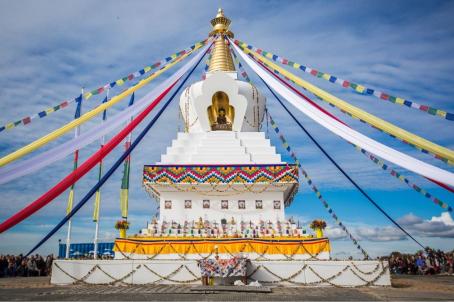
10 Buddhist stupas to discover in Europe

Stupas are symbols of enlightenment and peace that commemorate different stages of Buddha's life. Since the mid-20th century, thousands of stupas have begun to populate Europe. We have compiled some of the most impressive ones in this list.