Explore Religious Heritage Across Europe

Here you can search for a building to visit. You can use the map find destinations, or you can use the filters to search for a building based upon what different criteria.

Refine search

Witte kerk

Heiloo, NL

Reformed Church. Single-nave building, 11-17I, with three-sided closure, 17I. Pulpit and baptismal fence, 17I. Two lecterns, two baptismal arches and a baptismal font holder of copper, 17I. Between portal and church a carved crowning with the coat of arms of Heiloo, 18a. Sarcophagus lid of red sandstone re-used as a gravestone (Gothic letters). Gravestone of a minister 1636. Cabinet organ from ca. 1810.

Witte Kerkje

Lochem, NL

This church building dates from 1909. The then congregation of the Reformed Church of Lochem had this new church built in one year. The building offered space for 100 people. The building was a very heavy financial drain for the congregation of 75 souls at the time. The chairs in the church were therefore initially rented to the members of the congregation. In 1918 this rental stopped, because it also caused many problems. In 1953 the house next to the church was purchased to make expansion possible. The number of members of the congregation had already increased to over 270 souls. In 1955 the side rooms were also built. The number of seats increased to 282. In the 1960s the church again proved to be too small and it was decided to hold double services. At the end of the 1960s the double services were stopped again and the morning services were held in the theatre. However, renting the theatre proved to be too expensive. In the early 1970s (yes, even then!) it was considered to help pay for the restoration of the Gudulakerk and then share it with the Reformed brothers, so that there could be a Reformed and a Reformed service every Sunday morning. These restoration plans remained too vague and therefore it was decided to move to the Roman Catholic church on the Nieuweweg for five years. The last major expansion took place in 1985. The old sexton's house was added to the church and the 'bar room' was added to the church. As a result, the church hall offered space for 425 visitors and from that moment on the morning services could take place in the Witte Kerk again. (source: Reformed Church Lochem 1895-1995)

Witte Kerkje

Baarn, NL

Nickname "The White Church". Charming hall church with tower, in neo-Romanesque forms. Also for a time in shared use as the Reformed Church Liberated (GKV) Baarn. The GKV Baarn later merged with the GKV Soest, where they use the church building De Schuilplaats .

Witte Kerkje

Huis ter Heide, NL

It is a simple hall church that was built in typical water board style at the time . At the end of the long and rectangular hall is the pulpit . Round arch windows are one of the many classicist details that the church has.

Witte Kerkje

Noordwijkerhout, NL

Historic village church with tower. Originally dedicated to Saints Peter and Paul. This church is listed as a National Monument of the Netherlands.

Witte Kerkje

Haren, NL

Church built in 1937 for the Liberal Reformed Church, who still use the church today.

Witte Kerkje

Sneek, NL

Built as Christian Reformed Church (CGK). Hall church in sober neo-Romanesque style, with round arch windows and a small bell pylon above the front facade. Damaged by fire in 1966, after which it was restored in a modified, more sober form. Since January 2005, the Reformed Church (GKV) has also been holding church services here. In 2008, the church was temporarily out of use due to renovations. The CGK and the GKV began discussions in 1992. A joint church service was held for the first time in September 2002. In 2004, the Reformed Church was able to sell its building profitably to the Fries Scheepvaartmuseum next door. And since 1 January 2005, both have been using the CGK building. Initially, there were separate morning services and joint afternoon services. But soon all services were held jointly and the federation was formed on 1 January 2007. On November 23, 2008, the first church service was held in the fully restored and renovated Chr. Geref. Church. The restored church was officially put into use on Saturday, February 28, 2009. The so-called White Church, built in 1907 and rebuilt after a fire in 1966, is the permanent home of the CGKV church. During the restoration, church services were held in the former youth hostel De Wigledam on the Oude Oppenhuizerweg, behind the former Kingfabriek. (53-05/54-05/57-07/61-09) Dbb.

Witte of Lambertuskerk

Heemserveen, NL

Reformed Church. Single-nave church (15th century) with three-sided closure, extended on the north side in the previous century and in 1936. Pulpit (1681) with copper lectern (17th century), iron baptismal font holder (18th century), remains of an oak bench, tombstones, sandstone baptismal font. (13th century).

Wolf Popper Synagogue

Wolf Popper Synagogue

Kraków, PL

The Wolf Popper (Bocian) Synagogue in Krakow is an Ashkenazi synagogue from 1620. The synagogue was restored throughout the 19th century and for the last time in 1904. This baroque stone synagogue now serves as a cultural centre.

Wooden articular church in Kežmarok

Wooden articular church in Kežmarok

Kežmarok, SK

The wooden joint church of Kežmarok is a 17th century Protestant church. The bricks, prohibited in the original construction, were added to the building during the last repair in the 1990s. As part of the wooden churches of the Slovak Carpathians, the building is a UNESCO World Heritage Site.

Be inspired

Stupkalnis.lt

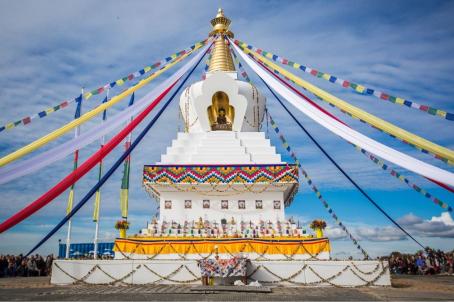
10 Buddhist stupas to discover in Europe

Stupas are symbols of enlightenment and peace that commemorate different stages of Buddha's life. Since the mid-20th century, thousands of stupas have begun to populate Europe. We have compiled some of the most impressive ones in this list.