Explore Religious Heritage Across Europe

Here you can search for a building to visit. You can use the map find destinations, or you can use the filters to search for a building based upon what different criteria.

Refine search

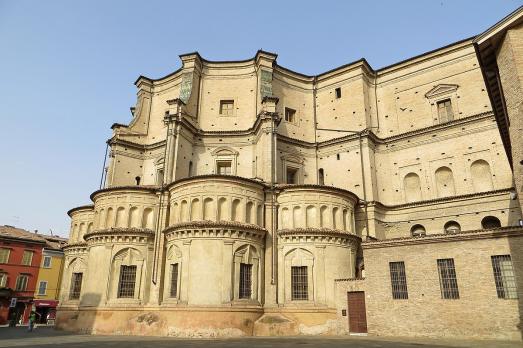
Church of the Santissima Annunziata

Church of the Santissima Annunziata

Parma, IT

The church of the Santissima Annunziata was built from 1566 to the 17th century as part of the nearby convent of the Friars Minor. The original church of the convent of the Santissima Annunziata was built in 1546 to make way for military structures. The Mannerist building consists of a central body with an elliptical plan with ten apses (five on each side) arranged in a radial pattern around the sacred hall: the building is accessed through a monumental entrance arch located in Via d'Azeglio, formerly the main road of Santa Croce, and the portal is dominated by a large stucco relief, a Madonna Annunciata, located above the tympanum of the central door and built in 1681 by Giovan Battista Barberini.
Church of the Santissima Annunziata

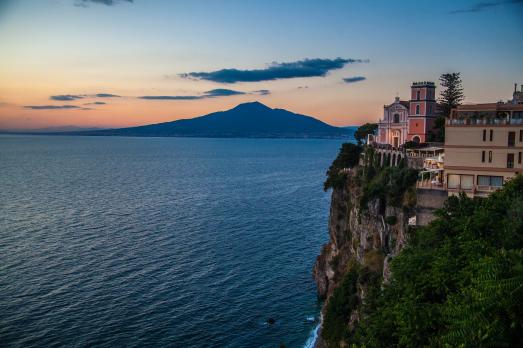
Church of the Santissima Annunziata

Vico Equense, IT

The church of the Santissima Annunziata was the cathedral of the diocese of Vico Equense until 1818, when it was suppressed and incorporated into the church of Sorrento. The first cathedral of Vico Equense was located on the beach, in the lower part of the city, but subject to pirate raids it was moved and rebuilt to a higher area. The new church was built probably between 1320 and 1330, and major restoration work was carried out between 1773 and 1792, including a reconstruction of its façade.

Church of the Saviour of Aveleda

Church of the Saviour of Aveleda

Lousada, PT

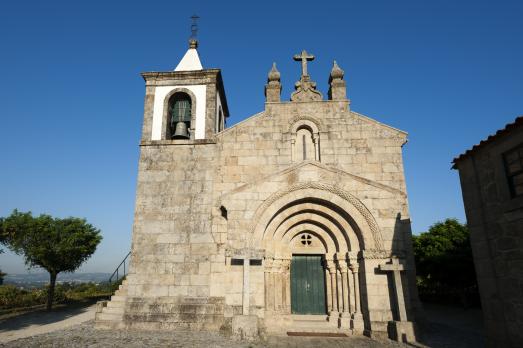
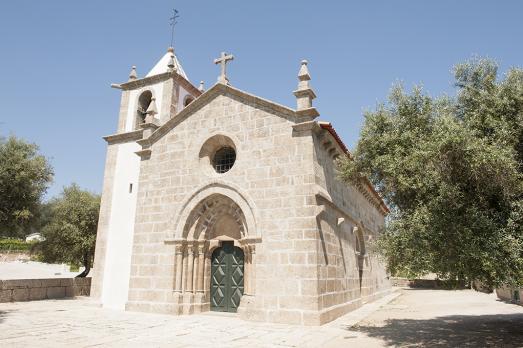
The foundations of the Church of the Saviour of Aveleda date back to the 11th or 12th century. In 1177, Vela Rodrigues donated the Church to the Monastery of Paço de Sousa. The architecture and ornamentation of the current building, dating from the end of the 13th century or the beginning of the 14th century, are evocative of the long persistence of the Romanesque shapes which characterise Portuguese medieval architecture. The main portal preserves the most evident, though very late, Romanesque elements in the columns [botanical capitals, circular shafts, bulb-like bases] and clean tympanum.The lateral portals without columns and the modillions stripped from decoration also reflect the late character of the construction. A typically Romanesque drip-course runs along the exterior walls of the nave. The bell-tower, the chancel and the sacristy are most likely 17th and 18th century. The collateral altars, the pulpit, the painting of the nave ceilings and the crossing arch, as well as the coffered ceiling of the chancel with symbols of the Litanies to the Virgin, are Modern Age works which also deserve a mention. The presence of a decorated piece, which may be found in one of the steps inside the Church, may point to the former existence of an ancient Visigoth or Mozarabic construction [5th-8th centuries].

Church of the Saviour of Cabeça Santa

Church of the Saviour of Cabeça Santa

Penafiel, PT

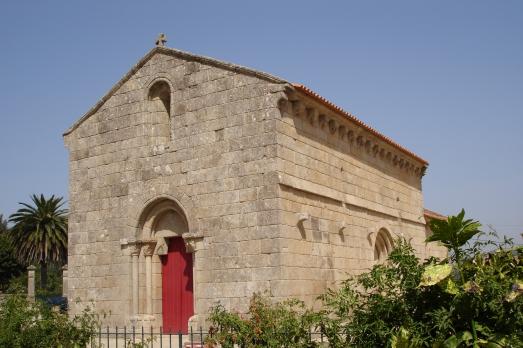
The Church of Cabeça Santa dates back to the first half of the 13th century and is an excellent example of Portuguese Romanesque architecture. The constant displacement of artisans [masons, sculptures, carpenters] in medieval times promoted the repetition of constructive and ornamental models in several territories. The portals and sculptures in the capitals of Cabeça Santa are very similar to those in the Church of Saint Martin of Cedofeita in Porto, which is decorated in a very similar way to the Romanesque Cathedral of Porto and other examples of the Romanesque style in the region of Coimbra. The main portal presents a tympanum with heads of cows, built to symbolically protect the entrance to the Church. A representation of a street performer [acrobat] stands out in the south portal for its originality. The artistic set of the Chapel of Our Lady of the Rosary, from the Modern Era [17th-18th centuries], deserves special attention. Inside the Church are the remains of three graves excavated in the stone and three medieval tombs.

Church of the Saviour of Fervença

Church of the Saviour of Fervença

Celorico de Basto, PT

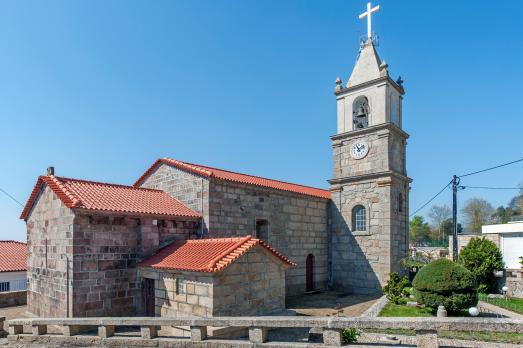
Church of Romanesque nature, from whose period and style only the vaulted chancel remains. This presents a décor with an unusual quality for the region. In fact, a comparison can be drawn between the ornamentation of the capitals of the triumphal arch, composed of botanic and phytomorphic motifs, with the ones from the Church of the Monastery of Ferreira (Paços Ferreira).In the chapel, various influences are blended, some from the buildings constructed on the left bank of the River Minho, with influence from the construction site of the Cathedral of Tui, while others originated from the Romanesque found on the Braga-Rates axis, which had the biggest impact on the basins of Tâmega and Douro. The existing evidence points to the second quarter of the 13th century. Outside, it is still possible to observe the buttresses that support the now broken barrel vault. In its side façades, the cornices are supported by corbels, of geometric decoration, and among which we point out a cask, the rolls motif or a composition made with volutes.The nave of the Church is the result of a reconstruction carried out in the 1970s and may have even used part of the original Romanesque building.

Church of the Saviour of Lufrei

Church of the Saviour of Lufrei

Amarante, PT

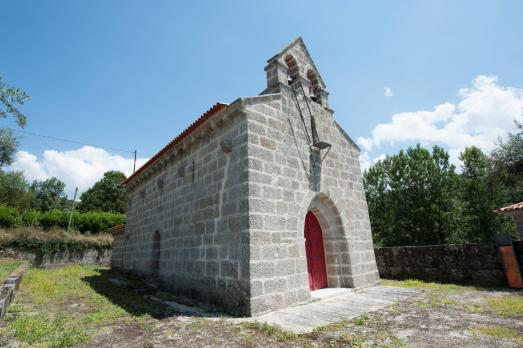
The temple of Lufrei, located in a valley near the confluence of two small water creeks, was once the seat of a small female monastic institute of which no traces remain.The Church, secularized in 1455, integrates the category of late Romanesque, witness of the vernacularity and popularity that such style had among rural communities in northern Portugal.Without any carved decoration, the Church is lit by narrow crevices positioned at key points of the building. The quadrangular corbels and the arrangement of the portals attest for its late execution.The interior was radically changed in Modern Age. The altarpiece [main altar] of Mannerist nature stands out, where paintings, "painted old style" are found preserved, as described in 1726 by the memoirist Craesbeeck.Also the two altarpieces [altars] of the nave feature traits from this period. However, what most arouses our curiosity are mural paintings hidden under the bed of plaster that covers the entire Church, though some traces are already visible both in the chancel and in the nave.

Church of the Saviour of Real

Church of the Saviour of Real

Amarante, PT

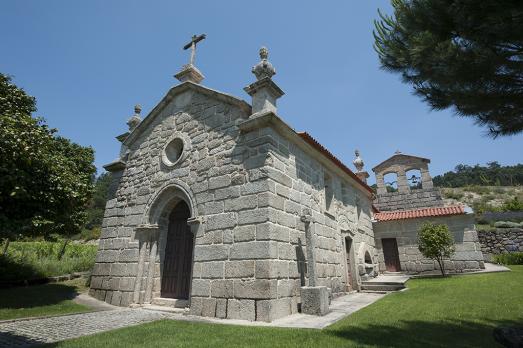
The Church of Real is situated on a small hill in a secluded location. Built-in the first quarter of the 14th century, it falls into the category of late Romanesque, as shown by the main portal, with no tympanum, with columns headed by capitals deployed of voluminous sculpture. This is an adaptation of the influence of the Romanesque from the city of Porto may have arrived here through Travanca (Amarante) since the Church of Real belonged to the patronage of that Monastery. On the south side façade, one can still enjoy an arcosolium with sarcophagus, whose lid bears an engraved sword, which demonstrates the social status of those who are buried there. Close to this stands a bell tower clearly showing Romanesque traits. The 18th century and the Baroque changes have left deep marks in this Church. Large windows for lighting were opened, three aligned crosses were placed in the gables and the cressets in the corners of the nave. Furthermore, the variations at the level of the structure are also evidence that this building was modified enough throughout its history. Inside, even today, one may appreciate the consecration crosses, of Romanesque nature, pattée and inscribed in a circle. In 1938, Real was no longer a mother church.

Church of the Saviour of Ribas

Church of the Saviour of Ribas

Celorico de Basto, PT

Tradition credits the Canons Regular of Saint Augustine for having founded a small monastery in Ribas. It would be up to D. João Peculiar, archbishop of Braga, to protect the monastery marked by the presence of father D. Mendo, whose body would provide miracles long after his death in 1170, although this has not been proved by documents. We should point out the homogeneity of the Church of Ribas, which must have been built in one go. The decoration shows great consistency in its preference for pearl motif, which appears both inside and outside the Church. Inside, as with most Romanesque churches, another spirit prevails, marked by the counter-reformation and by liturgical renewal following the Council of Trent (1545-1563). Examples of this include the exuberance of the gilding in altarpieces [altars] and valance that crowns and covers the triumphal arch, the sectioned box ceiling and the choir balustrade. Noteworthy from this set are images of the Holy Savior, the Virgin of the Valley and the Virgin of the Rosary. In the back wall of the chancel, behind the altarpiece [altar], a major campaign of mural paintings was identified, where the patron saint of the Church is depicted.

Church of the Saviour of Tabuado

Church of the Saviour of Tabuado

Marco de Canaveses, PT

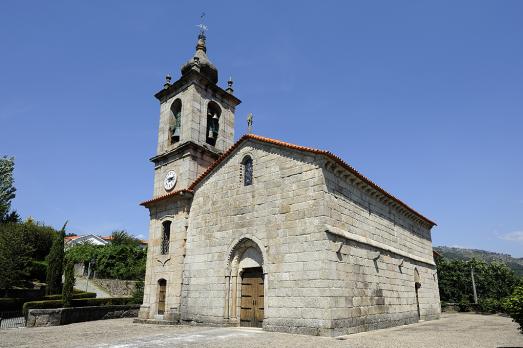
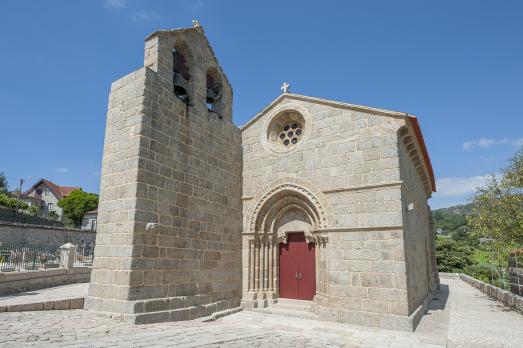
While sources attest the existence, in the 12th century, of two temples in Tabuado, one dedicated to Saint Mary and another one to the Saviour, the latter seems to have won out as the leading patron. This was, however, erected later on, probably in mid 13th century, according to the proto-Gothic rosette in the main façade and other ornamental elements of the building. The main portal stands out for its quality: tympanum supported on corbels [salient support stones] in the form of bovine heads (such as the ones in the Monastery of Paço de Sousa, Penafiel) and capitals carved with botanic motifs. Also featured here is the pearls motif, recurrent in the Romanesque of the basins of the Tâmega and Sousa. The belfry stands as a defensive tower. In the body of the nave, and at the level of the cross arch, two buttresses remain, which accentuate the volumetrics of the Church. Inside, the most evident trace of the Romanesque is the triumphal arch, whose archivolts sit on two columns, with the lines of ashlars decorated with saw teeth and chained circles. Their capitals result from a contemporary arrangement. Vibrant is the 16th-century mural painting that covers the back wall of the chancel, depicting Christ as a judge, flanked by Saint John the Baptist and Saint James, the Greater.

Church of the Saviour of Unhão

Church of the Saviour of Unhão

Felgueiras, PT

The Church of the Saviour of Unhão is an excellent example of Portuguese Romanesque architecture and sculpture, highlighting the main portal with its botanic decorated capitals. Despite the transformations it has undergone throughout the years, the inscription that marks the Dedication of the Church [consecration and beginning of services at the church] on 28th January 1165, celebrated by the archbishop of Braga, D. João Peculiar, has been preserved. The reference to "Magister Sisaldis" and the existence of a series of initials (marks of the mason) with a big "S" seem to indicate the name of the master artisan who oversaw the work, a rare element in the panorama of Portuguese Romanesque architecture. The Church of Unhão maintains its Romanesque nave, built in the first half of the 13th century. Inside, the image of Our Lady of the Milk, a sculpture in polychromatic limestone of unknown origin, stands out. The absence of movement in the image, the size of the head and hands and her fixed, blank stare suggest that this is a Romanesque sculpture. However, the fact that the Son is represented as a child, naked and gazing at the Madonna, is a feature more common of the Gothic style.

Be inspired

Stupkalnis.lt

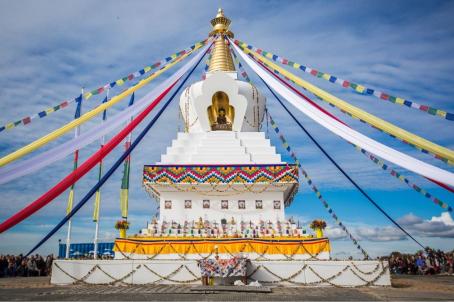
10 Buddhist stupas to discover in Europe

Stupas are symbols of enlightenment and peace that commemorate different stages of Buddha's life. Since the mid-20th century, thousands of stupas have begun to populate Europe. We have compiled some of the most impressive ones in this list.