Doopsgezinde Kerk
Goes, NL
Built as a Mennonite Church. Small hall church without a tower.

Here you can search for a building to visit. You can use the map find destinations, or you can use the filters to search for a building based upon what different criteria.
Goes, NL
Built as a Mennonite Church. Small hall church without a tower.
IJlst, NL
Mennonite church with extensions. The church has a neck gable dated 1857; heavily framed entrance. On either side service buildings under a saddle roof with a shield in front and behind and chimneys above. Six-pane windows. Cast iron fence along the church grounds. Pavement posts of the service buildings. Single manual organ, made in 1881 by Bakker and Timmenga.
Noordhorn, NL
Mennonite church from 1838. The side walls are divided by lesenes, between which there is a semicircular closed window. It also has a framed entrance. This church is listed as a National Monument of the Netherlands.
Bolsward, NL
The Bolsward clandestine church is located behind the building line of the buildings in the street. Built in 1809 and expanded and embellished from 1848 to 1855. Framed entrance (all mid-19th century). With a roof turret.
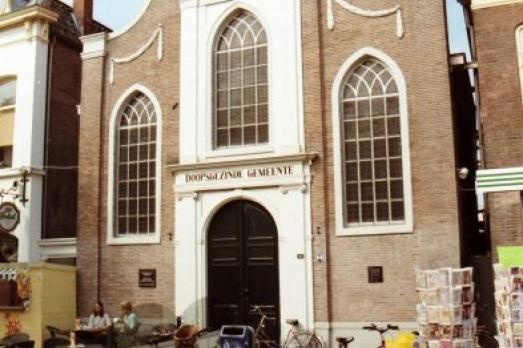
Almelo, NL
The Doopsgezinde Kerk (Mennonite Church) in Almelo was built in 1684. In 1732, the church was expanded and the current facade was added. The building was restored in 1978. It is listed as a National Monument of the Netherlands.
Rottevalle, NL
Mennonite Church. Simple hall building according to the facade stone from 1838. Two weather vanes, a ship and a horse.
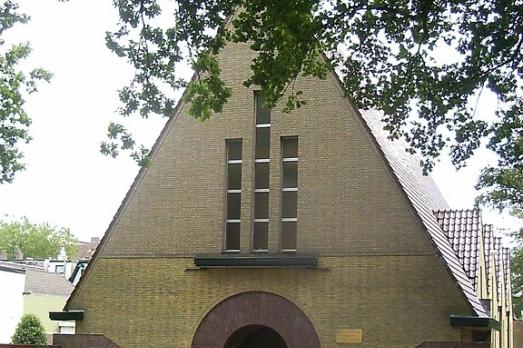
Apeldoorn, NL
Interesting reconstruction building. Built to replace a synagogue from 1890. The synagogue is situated on its own on the south-east side of the Paslaan in the part east of the Kerklaan. Here the building is situated on its own terrain that is separated from the pavement by an associated fence. In the street there are several other (partly) detached objects, mainly dating from the 19th century, next to and opposite the synagogue.
Deventer, NL
This important, beautiful church building without a tower is almost entirely built into an (irregular) residential block. Of the exterior (unless the church is open) only something can be seen at the back. In 1588, during the years of the restoration of the Spanish rule in Deventer, the Catholic merchant and mayor Macharius Penninck bought the hereditary property of the noble family Swaefken between Brink and Spijkerboorsteeg. The showpiece facade was probably built in 1597. A new "city palace" was built on the site of the old buildings.
Grou, NL
Frontage of the Mennonite Church. Above the gate passage, next to which two six-pane windows, floor with three such windows. Facade closed off by block moulding. Hidden church in a three-sided closed hall building covered by a barrel vault from 1829. Simple pulpit. Originally a single-manual organ made in 1872 by the Gebr. Adema from Leeuwarden. Modified in 1920 by Bakker and Timmenga.
Middelburg, NL
This church is listed as a National Monument of the Netherlands.
new
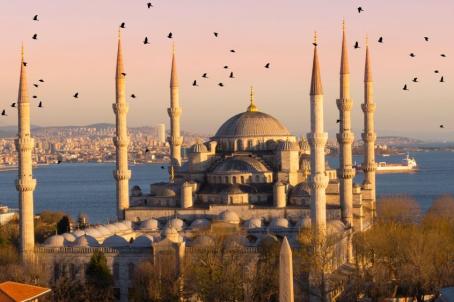
For a long time, Europe was ruled by powerful monarchies. Monarchy and religion have been connected since time immemorial. Here are 7 sites across Europe where royalty historically bent the knee to a higher power and received their crown.
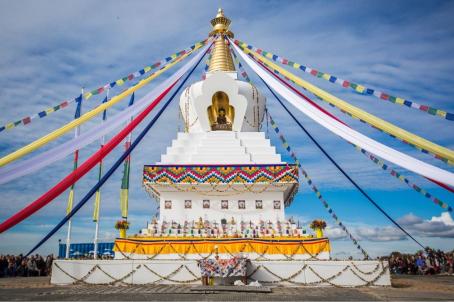
Stupas are symbols of enlightenment and peace that commemorate different stages of Buddha's life. Since the mid-20th century, thousands of stupas have begun to populate Europe. We have compiled some of the most impressive ones in this list.
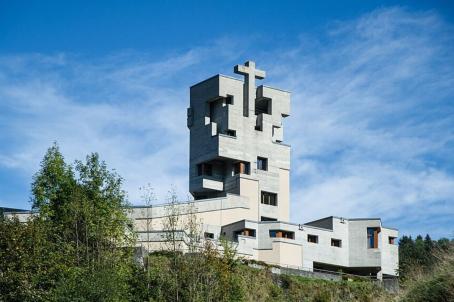
Walter Maria Förderer (1928–2006) was a Swiss architect and sculptor renowned for his neo-expressionist church designs in the 1960s. In this list we have compiled 6 of his church designs that seamlessly integrate religious and secular elements.

How is Religiana helping to conserve and promote Religious Heritage in Europe and why should you get involved?
Find out about Religiana
Are you a tourism organisation or religious heritage sites manager? Discover the advantages of becoming a partner.
See current partners
We can keep you up to date with the latest news from Religiana and religious heritage conservation across Europe.
Sign up to the FRH newsletter