Explore Religious Heritage Across Europe

Here you can search for a building to visit. You can use the map find destinations, or you can use the filters to search for a building based upon what different criteria.

Refine search

Grote Kerk

Halle, NL

Interesting reconstruction church in traditionalist style, built under the influence of the sober Protestant church architecture of the eighteenth century and classicism. The crowning of the tower dates from 1976.

Grote Kerk

Grote Kerk

Apeldoorn, NL

On the site of a former burnt down church from 1842. Large church with tower. One of the largest and most monumental still existing Reformed church buildings from the period 1850 - 1950. Now PKN.

Grote Kerk

Hoogeveen, NL

Built as a Reformed Church. Expansions 1766, 1801 and 1804. The Grote Kerk is closely linked to the history of the place Hoogeveen. At the beginning of the dyeing in 1631, by the General Company of the 5000 Tomorrow, it was determined that an area of 100 tomorrow had to be kept separate from peat including ground. The proceeds were for church, school and the poor.

Grote Kerk

Sliedrecht, NL

Dutch Reformed Church. Simple building of late 18th century character, with three-sided closures on the east and west sides, an extension with pediment on the north side and a heavy brick tower on the west side, the lower part of which gives the impression of being late medieval, but which otherwise dates from the 19th century. Inventory: beautifully carved pulpit with baptismal fence and decorated psalm boards in Lod. XV shapes. Richly carved organ case in transition Lod. XIV-Lod. XV. In it an organ with main work, upper work and free pedal, built in 1852 by CFA Naber (Deventer). Bell tower with bell by H. Meurs, 1604, diam. 91 cm.

Grote Kerk

Emmen, NL

Dutch Reformed Church from 1856, tending towards water board style, with historical tower. Formerly dedicated to St. Pancratius.

Grote Kerk

Monster, NL

For centuries, the tower of Monster was a familiar landmark for sailors who came into sight of the coastline. The fact that the restoration of the tower in 1662 was subsidized by the Admiralty of Rotterdam, among others, indicates the importance of the tower for shipping. Skippers and helmsmen, "living in the village of Heijde" (Ter Heijde), submitted a request to the municipal authorities of Monster in 1734. They wanted the tower not to be demolished, but to be preserved as a beacon when entering the Maas from the sea. If the tower were no longer there, all sea charts would have to be remade, according to the skippers. The tower was preserved. During a storm in 2019, no one was allowed to walk past the tower of Monster. Parts of the scaffolding, which were around the tower for a restoration, had come loose due to the wind. The fire brigade had cordoned off the area. The tower is now restored and the scaffolding has been cleared away. This church is listed as a National Monument of the Netherlands.
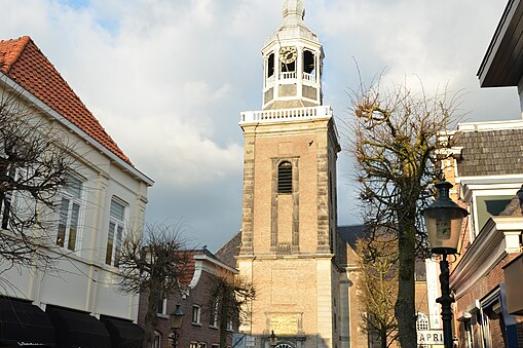
Grote kerk

Marken, NL

Three-aisled pseudo-basilica with a three-sided choir under a slate-covered saddle roof and with a tower at the entrance, built in 1903 -1904 and designed by AHLKups.

Grote Kerk

Gorinchem, NL

Built in 1849-51 to a design by I. Warnsinck on the site of the Gothic hall church that had been demolished in 1844 and in connection with the - separately protected - medieval Sint Janstoren. The church building, built in red brick, alternating with yellow ornamental bricks, on a natural stone plinth under slate-covered saddle and lean-to roofs, is straight-ended and contains an extended entrance portal on the east side, with the main entrance fitted with double panelled doors, a semi-circular and subdivided fanlight, a wooden pilaster frame and two lanterns with a wrought-iron volute arm, as well as a rose window in the pointed top and narrow side entrances on either side of the portal.

Grote Kerk

Drachten, NL

The first stone of this church was laid in 1742 by Hector Livius van Haersma, aged 5. Because Drachten was a peat digging village at the time, the weather vane shows 3 peat pieces.

Grote Kerk

Hengelo, NL

Designed and built in 1848 in neo-classical style by Rijkswaterstaat. During the restoration and modernization in 1990-1991, new construction was carried out at the rear that was not protected and the entrance was moved from the front to the rear. The church is currently used as an auditorium and concert hall of the Music School.

Be inspired

Stupkalnis.lt

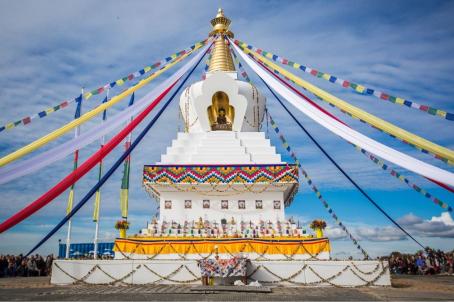
10 Buddhist stupas to discover in Europe

Stupas are symbols of enlightenment and peace that commemorate different stages of Buddha's life. Since the mid-20th century, thousands of stupas have begun to populate Europe. We have compiled some of the most impressive ones in this list.