Explore Religious Heritage Across Europe

Here you can search for a building to visit. You can use the map find destinations, or you can use the filters to search for a building based upon what different criteria.

Refine search

Heilige Nicolaas

Odijk, NL

Traditionally, the parish of Odijk belonged to the archdeaconry of Oudmunster. In Odijk there were grounds, 'a court' which were successively in the hands of the German emperors (end of the 10th century), the archbishop of Cologne (until 1019), the Benedictine abbey of Deutz (until 1256) and finally of the count of Gelre. The oldest church building of Odijk, a chapel, probably stood within this court. This was probably a 'daughter' of the church of Werkhoven. In the 12th century, a Romanesque cruciform church with tower was built in Odijk. This church was probably dedicated to St. Heribert. In the sixteenth century, around 1547, the choir of this church was replaced by a late Gothic choir. In the 19th century, the tower, the transept and the nave were demolished. What remained, the choir, is the current Dutch Reformed Church (the 'white church'). During the Reformation, Odijk initially remained Roman Catholic. From 1564, Evert Aelbertsz. was pastor in Odijk and around 1593 he baptized Protestants and Catholics, depending on the denomination of the parents. After the death of this last Catholic pastor, the people of Odijk went to church in Bunnik (Rhinauwen castle), Blikkenburg castle south of Zeist and also to Rijsenburg castle. In 1718, a new church was built in the hamlet of Schoudermantel near Bunnik. This church became the heart of the Bunnik station, which also included Odijk.

Heilige Nicolaas

Kuinre, NL

Small reconstruction church with tower, put into use as a Reformed Church in 1958. In use as such until 1972.

Heilige Nicolaas

Muiden, NL

Single-nave church with neoclassical, stately façade, turret and bollards, early 19th century. Neo-Romanesque transept and choir from 1894. In the choir of the church a bell by Melchior de Haze, 1686, diam. 39.2 cm. This church is listed as a National Monument of the Netherlands.

Heilige Nicolaas

Helvoirt, NL

Since the 12th century, there has been a religious community of Christians in Helvoirt. In the beginning, they met in a chapel (from 1192). This chapel was renovated several times and around 1375 a Romanesque church was built. Around 1510, after major renovations, this church was given its current Gothic form (The 'Old Church' on the Van Grevenbroeckstraat). With the Reformation, this church passed into the hands of the Reformed in 1648. The Roman Catholic community built another church around 1675, this time on the Dreef. This was a barn church with clay walls and a thatched roof. Later in 1724, this would be replaced by a new barn church, now with stone walls. In 1840, the Waterstaatskerk came into use for the parish. On 30 April 1901, the foundation stone was laid for the current neo-Gothic St. Nicholas Church, which was officially consecrated on 5 October 1903. The church was built under the architecture of architect JHH van Groenendael, and was placed on the list of the National Service for the Conservation of Monuments as a recognised national monument in 1974.

Heilige Nicolaas

Sint Nicolaasga, NL

St. Nicolaas, 1885-1887, JD van de Weide. Neo-Gothic cruciform basilica with a two-storey tower with balustrade, spire and pinnacles, supported by perpendicular and diagonal buttresses. Brick-built cluster pillars on hardstone bases, cross-ribbed vaults. A star vault over the crossing. Rose windows in the west facade of the tower and in the end gables of the transept. Plastered wall surfaces, structural parts treated as fair work. Neo-Baroque communion bench, now converted into an altar; neo-Gothic interior with the exception of the pulpit still present. A bronze baptismal font by the Brom brothers from 1933, carried by four prophets. Tub and lid with twelve biblical scenes and crowned with the scene of the baptism of Christ. Mechanical tower clock B. Eijsbouts, Asten, 1925, no. 871, later fitted with electric winding.

Heilige Nicolaas

Schalkhaar, NL

Three-aisled neo-Gothic pseudo-basilica with front tower, designed by G. te Riele. Stylistically influenced by the late Lower Rhine Gothic and by the work of A. Tepe. In 1933 drastically changed and expanded with a new transept and choir by J. Haket. On the choir tribune provided with letter panels a single-manual organ from 1900, made by Ludwig Schwarze (1858-1925) from Anholt. In the period January to June 2005 the church (1895, G. te Riele) was restored. The chancel in particular has been changed and is now much more functionally furnished. This means that the church can be given a multifunctional purpose, such as a concert hall. (54-05)

Heilige Nicolaas

Heythuysen, NL

Late Gothic pseudo-basilica, with west tower and two western bays from 1847-19th and wide side aisles, built in 1927 to replace the Gothic ones, which were narrower. Short five-sided closed choir, 16th. Decorative vault paintings in choir and nave, 1507. Communion rail, 18th; two confessionals, respectively 1704 and 1773; marble baptismal font, 19th century; pulpit, 19th century; pews, 19th century, porch, 18th century. Wooden statues: St. Joseph, 15th century; calvary group, 16th century; St. Lucia, 17th century, crucifix, circa 1700, Madonna, circa 1700, in the churchyard fragment of a gravestone, 17th century and stone grave crosses, 1604-1761.

Heilige Nicolaas

Eemnes, NL

Roman Catholic church 1845, elongated house of worship with built-in tower against which adjoins the rectory. In the bell spire a clock by Petit and Fritsen, 1892, 72 cm.

Heilige Nicolaas

Nieuwegein, NL

Built as a Roman Catholic church for the village of Jutphaas. From the outside rather sober, from the inside beautiful, extremely richly decorated neo-Gothic church, with tower. This church is listed as a National Monument of the Netherlands.

Heilige Nicolaas

Lierderholthuis, NL

Tower 1866. Church replaced old barn church from 1776. Characteristic small neo-Gothic church, prominently situated in the landscape.

Be inspired

Stupkalnis.lt

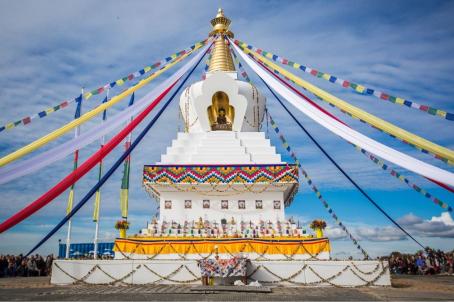
10 Buddhist stupas to discover in Europe

Stupas are symbols of enlightenment and peace that commemorate different stages of Buddha's life. Since the mid-20th century, thousands of stupas have begun to populate Europe. We have compiled some of the most impressive ones in this list.