Onze Lieve Vrouw ten Hemelopneming
Maurik, NL
Church from 1949.

Here you can search for a building to visit. You can use the map find destinations, or you can use the filters to search for a building based upon what different criteria.
Maurik, NL
Church from 1949.
Heemstede, NL
In several architectural respects this church is comparable to the Roman Catholic Church of Our Lady of Lourdes in Bergen op Zoom, designed at almost the same time, designed by the same architects, with almost the same floor plan, but higher (church hall, tower, dome). As such typical of the late oeuvre of Joseph Cuypers (1861 - 1949) (in collaboration with his son Pierre Cuypers Jr (1891 - 1982)), in which he experimented with the cross between the people's church and the central building.
Huissen, NL
Large reconstruction church with a large tower. Immediately after the destruction of the medieval parish church on 13/14 May 1943, plans were made to rebuild the church. Ir. GM Leeuwenberg designed a basilica-shaped nave in the style of the Delft School, inspired by the Romanesque architectural style, built in 1949-1950. The tower was built in 1961-1962 on the foundations of the predecessor. The church was also expanded at that time. The carillon was installed in 1965. Two chapels were set up next to the tower: that of Our Lady of Perpetual Help and the Gildenkapel, completed in 1971. The tower was restored in 1981 and 1997. Several authentic objects from the pre-war church can still be seen in the interior. Pulpit from 1656, originating from the old church .
Renkum, NL
This church replaced the previous church from 1838. Three-aisled basilica cruciform church without tower, in light expressionist forms. Sober work in the later oeuvre of Joseph Cuypers (1861 - 1949). Due to the lack of a real tower, this beautiful church is not noticeable enough. The Church of Our Lady of the Assumption on the Utrechtseweg is on the list to be closed. When the Cuypersgenootschap Foundation discovered that the church was not a municipal monument, it asked the board to grant the church the municipal monument status.
Hoogerheide, NL
Neo-Gothic church, situated on a hill and therefore visible from far. Replaced an earlier church. Expansion, including a tower, 1910 after a design by J. van Gils.
Philippine, NL
Roman Catholic brick dome church with tower and consistory designed in 1952 by Alphons M. Siebers (1893-1978) and Wilhelm M. van Dael (1912-1985). The architectural firm Van Zantbeek en Schoonis from Sas van Gent was responsible for the execution in the years 1953-1954. The church was built in a traditionalist style according to the principles of the Bossche School. It can be seen as Siebers' built argument in his discussion with JAC Tillema in the Katholiek Bouwblad in 1951-1952 about the values of post-war (Catholic) church construction and the relationship between liturgy and architecture. Important artists made high-quality contributions in the form of stone and sculpture, bronze works and paintings. The church was built as a successor to the church that was partly destroyed on 20 September 1944, whereby the building site was moved slightly to the southwest and a row of houses was demolished for the sake of a better urban and visual connection to the Market. The painted Stations of the Cross from 1938 by the Ghent artist Alberic Ysabie - on which parishioners were also depicted - were taken from the predecessor. The church is known as the Holy Assumption of Mary.
Kockengen, NL
Nice church in neoclassical to neo-Romanesque forms, with a small tower and with reasonably well-preserved inventory.
Bavel, NL
In 1648, the practice of the Catholic religion was prohibited and the old church came into the possession of the Reformed. The parishioners first moved to the chapel of IJpelaar Castle. From 1683, a barn church was used. In 1809, the badly dilapidated old church of Bavel was returned to the Roman Catholics. After the Catholic hierarchy was restored in the Netherlands in 1853 and there were dioceses with bishops again, the existing parish of Bavel was confirmed in 1855 by the Breda bishop Mgr. Van Hooydonk. The old parish boundaries were practically maintained. In addition to Saint Brigida, the parish now had Our Lady as its first patroness and the church became the church of Our Lady of the Assumption (also called H. Maria Hemelvaart). Because the almost 400-year- old church had become too small, pastor Leyten decided to build a new church. Architect JJ van Langelaar, a student of Pierre Cuypers, was commissioned to design the church, after which construction began and a foundation stone was laid on 6 April 1886. On 23 May 1887, the church was consecrated by former pastor Leyten, who had since been ordained bishop.
Houten, NL
Important neo-Gothic church with tower, the only crossing tower of WVA Tepe.
Nispen, NL
The church was built around 1400. In 1640, the church was rebuilt on the same foundations using the old parts. The pulpit and some gravestones in the church date from that time. When the population increased significantly in the 19th century due to the establishment of the Maatschappij van Weldadigheid in Frederiksoord, the church was given a side aisle in 1853, which was removed during the restoration in 1964-1967. The tower on the church was built in 1874 to replace an old double bell tower. In 1875, the monumental Van Dam organ was built. The church is located on the churchyard and is a late Gothic single-nave church built around 1400, when it did not yet have a tower. In 1842 it was enlarged with a transept in a northern direction. Above the west facade there is a roof turret. The current tower dates from 1874 and replaced the bell tower. During the restoration of 1960 and 1967, the northern extension was removed and the original appearance was restored. Since the Reformation, Noordwolde has been part of the combination Steggerda, Vinkega, Noordwolde and Boijl. The then minister lived in Noordwolde. In 1727, the municipality of Steggerda, Vinkega and got its own minister. In 1860, the municipality of Boijl also became independent. (Source: Information board at the church) This church is listed as a Municipal Monument of the Netherlands.
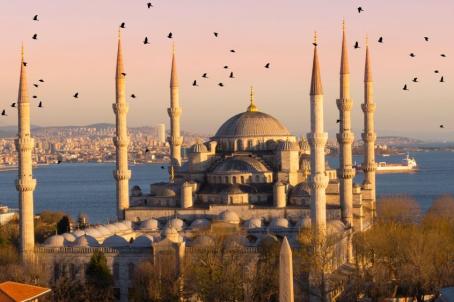
new
For a long time, Europe was ruled by powerful monarchies. Monarchy and religion have been connected since time immemorial. Here are 7 sites across Europe where royalty historically bent the knee to a higher power and received their crown.
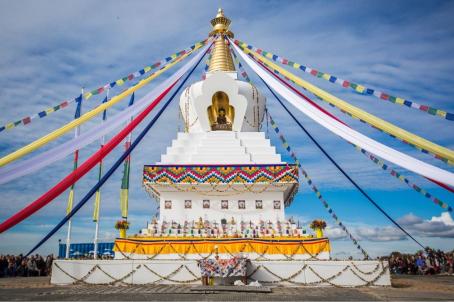
Stupas are symbols of enlightenment and peace that commemorate different stages of Buddha's life. Since the mid-20th century, thousands of stupas have begun to populate Europe. We have compiled some of the most impressive ones in this list.
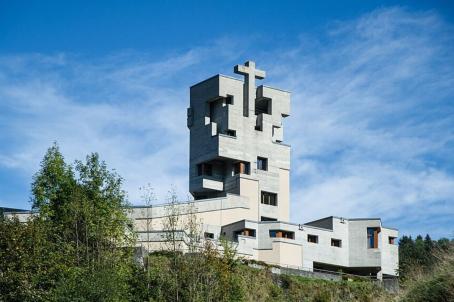
Walter Maria Förderer (1928–2006) was a Swiss architect and sculptor renowned for his neo-expressionist church designs in the 1960s. In this list we have compiled 6 of his church designs that seamlessly integrate religious and secular elements.

How is Religiana helping to conserve and promote Religious Heritage in Europe and why should you get involved?
Find out about Religiana
Are you a tourism organisation or religious heritage sites manager? Discover the advantages of becoming a partner.
See current partners
We can keep you up to date with the latest news from Religiana and religious heritage conservation across Europe.
Sign up to the FRH newsletter