Explore Religious Heritage Across Europe

Here you can search for a building to visit. You can use the map find destinations, or you can use the filters to search for a building based upon what different criteria.

Refine search

Protestantse Kerk

Nijega, NL

The Dutch Reformed Church of Nijega is originally a medieval hall church, dedicated to St. Agatha. After a major renovation in 1893 by municipal architect DD Duursma, the church was given its current appearance. The bell tower was also built in that year. The two bells in it came from the belfry, which stood in the churchyard. The year 1381 is mentioned on the oldest preserved bell. A bell from 1793 was removed by the Germans during WWII and replaced in 1957. The entrance gates decorated with cast iron death symbols also date from 1893.
Protestantse Kerk

Hoogkerk, NL

A Romanesque brick house of worship from the early 13th century. The church once had a tower but it was lost to war violence. With old, new facade from the 1960s. Also known as Haghekerke, Hogerkerken, Hoegekerk or Ollekerk.

Protestantse Kerk

Kleverskerke, NL

Around 1200 the first church was founded in Kerkwerve. For the first centuries it was Roman Catholic. Shortly after the siege of Zierikzee around 1576 the Reformation began to break through on Schouwen-Duiveland. The residents of Kerkwerve joined the new doctrine. The damaged church was partly demolished and partly restored and made suitable for the Reformed church service. In the 1980s the exterior of the Dutch Reformed church was restored. Between 1992 and 2004 the interior was restored in phases. Finally the coats of arms of the Lords of Kleverskerke were given a makeover. They are hanging back in their place in the pew. And with this the restoration was completed on 22 October 2004.

Protestantse Kerk

Schraard, NL

Single-nave, predominantly yellow brick (various sizes), slate-roofed CHURCH BUILDING with semi-circular closed choir and unarticulated saddle roof tower. The 12th-century Romanesque tower was raised in the 13th century during the construction of the Romanesque church. The top of the tower was renewed, possibly in the 18th century. Deep-set round-arched and pointed-arched windows with glazing bars. Access on the south side under a pointed arch. The nave is covered by a wooden barrel vault, possibly from after a fire in 1524. The inventory includes a pulpit from 1633, a baptismal fence and several pews with balls on the corners and cheeks with heads in early Renaissance style (ca. 1560). Furthermore, some tombstones and a funeral board. In the tower a belfry with a bell by W. Wegewaert, 1603, diameter 81 cm.

Protestantse Kerk

Lemele, NL

Around 1860, the committee for the Foundation of a Reformed Church of Lemele and Archem was established. At that time, the inhabitants of Lemele still had to walk about nine kilometres to Ommen to attend church services on Sundays. This proved to be too much of a task for many people. The efforts of the committee paid off. On 21 May 1865, the Koepelkerk was consecrated. This soon proved to be too small and after several renovations, it was decided to build a new church at the end of the 1930s. This was put into use in January 1940.

Protestantse Kerk

Blitterswijck, NL

The church was founded in 1828 by AM Baroness Mackay. Hall church with roof turret. This church falls under the Protestant Community of Venray and surroundings, and is currently only in use in the summer.

Protestantse Kerk

Kerkdriel, NL

There used to be a church building here . There was already a small church in the 11th century. The church building from the 15th and 16th centuries, which was known for its leaning tower, was only partly used by the Reformed community. At that time, there were still remains of old frescoes in the building. On April 23, 1945, the church was destroyed by the Germans.

Protestantse Kerk

Nieuwehorne, NL

This church is listed as a National Monument of the Netherlands.

Protestantse Kerk

Okkenbroek, NL

This church is listed as a National Monument of the Netherlands.

Be inspired

Stupkalnis.lt

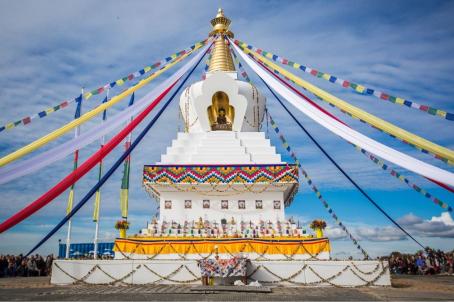
10 Buddhist stupas to discover in Europe

Stupas are symbols of enlightenment and peace that commemorate different stages of Buddha's life. Since the mid-20th century, thousands of stupas have begun to populate Europe. We have compiled some of the most impressive ones in this list.