Explore Religious Heritage Across Europe

Here you can search for a building to visit. You can use the map find destinations, or you can use the filters to search for a building based upon what different criteria.

Refine search

Protestantse Kerk

Oudehaske, NL

The hall church from 1906 has a wooden facade tower with a constricted spire on the north side An extension was built on the south side. The organ from 1869 was made by Adema and is a national monument because it has been preserved in its original state. This church is listed as a National Monument of the Netherlands.

Protestantse Kerk

Cuijk, NL

So-called Lodewijkskerkje, one of the dozens built in North Brabant at the beginning of the 19th century, after the historic churches in various places had to be "returned" to the Roman Catholic Church by the Reformed Church.

Protestantse Kerk

Biervliet, NL

In 1659, construction of this church began. The Middelburg stained glass artist Cornelis Van Barlaar made three windows that were placed in the east facade (1660-1661). The oak wall paneling next to the pulpit (priest's chancel) is from the previous medieval church, as is the separation between the chairs and the garden. The copper chandelier is a gift from the local preacher Lucas Schortinghuis, late 18th century. During the liberation in 1944, the tower was destroyed. Reconstruction in a modified form took place in 1947.

Protestantse Kerk

Dalen, NL

Church in neo-Gothic style with a tower from the 15th century.

Protestantse Kerk

Oisterwijk, NL

The original parish church (Petrus' Banden) of Oisterwijk is returned to the Roman Catholics during the reign of King Lodewijk Napoleon. For an amount of ƒ 7,000, a new church for the Reformed (later Protestant) will be built. Mr. Hubert is given and accepts the assignment to design the drawings of the new church and to draw up the associated specifications, cost estimates, etc. This church is listed as a National Monument of the Netherlands.

Protestantse Kerk

Oud Gastel, NL

Built as a Reformed Church. Now a church of the Protestant Community of Gastel and Kruisland. A classicist hall church in the so-called Waterstaat style. It dates from 1811 and is a gift from King Louis Napoleon. After a restoration in 1960, the church was restored again in 2000. In addition to the renovation of the exterior, which was carried out by contractor Van Agtmaal, the interior was tackled by the Gastelse former furniture maker Van der Zee, who refurbished the pews and made a new pulpit and cross. This church is listed as a National Monument of the Netherlands.

Protestantse Kerk

Oostwold, NL

Beautiful interbellum church in the style of the Groningen variant of the Amsterdam School, with characteristic needle as a tower. Nowadays in the possession of the Protestant Community of Nieuwolda-Oostwold. This church is listed as a National Monument of the Netherlands.

Protestantse Kerk

Assendelft, NL

Interesting neo-church with tower, built 1894-1895, replacing a burnt down church. (See also below the interesting description by the SKKN, in which however no further description of the important Bakker and Timmenga organ is given).

Protestantse Kerk

Nijega, NL

The Dutch Reformed Church of Nijega is originally a medieval hall church, dedicated to St. Agatha. After a major renovation in 1893 by municipal architect DD Duursma, the church was given its current appearance. The bell tower was also built in that year. The two bells in it came from the belfry, which stood in the churchyard. The year 1381 is mentioned on the oldest preserved bell. A bell from 1793 was removed by the Germans during WWII and replaced in 1957. The entrance gates decorated with cast iron death symbols also date from 1893.

Protestantse Kerk

Saaksum, NL

Reformed Church and tower on spacious churchyard. Small church rebuilt in 1850 in a characteristic style for that period with plaster window frames and plastered fields above. Brick saddle roof tower with low extended staircase tower; tower vault on sandstone corbels. Epitaph from 1550 in the tower portal. 17th century pulpit tub carved into the church; younger rear bulkhead and sounding board. An 18th century gravestone and a bell from 1629 in the tower. Organ from 1889, wind chest by the Gebr. Franssen, partly older pipework.

Be inspired

Stupkalnis.lt

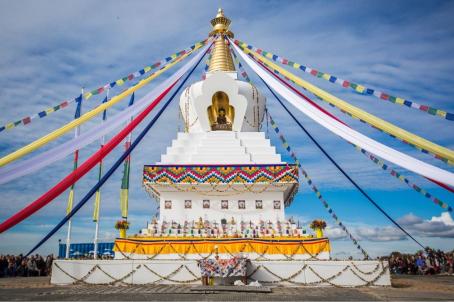
10 Buddhist stupas to discover in Europe

Stupas are symbols of enlightenment and peace that commemorate different stages of Buddha's life. Since the mid-20th century, thousands of stupas have begun to populate Europe. We have compiled some of the most impressive ones in this list.