Explore Religious Heritage Across Europe

Here you can search for a building to visit. You can use the map find destinations, or you can use the filters to search for a building based upon what different criteria.

Refine search

Protestantse Kerk

Lemele, NL

Around 1860, the committee for the Foundation of a Reformed Church of Lemele and Archem was established. At that time, the inhabitants of Lemele still had to walk about nine kilometres to Ommen to attend church services on Sundays. This proved to be too much of a task for many people. The efforts of the committee paid off. On 21 May 1865, the Koepelkerk was consecrated. This soon proved to be too small and after several renovations, it was decided to build a new church at the end of the 1930s. This was put into use in January 1940.

Protestantse Kerk

Oostwoud, NL

A single-aisled building with a five-sided closure, built in 1753, to which a northern extension, also closed on five sides, was added at the end of the 19th century. Memorial stone in the south-east facade 1753. Pulpit 17th century. Copper baptismal cymbal arm with cymbal 17th century; copper precentor's lectern 18th century. Psalm board 1769. Two-manual organ, made in 1874 by L. van Dam and Sons. This church is one of the 4 churches of the Protestant Community of Thomas, a regional community with that apostle name, consisting of Twisk, Hauwert, Midwoud and Oostwoud. The church itself is not called Thomaskerk.This church is listed as a National Monument of the Netherlands

Protestantse Kerk

Pernis, NL

Tower of the Dutch Reformed Church. Brick building, two sections, with natural stone corner blocks and blind fields with arched friezes, second half of the 15th century. Bell tower with clock by Pieter Ostens, 1672, diam. 68 cm.

Protestantse Kerk

Haaksbergen, NL

From 1854, designed by the City Architect of Enschede F. Doorwaart Niermans, influenced by German examples. Octogenous ground plan and central tower. One of the eight sides, slightly projecting, provided with a classicistically framed entrance section. Organ with main work and subpositive, made in 1864 by H. Honhof.

Protestantse Kerk

Hooge Zwaluwe, NL

Dutch Reformed Church. Built in 1639-1641 with the support of Prince Frederik, restored in 1859, completely burned down in 1910 and modified during reconstruction, restored in 1951 after war damage. In plan a Greek cross with short arms, which, in elevation, connect with lean-to roofs against the higher square central section. Open dome on the pyramidal roof from 1912. Buttresses with inward-turning exterior, windows with pointed arches. Oak pulpit in Louis XV style, from around 1760, originating from the church of Zevenbergse Hoek. Mechanical tower clock, firm De Klok, 1956.

Protestantse Kerk

Oosterhout, NL

The protestant Church of Oosterhout was commissioned in 1900. The church had an old steel bell tower (or tower), which was removed. After that it took some time until a new steel bell tower was built. This church is now listed as a Municipal Monument of the Netherlands.

Protestantse Kerk

Hulst, NL

In 1930, the Dutch Reformed Church of Hulst took the current hall church with saddle roof tower on the Houtmarkt into use. The pulpit, pew, choir screens and chandeliers were moved from the current Roman Catholic Basilica of St. Willibrordus, which is diagonally opposite the Reformed Church. Before 1930, the Dutch Reformed Church held church services in the Basilica at the same time as the Roman Catholic Church. At the time, a wall was built into it, which separated the two denominations. They also both had their own bell. After the Reformed Church took their current church into use in 1930, the basilica was returned in its entirety to the Roman Catholic Church.

Protestantse Kerk

Egmond aan Zee, NL

Built as a Dutch Reformed Church. Replaced an older church, which was dedicated to St. Agnes.

Protestantse Kerk

Berlicum, NL

Single-nave church with a tower of three sections. The original 13th century tower, the 15th century nave and an organ by WH Kam from 1859 were destroyed in 1944. The 15th century choir was preserved and renovated in 1949 to a design by FJA den Tex and J. Hillebrants, and extended with a new narrower nave. In 1953 provided with a new tower of three sections. In 1986 the liturgical arrangement was changed. During an extension in 1999 the nave was provided with modern bay windows.

Be inspired

Stupkalnis.lt

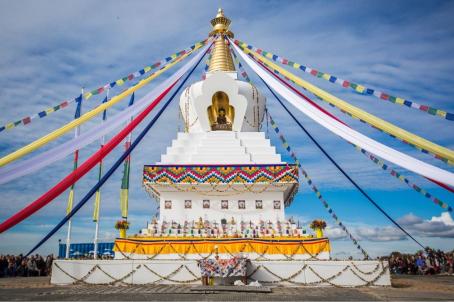
10 Buddhist stupas to discover in Europe

Stupas are symbols of enlightenment and peace that commemorate different stages of Buddha's life. Since the mid-20th century, thousands of stupas have begun to populate Europe. We have compiled some of the most impressive ones in this list.