Explore Religious Heritage Across Europe

Here you can search for a building to visit. You can use the map find destinations, or you can use the filters to search for a building based upon what different criteria.

Refine search

St. Maarten

Gendringen, NL

The Dutch Reformed Church in Gendringen is one of the oldest remaining buildings in the village. A chapel stood on this site as early as 800/900 AD. Around 1200, construction began on a church made of tuff stone and in later years the upper part of the masonry was replaced by brick. The Roman Catholic church at the time was much larger, approximately 12 metres longer, than the current church and also had an extension. This is still clearly visible because the tower is actually much too large in relation to the rest. During the Reformation, the church was stripped of all its decorations and it then became a Dutch Reformed Church. During the fire of 1830, a large part of the church was destroyed. Because there was no money for a complete restoration, the church was significantly shortened. This can still be seen in the brickwork on the current rear façade. The church was plastered to create a uniform appearance. The former entrance under the tower is no longer usable, but it is still visible that the current church was built on the remains of the former church. During excavations in 1955, the foundations of various burial vaults were uncovered. Some of these date from the Carolingian period and around 1700 the bodies of Count Willem van den Bergh, his wife Maria van Nassau and several of their children were also buried here. These burial vaults were also lost during the fire of 1830. The church still contains the organ that was built around 1840 by the Nolting company. The church and the organ were restored in ?. There used to be a bell foundry opposite the church. In the seventeenth century, the Voigt family (originally from Cologne) but then living in Isselburg cast bells here for many churches in the wide area, including Aalten and Winterswijk. The bell tower of Huis Landfort and the Dutch Reformed Church in Megchelen still contain bells from that period.

St. Margretchurch

St. Margretchurch

Knokke-Heist, BE

In 1227, a chapel of Saint Catherine was mentioned. The chapel has probably been incorporated in the later Saint Margaret's Church. This church was first mentioned in 1477. Its tower was an important beacon for shipping. the church suffered from the Iconoclasm in the late 16th and early 17th centuries. The building was restored in 1613. In 1796 the church was confiscated by the French administration and returned to the parish in 1801. The church was enlarged in 1852, according to plans by P. Buyck and in 1905 a new choir section was built. The building was severely damaged due to the Second World War. A new church was built from 1955 until 1958. The tower structure could be preserved after the war and became a classified monument in 1938. The church was rededicated to the Immaculate Heart of Mary and Margaret Church in 1958.

St. Mariä Heimsuchung

St. Mariä Heimsuchung

Warburg, DE

The first mention of St Mary's visit dates back to the late 13th century. In 1429 a sacristy was built to the north of the choir, which is now used as the Lady Chapel. In 1833, parts of the vault collapsed. A three-part window at the south portal was broken during the 19th century. In 1899-1900 a storey with a gallery was added to the church tower and the eight-sided spire was added. In 1947, the present sacristy was built to the south of the choir. From 1974 to 1975, the church was extensively renovated under the direction of the architect Heinrich Stiegemann from Warstein.

St. Maria im Kapitol

St. Maria im Kapitol

Cologne, DE

St. Mary of the Capitol is one of twelve Romanesque basilicas in the old town of Cologne. Built between 1040 and 1065 on an ancient Roman temple, it is the largest Romanesque church in the city.

St. Maria in Lyskirchen

St. Maria in Lyskirchen

Cologne, DE

St. Maria in Lyskirchen is the smallest of the twelve great Romanesque basilicas in the old town of Cologne. Built between 1198 and 1225, its architecture is inspired by that of Saint-Kunibert (in the same city).

St. Maria in vinea

St. Maria in vinea

Warburg, DE

The Protestant church of St. Maria in vinea, in early Gothic style, was the parish church of the old town of Warburg until 1283. The bishop of Paderborn, Otto von Rietberg, then ordered that the church be handed over to the Dominican order. St. Mary in Vinea remained the church of the Dominican monastery until its secularisation in 1803. Since 1824 it has been the church of the Protestant community. Next to the church is the Marianum Gymnasium in the former Dominican monastery.

St. Marien Bad Langensalza

Bad Langensalza, DE

The outstanding figure of the foundation of the congregation is the lay Apostle Anton Jungmann (*1777 in Prague, + 1860 in Langensalza), who came to Langensalza in 1821 and collected the Catholics. In addition to prayer hours and pilgrimages that he organized, he was intensively committed to founding the congregation. It is an example of the community growing from below, out of faith.

St. Marien

St. Marien

Suhl, DE

The Evangelical Lutheran Church of St. Mary was built between 1487 and 1491, making it the oldest place of worship in the city. The Henneberg rulers introduced the Reformation in 1544. In April 1590, the church burned down in the first major fire in Suhl. The new building was destroyed by a town fire in 1634 during the Thirty Years' War. Between 1647 and 1650, the church was rebuilt and consecrated on 8 October 1654. The next town fire took place on 1 May 1753. The present church was built after 1757 in the late Baroque style by the master mason Johann Philip Kober according to the plans of the scribe Ludwig August Hoffmann. The tower was completed in 1769 and the church received a bell in 1770.

St. Mark's Cathedral

St. Mark's Cathedral

Korčula, HR

St. Mark's Cathedral is the former cathedral of a diocese that was abolished in 1828. The cathedral was built in 1407 and a chapel was added along the north nave in 1525, giving the impression of a fourth nave with its columns and arches. Subsequent interventions, mainly in the late Baroque style, modified the original appearance of the cathedral, in the Gothic-Renaissance style.

Be inspired

Stupkalnis.lt

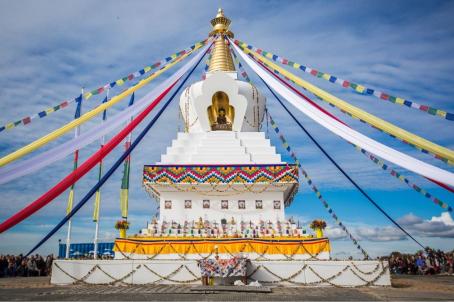
10 Buddhist stupas to discover in Europe

Stupas are symbols of enlightenment and peace that commemorate different stages of Buddha's life. Since the mid-20th century, thousands of stupas have begun to populate Europe. We have compiled some of the most impressive ones in this list.