Explore Religious Heritage Across Europe

Here you can search for a building to visit. You can use the map find destinations, or you can use the filters to search for a building based upon what different criteria.

Refine search

Protestantse Kerk

Mastenbroek, NL

Shortly after the embankment of 1364, Mastenbroek became an independent parish. At the same time, probably between 1364 and 1369, the church was built. The church was dedicated to Onze Lieve Vrouwe ter Zon. The church building was repeatedly restored and renovated, for example after a fire in 1647, of which renovation one of the inscriptions at the entrance still reminds us. The choir (1531) of the late Gothic single-nave building is somewhat narrower than the nave (1647). The tower was replaced by a new one in 1845.
Protestantse Kerk

Noordbroek, NL

This church is listed as a National Monument of the Netherlands.

Protestantse Kerk

Egmond-Binnen, NL

On the site of the old abbey church. Built as a Dutch Reformed church. Small church with a tower.

Protestantse Kerk

Ryptsjerk, NL

Reformed Church and tower, situated on a churchyard. Simple church building from 1757 with built-in west tower. In the church 17th century pulpit, baptismal fence and four pews, one 17th century and three 18th century gravestones. Two-manual organ made in 1891 by Bakker and Timmenga. In the roof turret hangs a clock by F. Haetiser, 1546, diameter 101 cm. Mechanical tower clock G. Delouche, Paris.

Protestantse Kerk

Losser, NL

Protestant (Reformed) Church. Simple hall church from 1810 with pointed arch windows and roof turret (tower). In 2009/2010, together with the adjacent Aleida Leurinkhuis, extensively renovated (and refurnished) into a modern Church Center. Single-manual organ, built in 1725 by Diedrich Martens from Vreden. Last restoration in 1991 (by Blank). Mechanical wrought-iron tower clock. A natural stone round dial.

Protestantse Kerk

Hoogkarspel, NL

The current Reformed Church of Hoogkarspel had two, probably three predecessors. The first church must have been a small tuff chapel that was later replaced by a late Gothic church dedicated to Laurentius. This church is at least mentioned in a deed from 1514. An engraving by H. Spilman after Cornelis Pronk from 1726 shows a church with a large tower. The building is briefly described in Van der Aa: '... an old building, that still stands well on its foundations and is provided with a tower with a stone spire. In the past, there was a house organ, which was donated to this church by Mr. P. van den Willigen, Councillor in the Vroedschap and Mayor of the city of Enkhuizen, but this was replaced in 1802 by a completely new one, which was paid for from the church fund. There is also a very neat and efficient public cemetery laid out in 1829, and a parsonage built in 1839, which is the most beautiful house between Hoorn and Enkhuizen. In 1859 the church was in such a bad state that "the Chief Engineer of the Water Board" was asked for advice on restoration or new construction. The latter was decided upon. The design for the new church came from D. and L. van der Tas, architects in Schiedam and Sloten. The foundation stone for the second church building was laid on 19 October 1860, and on 4 May 1862 the church was put into use. The very beautiful neo-Gothic church had, judging from old postcards, a matching interior. The building was a polygonal central structure of brick and stucco. Unfortunately, little of the old interior was saved and/or brought to the current church. The new church showed serious structural problems in 1909 due to subsidence due to an inadequate foundation. A major restoration prevented collapse, but only led to a postponement of the need for demolition and new construction. The new church was built in 1966, based on a design by the architects CH Bekink and J. Bijleveld. The church has a freestanding tower. It was built because the old church had become too large. On the north side of the current church, a number of gravestones from the first church can still be found in the pavement. It is not known whether they were removed from the old church and given a new resting place here or whether they were never moved from their place but suddenly ended up outside the church walls when the second and especially the third church became smaller.

Protestantse Kerk

Menaldum, NL

Neo-church with a tower from 1866. It was built to replace an older church. This church is listed as a National Monument of the Netherlands.

Protestantse Kerk

Makkinga, NL

This historic church building serves the Protestant community of Makkinga.

Protestantse Kerk

Ootmarsum, NL

Simple hall church from 1810 with sandstone pilaster facade with pediment, crowned by octagonal wooden dome with pilasters on the corners, from 1844. The church has an oak pulpit from 1674 and copper lectern XVIII B; iron precentor's lectern from 1687. Organ with main work, upper work and free pedal, made in 1781 by Eberhard Berner for the large old church, which was "returned" to the Roman Catholics in 1810. Moved to the current church in 1811. This church is listed as a National Monument of the Netherlands.

Be inspired

Stupkalnis.lt

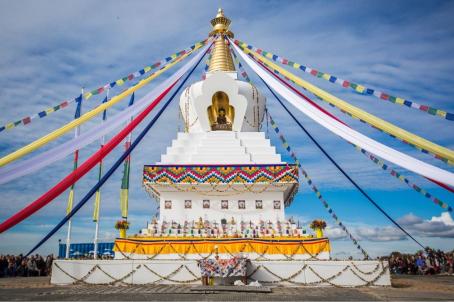
10 Buddhist stupas to discover in Europe

Stupas are symbols of enlightenment and peace that commemorate different stages of Buddha's life. Since the mid-20th century, thousands of stupas have begun to populate Europe. We have compiled some of the most impressive ones in this list.