Explore Religious Heritage Across Europe

Here you can search for a building to visit. You can use the map find destinations, or you can use the filters to search for a building based upon what different criteria.

Refine search

Protestantse Kerk

Nieuwpoort, NL

Dutch Reformed Church. Three-aisled PSEUDOBASILIC (16th century) with five-sided closed choir and narrow ambulatory. The three naves and the ambulatory under a high roof. Major renovations in 1774, when, among other things, the tower was demolished and replaced by a new west facade, above which an open dome tower. The church was restored in 1842-1843. Slender columns inside; a wooden barrel vault with tie beams over the tall central nave and half barrel vaults over the side aisles and ambulatory. Good inventory: pulpit in Lod. XVI-like forms (1842); baptismal fence (17th century B) with precentor's lectern (18th century A); beautifully carved lord's pew (1652); three copper crowns (18th century?); grave board (1679); several tombstones (17th-18th century). Bell tower with clock by H. Meurs, 1605, diam. 67.3 cm.

Protestantse Kerk

Biervliet, NL

In 1659, construction of this church began. The Middelburg stained glass artist Cornelis Van Barlaar made three windows that were placed in the east facade (1660-1661). The oak wall paneling next to the pulpit (priest's chancel) is from the previous medieval church, as is the separation between the chairs and the garden. The copper chandelier is a gift from the local preacher Lucas Schortinghuis, late 18th century. During the liberation in 1944, the tower was destroyed. Reconstruction in a modified form took place in 1947.

Protestantse Kerk

Sassenheim, NL

On the N. side of the single-nave nave remains of a tuff stone Romanesque church from the 12th century. Renovated in the 15th century, restored in 1956. Romanesque tower of brick, raised at the end of the 15th century, restored in 1957. At the site of the ME choir to the E. of the nave a choir-shaped extension from around 1700. During the restoration in 1971-73 the Romanesque appearance of the nave was reconstructed. Single-manual organ by Hans Goltfuss, originally made for the Gasthuiskerk in Delft in 1657. Reconstructed in 1973 and placed in Sassenheim. Bell frame with chime consisting of a bell by W. Wegewaert, 1592, diam. 126 cm and a modern bell. In the tower portal a bell by A. de Stomme, 1563, diam. 42 cm, has been decommissioned. Mechanical tower clock, B. Eijsbouts, 1906, equipped with electric winding. Above the entrance door of the church is a sundial on a red tile, 28 cm square, slightly obliquely built into the tuff wall.

Protestantse Kerk

Steenbergen (NB), NL

Classical building from 1832, consisting of a three-aisled hall church covered by a saddleback roof with a facade divided by Doric half-columns and a pediment with triglyph list, behind which rises the built-in tower, with double Ionic pilasters and crowned by a dome on which an obelisk. Interior: Doric columns with segmental arches, barrel vault in stucco over the central nave, rib vaults over the side aisles. Oak pulpit from the second half of the 18th century, to which is a copper lectern with the crowned initials W. and M. from 1693; carved organ case. Oak bell frame with bell by JP Huaert, 1794, diam. 105 cm. Iron entrance gate between bluestone pillars with vase crowning. Originally a two-manual organ from the second half of the 17th century. In the previous century the Positive was removed. Restored in 1963.

Protestantse Kerk

Ilpendam, NL

In 1408 a chapel dedicated to St. Sebastian was already mentioned. In 1449 the church was enlarged. In 1544 Ilpendam had a parish church. As a result of the Eighty Years' War the church was largely destroyed. Remains from the old church are the roguish statues in the choir closure. During the Reformation the church was transferred to the Dutch Reformed Church. A definitive reconstruction took place in 1656. The church then got its current form. In the years 1723, 1850, 1922, 1946 and 1984 the church was restored. The last major maintenance took place in 2004/2005.

Protestantse Kerk

Ballum, NL

The church, built in 1832, is known for its particularly richly carved pulpit, marked and dated: A. Jelles 1604; originating from Harlingen.

Protestantse Kerk

Scharsterbrug, NL

The foundation stone for the Reformed Church was laid on 30 April 1914 by Rev. JE Bos. The hall church was built to a design by architect Geert Stapenséa . The built-in unarticulated church tower has a tent roof . The glazed ceramic square clock faces and some facade stones were made by Willem Coenraad Brouwer . On a facade stone is the text: That your eyes are open night and day over this house, o Lord . (1 Kings 8:29a). The organ from 1918 was made by Van Dam .

Protestantse Kerk

Noorden, NL

Hall church from around 1825 with pointed arch windows and an octagonal wooden bell tower. It has a neo-classical entrance. This church is listed as a National Monument of the Netherlands.

Protestantse Kerk

Boxtel, NL

Reformed church. Elongated octagonal hall building from 1812, with blocked pilasters, pointed arch windows and roof turret. 17th century oak pulpit, organ from the first half of the 19th century, gravestones from 1820-1845.

Protestantse Kerk

Bergeijk, NL

Dutch Reformed Church. Founded in 1812, rebuilt in 1857. Simple brick building, in plan an elongated back, with flat buttresses, pointed arch windows and roof turret. 17th century oak pulpit, bell cast in 1626, originating from the castle in Helmond.

Be inspired

Stupkalnis.lt

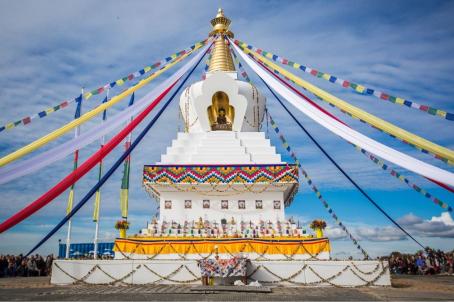
10 Buddhist stupas to discover in Europe

Stupas are symbols of enlightenment and peace that commemorate different stages of Buddha's life. Since the mid-20th century, thousands of stupas have begun to populate Europe. We have compiled some of the most impressive ones in this list.