Explore Religious Heritage Across Europe

Here you can search for a building to visit. You can use the map find destinations, or you can use the filters to search for a building based upon what different criteria.

Refine search

Protestantse Kerk

Ochten, NL

The older Reformed Church of Ochten was destroyed in the fall of 1944 during the Battle of the Betuwe. The current church building dates from the 1950s, and is a typical example of Protestant church building from the reconstruction period, influenced by traditionalism, and as such a very important reconstruction church. In the tower hangs a bell by Peter van Johan van Trier, 1643. At the end of 2017, the Cuypersgenootschap submitted a request for recognition as a Municipal Monument.
Protestantse Kerk

Heelsum, NL

Dutch Reformed Church. Beautifully situated on the wooded Noordberg, single-nave late Gothic village church with narrow tower and three-sided closed choir (1517-1519), which is higher than the nave. Disturbing transept arm (1859) on the south side. Bell frame with bell by Petit and Fritsen, 1905, diam. 51.8 cm.

Protestantse Kerk

Nieuw-Vossemeer, NL

Dutch Reformed Church. Hall building from 1649, restored and provided with a new front facade in 1849. Above the facade a bell tower. Along the side walls buttresses, pointed arch windows with bevelled jambs and natural stone sills with drip moulding profile. Interior: flat ceiling. Bell tower with clock by J. Burgerhuys, 1652.

Protestantse Kerk

Grijpskerk, NL

Built as a Reformed Church. Iconic interbellum church with tower. Hall church with high, side-standing tower in a light expressionist style.

Protestantse Kerk

Spannum, NL

In construction late Gothic building of which the choir closure and south wall were renewed or bricked in the second half of the 19th century. Heavy west tower with niche section in the second and third section and covered by saddle roof. The southern cartouche with coat of arms of Sminia recalls the restoration of the church in 1743. However, the roof was already renewed in 1726. In the church beautiful 17th century pulpit with rear bulkhead and sounding board. Closed baptismal gate and two covered gentlemen's pews. Communion table. Wainscoting. Two pews with baluster railing; forty pews with carved end pieces, two text boards with carved frame; Ten Commandments board with painted representation of Moses with the Tables of the Law in carved frame. Three copper crowns. Two-manual organ made in 1911 by Bakker and Timmenga instead of the Radersma organ that was moved to the Herv. Church in Metslawier. Bell tower with the sound of two bells, one by T. Both, 1590, diam. 125 cm. and one by H. Falck, 1620, diam. 115 cm. Mechanical tower clock D. Wielinga, Franeker, 1922, has been decommissioned.

Protestantse Kerk

Pijnacker, NL

Dutch Reformed Church. From the late Gothic village church, the following were preserved during the construction of the neo-Gothic church in 1892: the foundations on which the new church was built, and the columns with capitals, provided with some curly cabbage leaf wreaths, as well as the arches of the nave. Two-manual organ, made in 1830 by H. Knipscheer. Bell frame with bell by G. van Hyntym from 1434, diam. 118 cm.

Protestantse Kerk

Ressen, NL

A small Romanesque church, largely made of tuff. The tower is 12th century, the nave perhaps even older. Both are decorated with arched friezes. The Gothic choir is 15th century.

Protestantse Kerk

Oudenhoorn, NL

Historical church with roof turret, Originally a Gothic church building, now consisting only of a single-aisled nave of seven bays, with a wooden roof turret on the ridge and an extended portal against the east facade. The church is oriented and stands on the spacious, moated churchyard in the centre of the village.

Protestantse Kerk

Gasseltenijveen, NL

Reformed church, built in 1858 in the water board style. The facade tower placed above the front building was added in 1879. Next to it is the catechism room GAN-OV13B-59.

Be inspired

Stupkalnis.lt

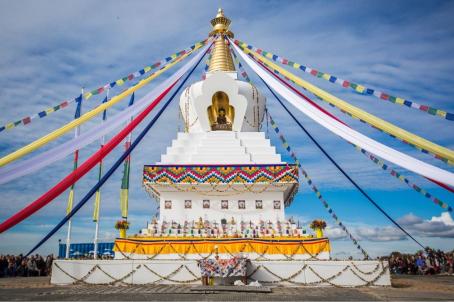
10 Buddhist stupas to discover in Europe

Stupas are symbols of enlightenment and peace that commemorate different stages of Buddha's life. Since the mid-20th century, thousands of stupas have begun to populate Europe. We have compiled some of the most impressive ones in this list.