Explore Religious Heritage Across Europe

Here you can search for a building to visit. You can use the map find destinations, or you can use the filters to search for a building based upon what different criteria.

Refine search

Protestantse Kerk

Bergharen, NL

The Herv. CHURCH consists of the 15th century three-aisled, pseudo-basilica-shaped nave of the old village church, whose choir has been demolished. The building has pillars, cross-ribbed vaults and sculpture on capitals and corbels. The church has a simple pulpit, 17th century; a baptismal fence, 18th century and two covered benches, first half of the 19th century. Two tombstones, 17th century.

Protestantse Kerk

Heelsum, NL

Dutch Reformed Church. Beautifully situated on the wooded Noordberg, single-nave late Gothic village church with narrow tower and three-sided closed choir (1517-1519), which is higher than the nave. Disturbing transept arm (1859) on the south side. Bell frame with bell by Petit and Fritsen, 1905, diam. 51.8 cm.

Protestantse Kerk

Nieuw-Buinen, NL

This church is listed as a National Monument of the Netherlands.

Protestantse Kerk

Schagerbrug, NL

The church is of architectural historical value as an authentic example of a church under water built around the middle of the nineteenth century, where the simplicity of construction and detailing is characteristic. The vault on the columns in the interior and the preserved main shape also contribute to that value. The church is part of church history, in particular the history of the reformed churches in North Holland.

Protestantse Kerk

Sirjansland, NL

In 1956, a new Mennonite Church was built in Amsterdam-Slotermeer at Arthur van Schendelstraat 17. The building was designed by Karel Sijmons. In 1957, Willem van Leeuwen installed a new organ in this church with two keyboards and sixteen registers. In 1969, the church building was sold to the Reformed Church Slotervaart/Osdorp, who took over the building including the organ. It was then named De Olijftak. In 1993, the church was closed for worship. The organ was sold to the Reformed Church in Sirjansland in 1996. De Olijftak has been in use as a Moroccan mosque since 2000. The organ was moved to Sirjansland by the firm Pels & Van Leeuwen. The organ was put into use on 11 February 1996. The organ was not changed during the move. However, the front was decorated with several wooden ornaments.

Protestantse Kerk

Kolham, NL

Reformed Church on churchyard. Small church built in 1640, closed on three sides on the east side and provided with a roof turret above the west facade that was renovated in 1808. A bell from 1808 once hung in the roof turret. This was stolen during the Second World War by order of the occupier.

Protestantse Kerk

Ossendrecht, NL

The 19th-century Protestant Church (formerly Dutch Reformed) on Dorpsstraat was restored in the summer of 2006 and put back into use on Sunday 3 September. The most important thing is that the church now has ancillary rooms for all kinds of activities outside of church services. The restoration was led by architect Weijts from Bergen op Zoom. A bell tower at the church. This church is listed as a National Monument of the Netherlands.

Protestantse Kerk

Ossenzijl, NL

Built to replace "Het Lokaal" from 1889. Modern church with tower.

Protestantse Kerk

Noardburgum, NL

When the Protestant Church of Noardburgum was formed, it was decided to continue using the Dutch Reformed Church as a Protestant church and to sell off the Protestant Church. This church is listed as a National Monument of the Netherlands.

Protestantse Kerk

Scherpenzeel, NL

Dutch Reformed Church. Simple hall church from around 1800. Enlarged in 1860 with north arm and tower. In the windows four stained glass windows by Ype Staak, 1788. Single manual organ, made in 1881 by L. van Dam and Sons. Bell tower with clock by J. Noteman, 1638, diam. 66.5 cm. Mechanical tower clock by JV de Vries, Drogeham, 1913.

Be inspired

Stupkalnis.lt

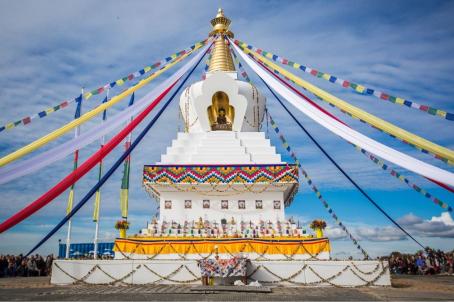
10 Buddhist stupas to discover in Europe

Stupas are symbols of enlightenment and peace that commemorate different stages of Buddha's life. Since the mid-20th century, thousands of stupas have begun to populate Europe. We have compiled some of the most impressive ones in this list.